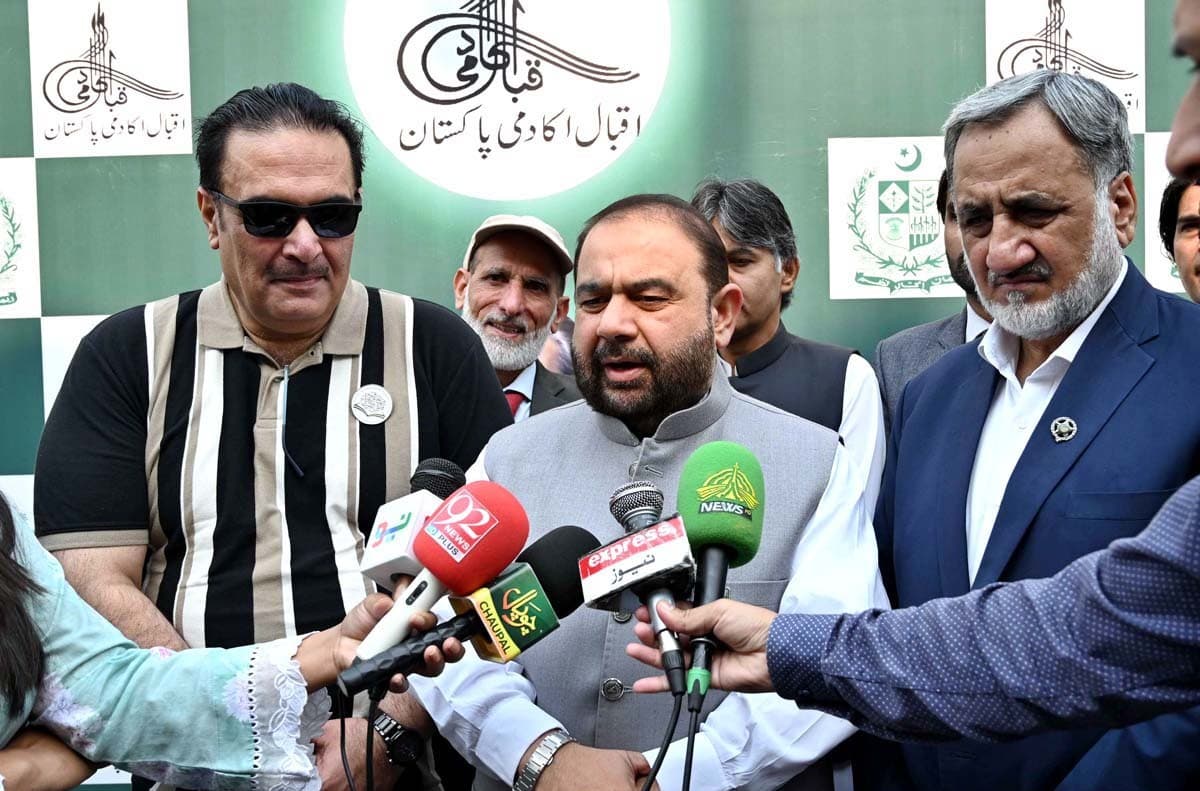
Federal Minister for National Heritage and Culture Aurangzeb Khan Khichi stated on Sunday that connecting the younger generation with the message of Allama Iqbal is essential for achieving true success. Speaking to the media in Lahore, Khichi noted that the country's success is closely tied to transmitting Iqbal's message to future generations.
Khichi spoke during the inaugural session of the International Iqbal Conference at Hazoori Bagh. He noted that the 150th birth anniversary of Dr. Allama Muhammad Iqbal would be celebrated the following day, with various programs organized by federal and provincial governments to pay tribute to the poet and philosopher.
The minister described Iqbal as a leader who provided a universal message for Muslims worldwide. He emphasized that intellectuals, scholars, media organizations, and educational institutions are currently playing roles in highlighting Iqbal's message. Regarding the country's youth, Khichi stated they are proving their mettle in various fields and expressed full confidence that they will follow the teachings of Quaid-i-Azam Muhammad Ali Jinnah and Dr. Allama Muhammad Iqbal.
During the conference, Khichi argued that a gap exists in the current intellectual and moral environment compared to the past, when the works of Saadi and Rumi enriched the educational landscape. He urged for more efforts to promote Iqbaliyat to bridge this gap, stating that the younger generation needs guidance from Iqbal's poetry more than ever today. He warned that if the youth are not connected to these teachings, the country's future may not be as bright as hoped.
Recalling a visit to Iran in December under the leadership of Dr. Mazhar, Khichi observed the efforts of scholars there to promote national thinkers. He requested the Iqbal Academy to create opportunities for the younger generation to develop a stronger association with Iqbal’s philosophy.
Khichi acknowledged the support of Prime Minister Muhammad Shehbaz Sharif, noting the prime minister responds positively to proposals concerning Iqbal and Jinnah, especially those requiring financial support. He described the 150th birth anniversary celebrations as an opportunity to highlight Pakistan’s national cultural identity globally.
The minister praised the Iqbal Academy Pakistan for its role in editing, publishing, and translating Iqbal’s works, as well as promoting research and establishing academic links. He expressed confidence that the academy, with the cooperation of universities and international organizations, would transform the celebrations into a result-oriented movement to project Pakistan’s heritage.
Khichi characterized Iqbal as a 20th-century figure who influenced human thought through poetry that represents Eastern traditions while carrying a universal message. He stated that Iqbal's works are a living reference to national identity and that his philosophy emphasizes Khudi (selfhood), love for the Holy Prophet Muhammad (Peace Be Upon Him), freedom of thought, human brotherhood, Ijtihad (independent reasoning), knowledge and action, creative struggle, and cultural self-awareness.
Iqbal Academy Pakistan Director Dr. Abdul Rauf Rafiqui, Dr. Saleem Mazhar, Waleed Iqbal, and others also spoke at the occasion.