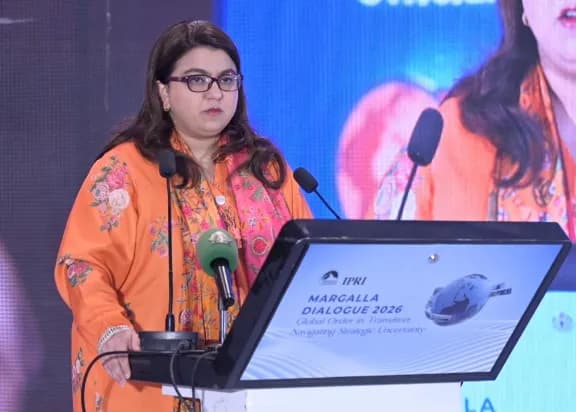
Federal Minister for Information Technology and Telecommunication Shaza Fatima Khawaja stated on Wednesday that artificial intelligence (AI) would become a $4.8 trillion global economy by 2033. Speaking at the Margalla Dialogue, Khawaja emphasized that AI would not necessarily eliminate jobs but would change their nature, making new skills essential for employment. She noted that people equipped with AI-related skills would enjoy a significant productivity advantage over those without them, stating that a person using AI could be up to 100 times more productive than another individual with similar skills who did not use the technology.
To prepare for this shift, Khawaja outlined several government initiatives. She revealed that Prime Minister Shehbaz Sharif announced a $1 billion investment in AI earlier this year to focus on infrastructure, skills, innovation, and connectivity. The government has developed a seven-layer AI infrastructure framework to make computing resources available to government institutions, industry, and innovators. Furthermore, Pakistan aims to train one million young people in AI-related skills and produce at least 10,000 AI PhDs over the next five years. She added that the government is also working to strengthen the startup ecosystem through access to capital, cloud credits, and a proposed fund of funds, with support from the World Bank and other development partners.
The minister highlighted significant progress in Pakistan's digital infrastructure over the past two and a half years, noting that internet speeds had increased by 60 per cent. She reported that internet data capacity had increased by two terabits per second, while the country’s total live internet capacity currently stood at around seven terabits. Additionally, the country had added three international submarine cables, and a spectrum auction of 480 megahertz had increased the country’s spectrum capacity from 274 to more than 750 megahertz. Khawaja also reported that nearly 1.8 million people had subscribed to 5G services, while fibre-optic coverage had expanded from fewer than three million to more than six million household connections.
Regarding governance and security, Khawaja stated that the Digital Nation Pakistan Act had established the Pakistan Digital Authority, which was preparing a National Digital Master Plan and sectoral plans covering areas such as agriculture, real estate and healthcare. A data governance policy is being developed and will be announced in the coming weeks, while a national data exchange layer is being piloted. She asserted that the National AI Policy and data governance framework would ensure that humans remained responsible for decisions involving data and technology.
Khawaja also touched on cybersecurity and defense. She noted that Pakistan had been placed among the top 40 countries in the 2024 ITU Global Cybersecurity Index. She stated that the country had achieved success in Marka-i-Haq under the leadership of Chief of Defence Forces Field Marshal (CDF) Syed Asim Munir, noting that a major cyber war had also taken place in the background of the May conflict.