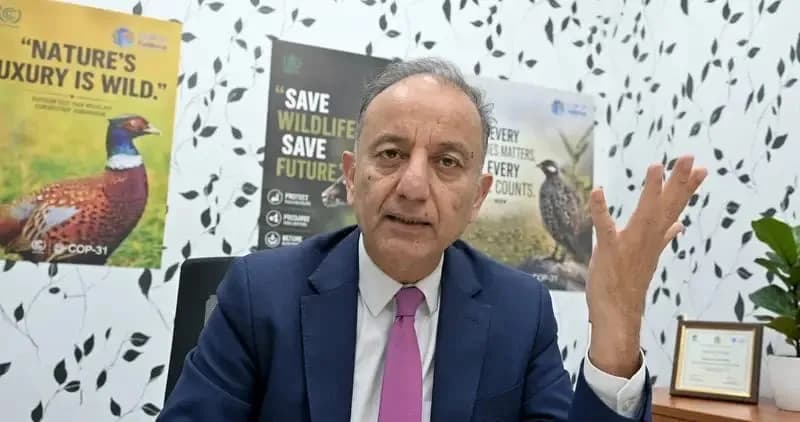
Federal Minister for Climate Change Musadik Malik has called for international scientific cooperation to study Pakistan's glaciers and mountain ecosystems. Speaking at the UN Climate Change Pavilion during COP31, the minister warned that melting ice and the growing risk of glacial lake outburst floods (GLOFs) are threatening vulnerable communities and their livelihoods.
Malik stated that more than 13,500 glaciers have been identified in Pakistan. He noted that the first impact of climate change is often felt in mountainous regions, making collaborative research on glaciers and associated environmental risks essential. The minister warned that glacier melt is putting thousands of people, their homes, and sources of livelihood at risk, describing climate change as a question of human survival rather than just an environmental challenge.
The minister highlighted that Pakistan contributes less than one per cent to global greenhouse gas emissions, yet remains among the countries most severely affected by climate change. He called for an equitable distribution of climate finance, observing that such funding remains concentrated among major emitting countries despite the vulnerability of nations contributing little to global emissions. He argued that scientific research in mountainous regions could also improve the understanding of climate risks in polar regions and plains.
To promote research and innovation, Malik outlined plans for a proposed Green Virtual University. This initiative aims to connect Pakistani students, researchers, and faculty members with leading international scientists and universities. Under this proposal, Pakistani students would have opportunities to participate in joint research, faculty exchanges, and student exchange programmes with internationally recognised researchers without necessarily having to study abroad.
Malik confirmed that Pakistan has already signed an agreement with Italy regarding this initiative, while cooperation with the United Kingdom is being pursued through a Green Compact. He also noted that discussions have been held with Iceland and countries associated with the Arctic Circle.
The minister stressed the need to encourage young people to turn innovative ideas into commercially viable green businesses instead of relying exclusively on government employment or conventional grant-based funding. Referring to potential students from institutions including LUMS and Government College University, he said graduates could develop innovative enterprises if provided with financial and institutional support. He proposed a framework to facilitate green entrepreneurship in areas such as renewable energy, environmental protection, and clean drinking water.
Malik also referred to emerging opportunities in carbon trading and innovative financing mechanisms, suggesting that international institutions and investors could collaborate with Pakistani entrepreneurs to support environmentally sustainable businesses. Regarding Pakistan's energy transition, he highlighted efforts to promote renewable energy and cleaner transportation, including a shift toward electric vehicles. He concluded by reiterating that climate justice requires fair international cooperation and urged developed countries to ensure timely financial and technical support for developing countries.