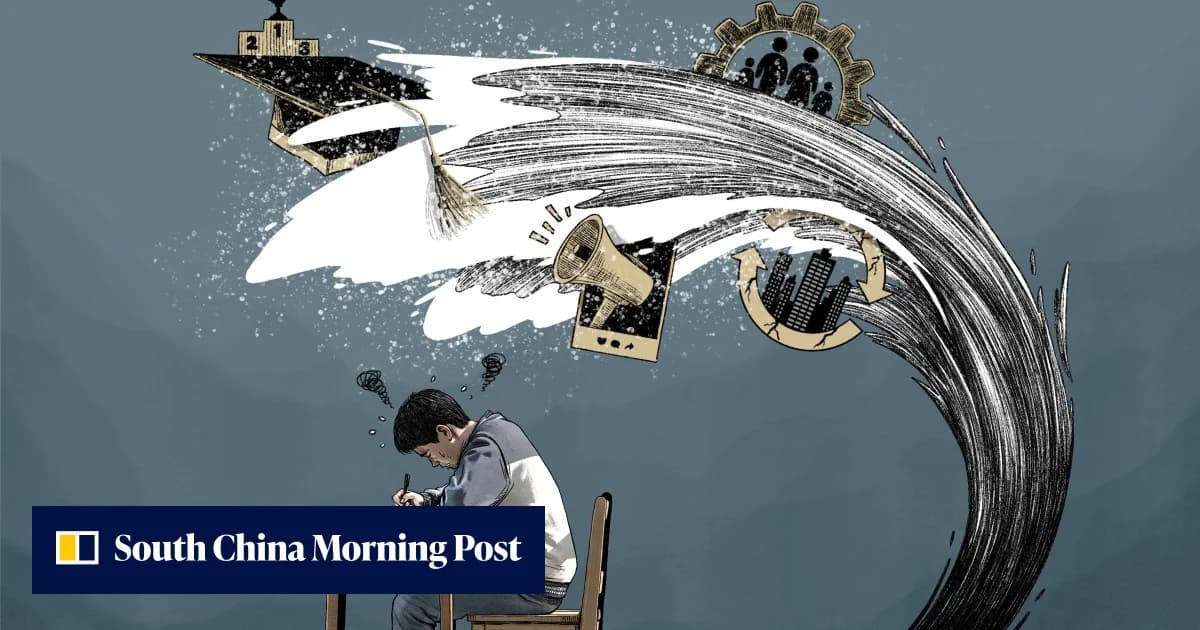
A growing number of young people in China are struggling with mental health issues as academic pressure on younger students intensifies. This trend reflects a broader societal environment of cutthroat competition for opportunities, which experts say has serious implications for the lives of the youth.
In Chongqing, 17-year-old Moon Chen recalls experiencing chest tightness and palpitations while in higher secondary school. She was initially taken to a cardiologist but was told she should see a psychiatrist instead. Chen was eventually diagnosed with depression and anxiety, a diagnosis that left her mother in tears. Chen noted that during her lower grades, her academic schedule stretched from 7.20am to 10.30pm, with weekends occupied by cram schools. She stated that almost everyone in her area takes extra classes to secure a place in secondary school.
The pressure to enter the academic track is high because, under China’s nine-year compulsory education system, schooling is only guaranteed through junior high. Policymakers use the senior high school entrance examination to sort students into academic or vocational tracks, but only around 50 to 70 per cent of test-takers in some regions can follow the academic path. Shimin Zhu, an associate professor at Hong Kong Polytechnic University, noted that the panic once reserved for the college entrance examination now grips teenagers much earlier. Zhu added that while Beijing has pushed to elevate the view of vocational education, winning public acceptance is a long process, and academic competition may intensify during this transition.
Data highlights the severity of the situation. A 2021 nationwide survey by Beijing Anding Hospital found that 17.5 per cent of children and adolescents in China suffer from mental disorders, primarily anxiety and depressive disorders. Researchers told Chinese media this figure may be an underestimate as the survey only examined school-going children aged six to 16. A 2022 report by the Chinese Academy of Sciences (CAS) showed 14.8 per cent of surveyed adolescents showed varying degrees of depression risk, a rate higher than that of adults. An earlier CAS report found that roughly 30 per cent of junior high students reported depressive symptoms, jumping from 10 per cent among primary school pupils, and climbing to nearly 40 per cent for senior high classes.
Zhu stated that the surge in mental health issues cannot be reduced to a single cause, but rather reflects the convergence of intensified educational competition, the penetration of digital media, changing family structures, and uncertainty regarding rapid social transition. She noted that digital media, including video games and AI-generated microdramas, can provide "temporary emotional relief" but often worsen social isolation. Zhu described the transition involving artificial intelligence as a "subterranean tsunami" that stirs widespread anxiety.
The government has pledged to ease academic burdens and establish a nationwide mental health screening system. By 2030, all primary and secondary schools are intended to have a counsellor and host at least one psychological lecture or activity annually. The State Council reported that 92 per cent of primary schools and 95 per cent of junior high schools now have a counsellor.
However, social stigma remains a major hurdle. Zhu said many parents are terrified of psychological intervention because they worry a diagnosis in a medical history could affect future opportunities. A CAS study on adolescent depression and rehabilitation dilemmas found that only 27.4 per cent of parents take their children to a clinic the first time a child asks for help, while nearly 30 per cent act only after a child has made pleas four or more times. Furthermore, a 2019 paper in The Lancet stated that China had only around 500 qualified child and adolescent psychiatrists nationwide, with the vast majority concentrated in metropolises like Beijing and Shanghai.