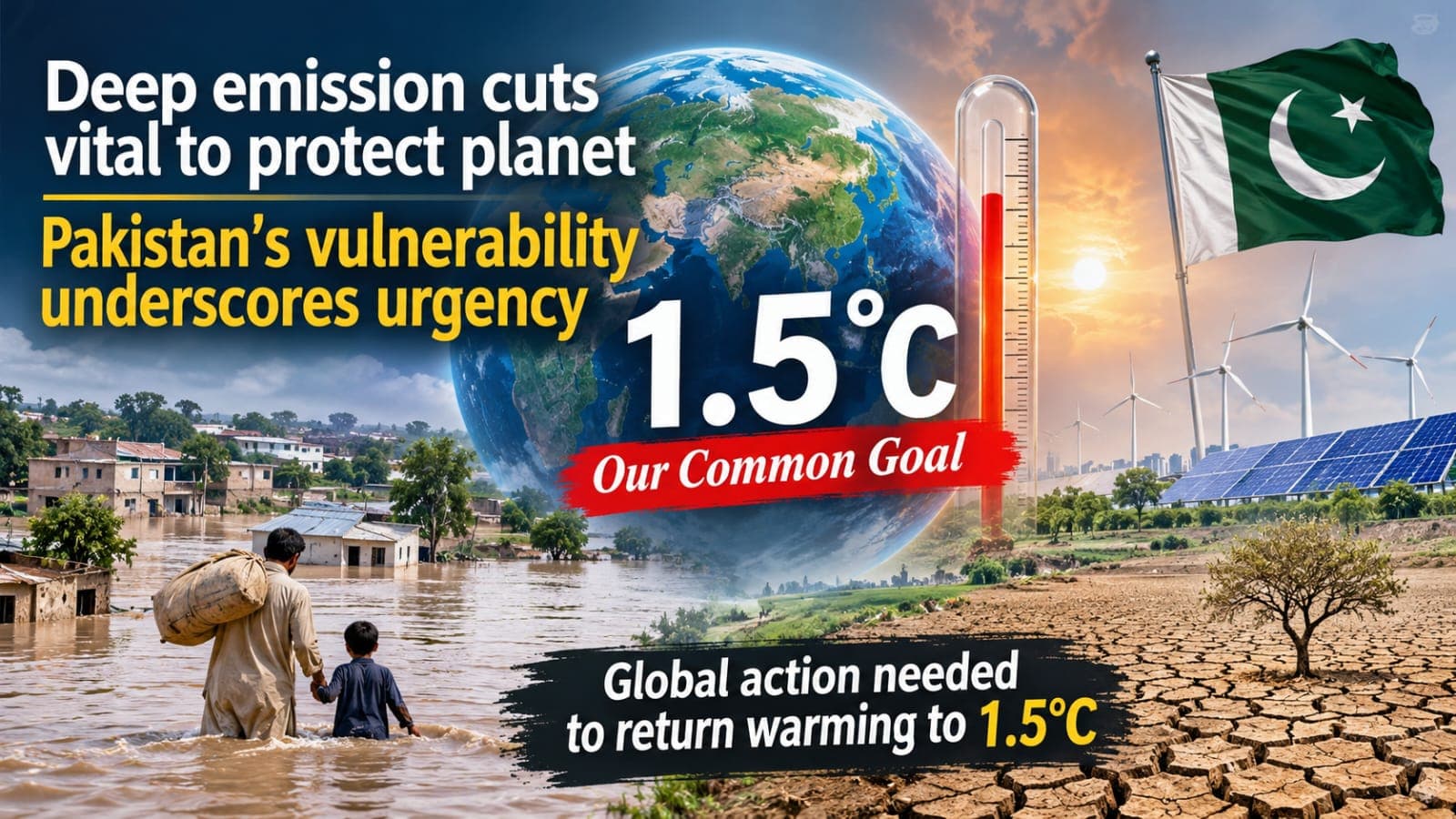
Pakistan’s growing exposure to floods, heatwaves, glacial melting and other climate-related hazards highlights the urgent need for deeper global greenhouse gas emission cuts, as the world risks exceeding the 1.5-degree Celsius warming threshold for decades, according to a new United Nations assessment. Despite contributing less than one per cent of global greenhouse gas emissions, Pakistan remains among the countries most vulnerable to climate change, facing mounting threats to its agriculture, water resources, livelihoods and economic stability.
The United Nations Environment Programme’s (UNEP) Emissions Gap Report 2026: The Point of Return estimates that global greenhouse gas emissions must decline by 18 per cent by 2030, 45 per cent by 2035 and 69 per cent by 2040, compared with 2025 levels, to limit temperature overshoot and eventually return global warming to 1.5C by 2100.
Mohammad Saleem Shaikh, a climate policy advocacy and governance expert and member of the Climate and Environmental Change Group at the University of Portsmouth, told APP that the opportunity to prevent global warming from exceeding 1.5C without or with limited overshoot had passed, but the extent and duration of the overshoot could still be reduced.
The report notes that existing national climate commitments remain insufficient. Even if countries fully implement their nationally determined contributions (NDCs), global emissions would decline by only 5 to 8 per cent by 2030 and 11 to 15 per cent by 2035, compared with 2025 levels. Under current policies, the world is heading towards approximately 2.8C of warming by the end of the century. Full implementation of existing NDCs could bring this projection down to 2.6C, while the most optimistic scenario, incorporating additional net-zero targets, would still result in around 2.1C of warming.
The UNEP assessment projects that even under the lowest-emissions pathway, global temperatures could peak at 1.7C to 1.8C above pre-industrial levels around the middle of the century before declining towards 1.5C by 2100. The report estimates that a pathway offering roughly a 50 per cent chance of returning warming to 1.5C by the end of the century remains possible, but would require unprecedented reductions in emissions.