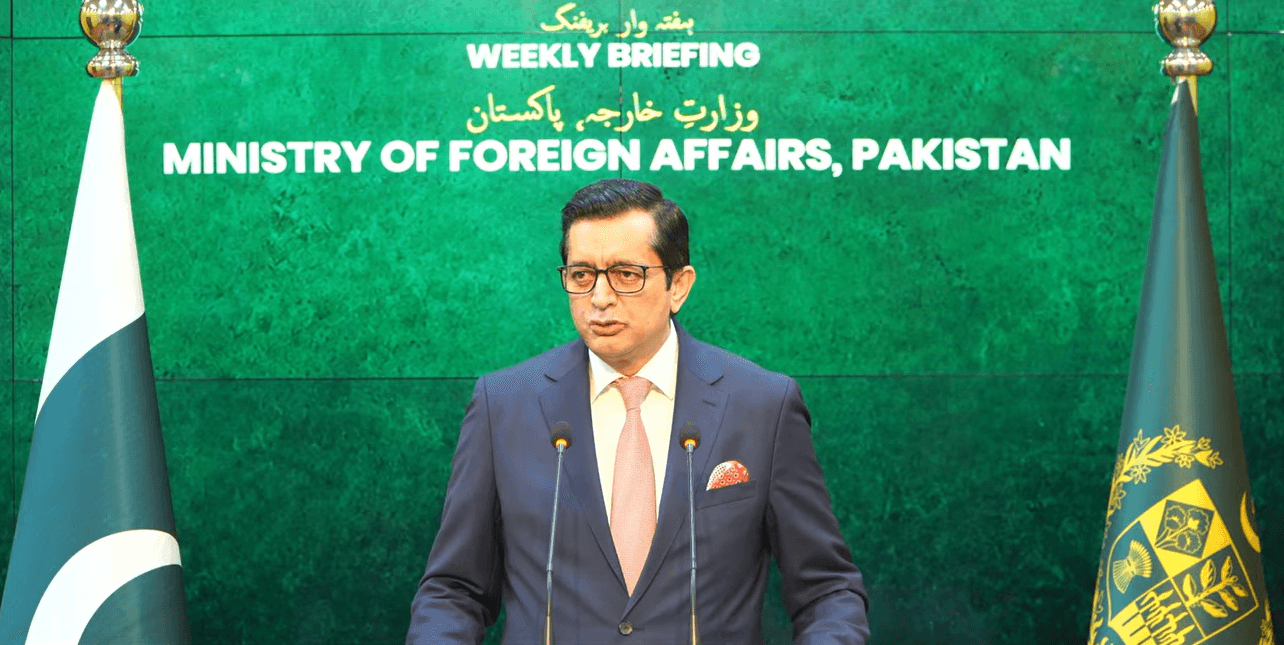
Pakistan has reiterated its commitment to resolving regional conflicts through dialogue and diplomacy, emphasizing its efforts to facilitate engagement between the United States and Iran. During a weekly press briefing on November 6, Foreign Office Spokesperson Ambassador Sajjad Haider Khan highlighted Pakistan's growing diplomatic engagement with regional and international partners, particularly amid heightened tensions involving the United States, Israel and Iran, and growing concerns over maritime security in the Strait of Hormuz.
Ambassador Khan stated that Pakistan has provided all possible facilitation in its capacity as an honest mediator, noting that it helped bring Washington and Tehran to the negotiating table after nearly 47 years without direct engagement, culminating in the signing of the Islamabad Memorandum of Understanding (MoU). Khan maintained that "Peace must be achieved through political dialogue and diplomacy, not war," expressing hope that these mediation efforts will ultimately produce a peaceful resolution.
Regarding potential military strikes against Iran and reported threats involving nuclear weapons, Ambassador Khan described threats to use nuclear weapons against another country as a serious matter but declined to comment on speculation. He stressed that all sides should pursue negotiations and diplomatic engagement rather than contemplate extreme measures. Khan identified Israel’s actions in the region as a major source of instability, describing its policies towards Iran, Palestine, Syria and Lebanon as unwarranted and expansionist. He specifically identified Israel as among the countries whose actions could undermine regional peace.
On the multilateral front, Khan highlighted Pakistan’s diplomatic success at the UN General Assembly’s First Committee, where three Pakistan-sponsored resolutions on arms control, confidence-building and security assurances for non-nuclear-weapon states were adopted. The resolution on conventional arms control at regional and subregional levels secured 180 votes in favour, while India and Israel were the only two countries to oppose it. Khan said the overwhelming support reflected international recognition that regional peace and stability required restraint, balanced defence capabilities and dialogue. He expressed concern over the growing gap between the stated commitments of India and Israel to international arms control and their opposition to regional arms restraint initiatives, warning that the acquisition and transfer of sophisticated conventional weapons systems in South Asia were heightening the risk of crises and military escalation.