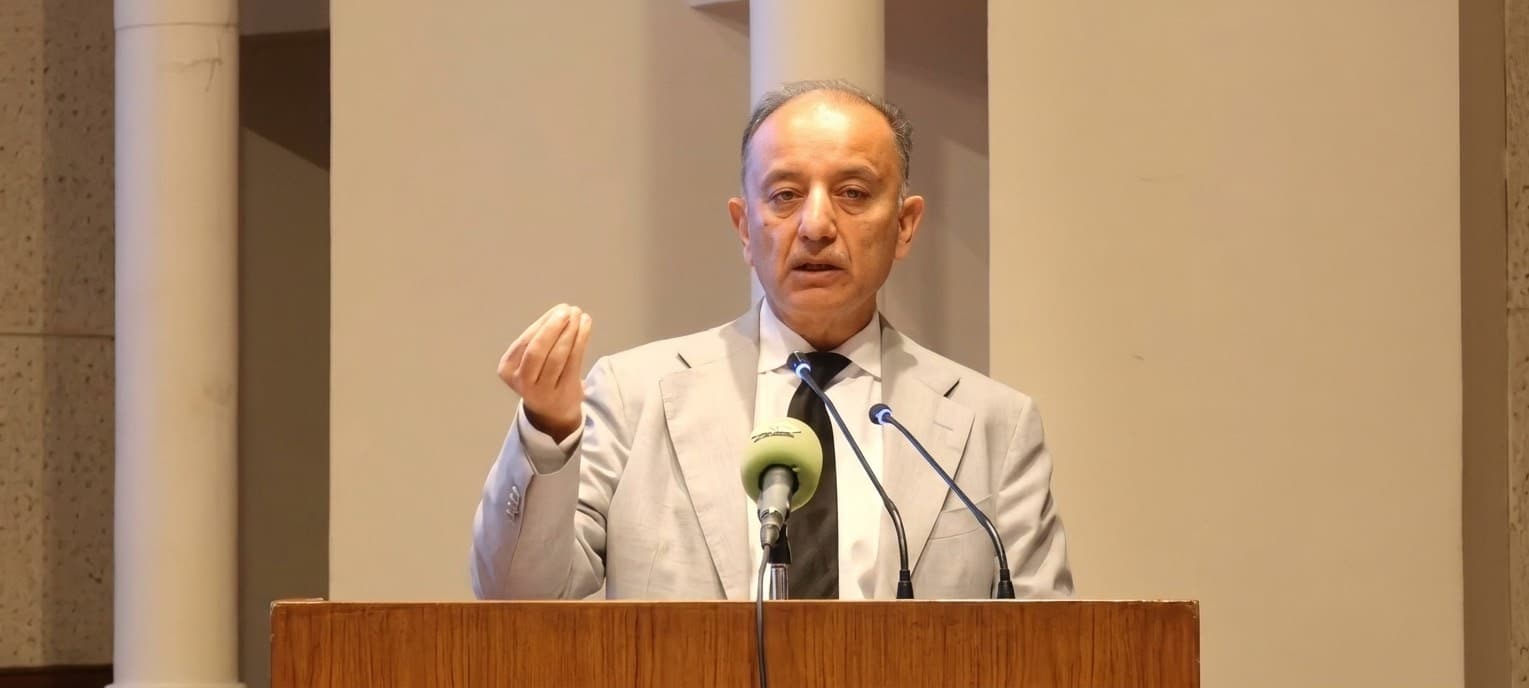
Federal Minister for Climate Change and Environmental Coordination Dr. Musadik Malik warned on Friday that Pakistan's economic vulnerabilities are being deepened by a convergence of climate disasters, technological disruption, and an increasingly unequal global economic order. Speaking at a keynote session at the Institute of Business Administration (IBA), Karachi University Campus, the minister cautioned that these combined factors could reverse decades of progress for vulnerable communities.
Dr. Musadik Malik argued that Pakistan’s economic difficulties cannot be understood only through domestic policy failures. He stated that global commodity cycles, interest rates, geopolitical conflicts, and technological changes also shape the country's economic prospects.
The minister identified the human cost of climate disasters as a central theme, noting that some families in flood-hit Gilgit-Baltistan took three generations to escape poverty, only to lose homes, livestock, schools, and clinics in a single flood. He described how these communities were pushed back into poverty after the destruction of their economic security. He also noted that farmers in Sindh and along the Sindh-Balochistan border were eventually forced to abandon farming after successive losses despite their attachment to ancestral homes.
Highlighting the dangers of extreme temperatures in Jacobabad, the minister shared the story of a furnace worker who continued to work in intense heat because he feared his children would go hungry.
Musadik Malik questioned the conventional economic approach of measuring climate losses through GDP and financial figures. He argued that consequences should be assessed through deaths, displacement, disability, disrupted education, infant and maternal mortality, and the destruction of family livelihoods. He cited figures of around 6,000 deaths, 20,000 injured or disabled people, and 30 to 40 million displaced persons over five major flood events.
The minister linked these vulnerabilities to technological disruption, stating that advances in robotics and automation are accelerating industrial transformation with serious consequences for workers with low or mixed skill sets. He added that the rapid expansion of artificial intelligence could disrupt the livelihoods of freelancers, requiring workers to acquire new skills at an increasingly rapid pace.