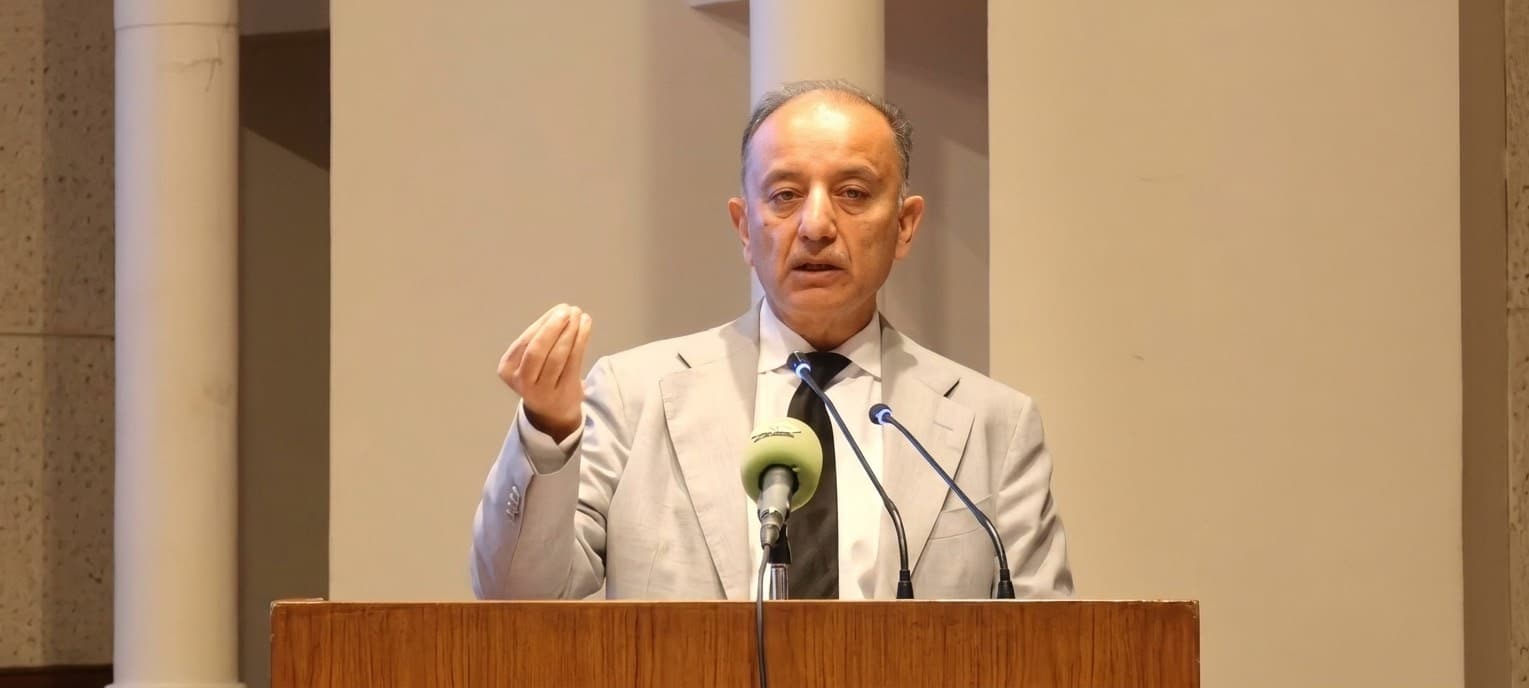
Pakistan has strongly condemned Houthi ballistic missile attacks targeting the Makkah and Madinah regions in Saudi Arabia. During a weekly press briefing on November 6, 2026, Foreign Office spokesperson Tahir Andrabi described the strikes as a "blatant disregard for the sanctity of Islam's holiest sites and civilian safety." Andrabi stated that the attacks violate the kingdom's sovereignty and reaffirmed Pakistan's "unwavering solidarity" with Riyadh.
The spokesperson noted that Pakistan had previously condemned the October 26 attacks and reiterated the country's commitment to the Makkah Alliance for Defence to protect the two holy mosques against external aggression.
These statements follow a series of diplomatic meetings. On October 23, the foreign ministers of Pakistan, Turkiye, Egypt, and Saudi Arabia met in Istanbul for the R4 ministerial meeting. During this session, the ministers condemned Houthi attacks against Saudi Arabia and commercial shipping in the Red Sea and Bab al-Mandab. They also reaffirmed support for the Palestinian people's rights to self-determination and the establishment of an independent state along the June 4, 1967 lines, with East Jerusalem as its capital. The ministers called for an immediate end to violence and the early implementation of a two-state solution.
On the same day, October 23, the R4 ministers met with counterparts from France, Germany, Italy, and the United Kingdom in Istanbul. These discussions covered the conflict involving the United States, Israel, and Iran, as well as maritime security in the Strait of Hormuz, Bab al-Mandeb, and the Black Sea. The ministers agreed to continue consultations to advance regional peace.
Pakistan also engaged in several other high-level diplomatic activities:
On October 24, Pakistan condemned a terrorist attack at a church in Jordan during a funeral procession, expressing solidarity with the Jordanian government.
On October 28, the Makkah Alliance for Defence's Secretary General, Lieutenant General Noman Mahmood, met with Deputy Prime Minister and Foreign Minister Ishaq Dar. Dar emphasized the importance of the alliance in achieving lasting regional peace.
On October 30, Singapore's Minister for Foreign Affairs, Dr. Vivian Balakrishnan, visited Islamabad. The two nations discussed cooperation in trade, investment, and disaster management, with Singapore set to assume the ASEAN chairmanship in 2027.
On November 1, Liu Haixing, Minister of the International Department of the Communist Party of China's Central Committee, made his first official visit to Islamabad. On November 2, FM Dar and Minister Haixing co-chaired a symposium on Xi Jinping's thought on party building. Earlier, on October 25, the Chinese ambassador met with Dar to discuss the China-Pakistan Economic Corridor (CPEC).
On November 5, FM Dar received British Minister of State for Security Dan Jarvis. Dar highlighted the threat of terrorism from Afghanistan and called for international efforts to counter it.
Additionally, the foreign secretary held meetings with ambassadors from ASEAN member states on October 23, the European Union on October 27, and the Arab Group on October 30. The secretary also met with ambassadors from Saudi Arabia, Japan, and Ukraine, as well as the British High Commissioner. On October 26, FM Dar spoke with Bahraini Foreign Minister Dr. Abdul Latif bin Rashid Al Zayani regarding bilateral relations and regional developments.