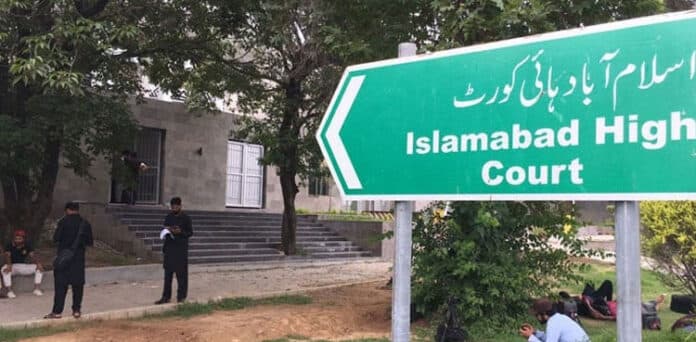
Human rights lawyer Imaan Zainab Mazari-Hazir and her spouse Hadi Ali Chattha filed appeals and applications for the suspension of their sentences before the Islamabad High Court (IHC) on Friday. The appeals challenge their convictions in a case involving the removal of security barriers during the movement of a foreign cricket team.
The appeals were filed by counsels Faisal Siddiqui, Riasat Ali Azad, and Zainab Janjua under Section 25 of the Anti-Terrorism Act, 1997, read with Section 410 of the Code of Criminal Procedure, 1898, against a judgment dated October 29, 2026, passed by the judge of Special Court-II (Anti-Terrorism), Islamabad. The IHC Registrar’s Office has numbered Imaan Mazari’s appeal as 283/2026 and Hadi Ali Chattha’s as 282/2026.
In their appeals, the counsel contended that the trial court failed to meet the requirements of a fair trial and that the conviction was the result of patently illegal and arbitrary proceedings. They contended that the jail trial, conducted in violation of Article 10 of the Constitution, effectively amounted to a secret trial without lawful authority. The counsel further argued that the charge was framed without providing copies under Section 265-C CrPC and that a plea of “not guilty” was recorded on the appellants’ behalf although none was taken.
The counsel also stated that prosecution evidence, including statements from prosecution witnesses 4 to 6, was recorded without the presence of the appellants and their counsel, contrary to Section 353 CrPC and Article 10-A of the Constitution. They further claimed that state counsel was imposed on the appellants against their stated wishes and that the trial court proceeded despite a pending transfer application before the high court, which they say violates Section 526(8) CrPC.
On the merits, the appeal argues that the conviction under Section 7 of the ATA is unsustainable because the prosecution failed to prove the design or purpose required under Section 6 of the ATA. The appeal notes that the trial court itself described the incident as “a very common nature, ordinary type of incident” and that evidence showed the appellants were on their way to court when they were held up at the barrier.