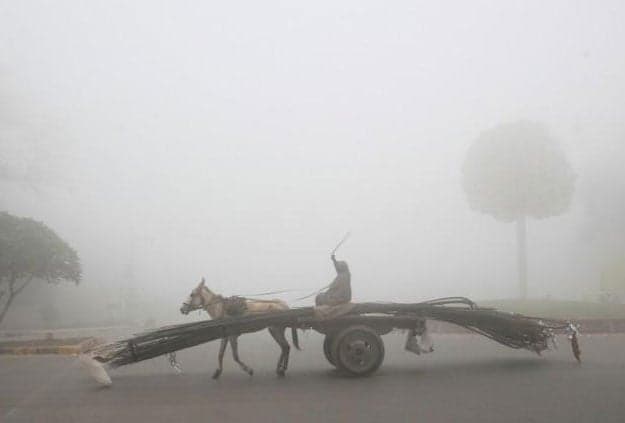
Smog continued to cover several parts of Punjab on Saturday, with the Environmental Protection Agency (EPA) reporting hazardous and unhealthy air quality at multiple monitoring stations. The Pakistan Meteorological Department (PMD) forecast largely dry conditions for the region, which the report suggests diminishes hopes of relief from the persistent pollution.
At 6pm on Saturday, EPA monitoring data showed significant variation in air quality across the provincial capital, Lahore. The Wagha Border recorded an Air Quality Index (AQI) score of 500, which is classified as hazardous. Barki Road reported an "unhealthy" reading of 288. Other locations in Lahore recorded elevated levels, including Egerton Road at 175, Shahdara at 173, Multan Road at 167, Kahna Nau at 165, Safari Park at 160, and DHA Phase 6 at 159; these were classified as "unhealthy for sensitive groups." Conversely, Punjab University and GT Road recorded lower scores of 149 and 148, respectively, classified as "moderate."
The EPA also reported elevated particulate matter concentrations. PM2.5 levels reached 108.3µg/m³ at Shahdara, 105.5µg/m³ at Egerton Road, 99.9µg/m³ at Multan Road, and 97µg/m³ at Kahna Nau, while Wagha Border recorded a PM10 concentration of 683.5µg/m³. The figures highlight the uneven distribution of air pollution across Lahore, with air quality varying considerably between different parts of the city.
Data from IQAir's live monitoring platform showed Lahore's US AQI reading at 275 on Saturday morning, improving to 172 by the evening, though it remained in the unhealthy category. Station-level readings on that platform showed 322 in Allama Iqbal Town, 312 in Cantonment, and 298 along Burki Road near Paragon City. Differences between IQAir and EPA readings reflect variations in monitoring networks, station locations, AQI calculation methods and reporting periods; nevertheless, the monitoring stations bear the consistent outlook that the air quality across Punjab is largely poor.
In the EPA's latest provincial AQI-based city ranking, Vehari topped the list with a reading of 369, followed by Multan at 354 and Sahiwal at 329. Gujranwala recorded 323, Sheikhupura 284, Kot Addu 271, Dera Ghazi Khan 270, Pakpattan 247, Nankana Sahib 238, and Wazirabad 233. While Lahore did not appear in the top 10 of this ranking, station-level readings showed several parts of the capital continued to experience unhealthy air quality.