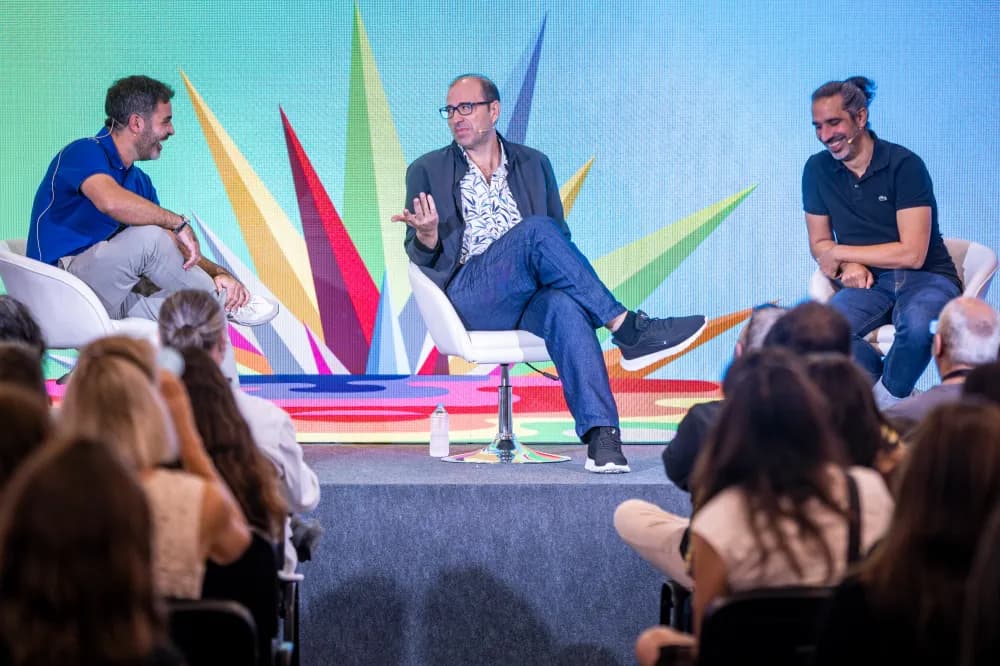
Spanish directors Paco Cabezas and Javier Ruiz Caldera discussed the pressures of filmmaking and the importance of creative risk during a "No Holds Barred" talk on Nov. 2. The event was part of the Creative Talks program at the fourth edition of the South International Series Festival in Cádiz, which ran from Oct. 30 to Nov. 4. The discussion was moderated by South Boost coordinator Alejandro Ávila.
Cabezas, known for his work on Netflix’s “Wednesday” and AMC’s “The Walking Dead: Daryl Dixon,” described the intensity of his directing process as "painting a picture during a fire" or "writing a poem on a roller coaster." He explained that he prepares by assembling a comprehensive book of drawings, photographs, and shot breakdowns before filming. He noted that by the time he reaches the set, he knows the material so well he rarely needs to open the book, stating, “To create under pressure, you have to be very relaxed.”
In contrast, Ruiz Caldera prefers a more spontaneous approach, suggesting directors should "leave the window open so the air can come in and things can happen." Ruiz Caldera, who has directed projects ranging from the spy caper “Anacleto: Agente Secreto” to the superhero film “Superlópez,” admitted that horror is his favorite genre. He joked that he would move into big drama once he ran out of adjectives to describe his comedy work.
Ruiz Caldera detailed the technical difficulties of his recent film “5 More Minutes” (“5 Minutos Más”), a time-loop thriller produced by El Terrat and Ikiru Films for Movistar Plus. The film was shot in continuous takes of exactly five minutes; any take exceeding six seconds required a restart, while finishing early required finding a pause to fill the remaining time. Ruiz Caldera, who transitioned into directing from an editing background, called it the "wildest technical challenge" of his life because he "took that tool away" from himself.
The film premiered in competition at San Sebastián, where Javier Cámara won the Silver Shell for best supporting performance. It also received an Audience Award and a Special Jury Mention at Austin’s Fantastic Fest. Filmax will release the movie in Spain on Jan. 22. Ruiz Caldera explained his decision to cast comedian Berto Romero in the lead, despite Romero's concerns that the screenplay lacked jokes. Ruiz Caldera argued that humor is an "essential ingredient" to move or scare an audience, while Cabezas added that if an audience laughs together, they "love them more," making the subsequent danger more impactful.
When discussing action choreography, Cabezas recounted a specific challenge from “The Walking Dead: Daryl Dixon” involving a catapult launching a "giant meatball of burning zombies." He described using a van rigged to jolt on cue, a drone with a light to trace the fireball, and stunt performers attached to a constructed ball. He mentioned he has shot equally "crazy" material for the upcoming third season of “Wednesday,” though he declined to provide spoilers.
Cabezas also compared his work on the Atresplayer crime saga “La Nena” to “Wednesday,” noting the "total freedom" of the former compared to the established visual parameters of the latter. Regarding the differences between working in Spain and the U.S., Cabezas acknowledged budget variations but stated, “in the end the heart is the same.”
The two directors first collaborated in 2009 on the spoof “Spanish Movie,” directed by Ruiz Caldera. Ruiz Caldera recalled it as "possibly the best day I’ve ever had on a shoot," specifically the moment he had Leslie Nielsen and Chiquito de la Calzada improvise together, describing the result as "like a National Geographic of comedy."
Cabezas’ Hollywood career began after his thriller “Neon Flesh” reached Tribeca, leading to work on Nicolas Cage’s “Rage.” However, he identified his biggest career challenge as a short film preceding “Neon Flesh.” After a producer called the film unfunny and refused to pay for a celluloid transfer, Cabezas raised €10,000 ($11,200) from relatives to finance the transfer himself. The short eventually won 60 awards, and Cabezas said the hardest part was "believing in yourself and taking that risk."