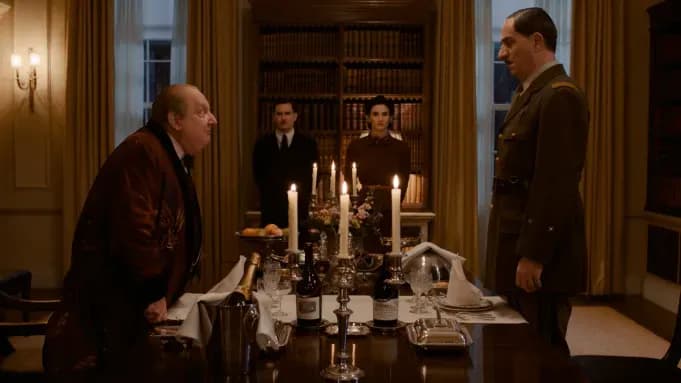
Samuel Goldwyn Films is betting that a sprawling French WW2 epic about Charles de Gaulle can appeal to U.S. audiences, despite the historical figure being relatively unknown in the U.S. The two-part production, directed by Antonin Baudry, made its U.S. premiere on Saturday at the American French Film Festival in Los Angeles. The films, which each run more than two and a half hours, received a seven-minute standing ovation from a packed audience at the DGA Theater.
The €74 million production stars Simon Abkarian as the French general and Simon Russell Beale as Winston Churchill. It marks one of Pathé’s boldest gambles following “The Count of Monte Cristo” and the two-part “The Three Musketeers,” which were also distributed in the U.S. by Samuel Goldwyn Films. The films have already gained momentum in France, selling over six million tickets, and have become a success in the U.K. In the U.K., the first installment, “De Gaulle: Resistance,” currently ranks as the highest-grossing French-language film of the year. The production has also been acquired by Light Films for a late November release in China.
Peter Goldwyn stated during the American French Film Festival that he’s betting the sprawling saga can appeal to U.S. audiences because World War II is an "easy entry point." He noted that while U.S. audiences have been very much enthusiastic consistently about stories about Roosevelt and Churchill, the story of De Gaulle is "relatively untold in America." Goldwyn described the films as having a "staggering scope and scale" comparable to “The Odyssey,” arguing that they function more as character studies than conventional European arthouse fare. He noted that the only thing that makes it an arthouse movie is because it’s in a foreign language, which "makes it hard for theaters to commit on that wide of a screen count."
To reach a broader audience, Goldwyn is rolling out the films theatrically in major U.S. markets—including New York, Los Angeles, Chicago, San Francisco, Washington, D.C., Seattle, Austin, Minneapolis, Houston, and Atlanta—while making it available nationwide on transactional VOD. This "combination method" is intended to compensate for the fact that theaters in the U.S. don’t have the patience or time to let things be discovered as they were in France. The distributor is mounting a single campaign targeting not only arthouse moviegoers but also history buffs, schools, cultural institutions and younger audiences through social media.
The films aim to challenge the familiar American and British narratives of World War II by exposing the tensions between De Gaulle, Churchill, and Franklin D. Roosevelt, who is played by Campbell Scott. Director Baudry and co-screenwriter Bérénice Vila read more than 150 books and dug into historical archives to reconstruct the general’s extraordinary journey from an isolated, virtually unknown military officer in 1940 to the leader of the French Resistance. Baudry stated that Roosevelt thought Churchill was being completely absurd with his romantic ideas about supporting De Gaulle, and that to Roosevelt, the idea of Free France was a "little fantasy of Churchill’s." Baudry noted that the complicated relationship among the three leaders remains largely unknown outside academic circles.
Baudry intended for the films to be accessible to viewers with no knowledge of De Gaulle. For the role of De Gaulle, he cast Simon Abkarian, an actor who spent roughly six months preparing for the part. Abkarian told Variety that he read the screenplay more than ten times and transcribed every line of his dialogue into a small notebook during the 150-day shoot. While Abkarian sought to capture De Gaulle’s distinctive voice and logic, he stated he did not want to represent the character in a "strictly anthropological way," aiming instead to find the right balance between doing nothing and caricature.
Abkarian described Churchill and De Gaulle as "romantics" who were united by an idealism that set them apart from Roosevelt’s "political pragmatism." While Abkarian expressed less certainty than Goldwyn regarding the American response to the films’ portrayal of their wartime leadership, he suggested that De Gaulle’s defiance could strike a chord with Americans' own "sense of nobility and their democratic convictions." Goldwyn, however, remains confident, describing De Gaulle as a patriotic man who didn't go along with what his government dictated, calling it a "story of an ally."
The second film, “De Gaulle: Liberty,” will be released in early December.