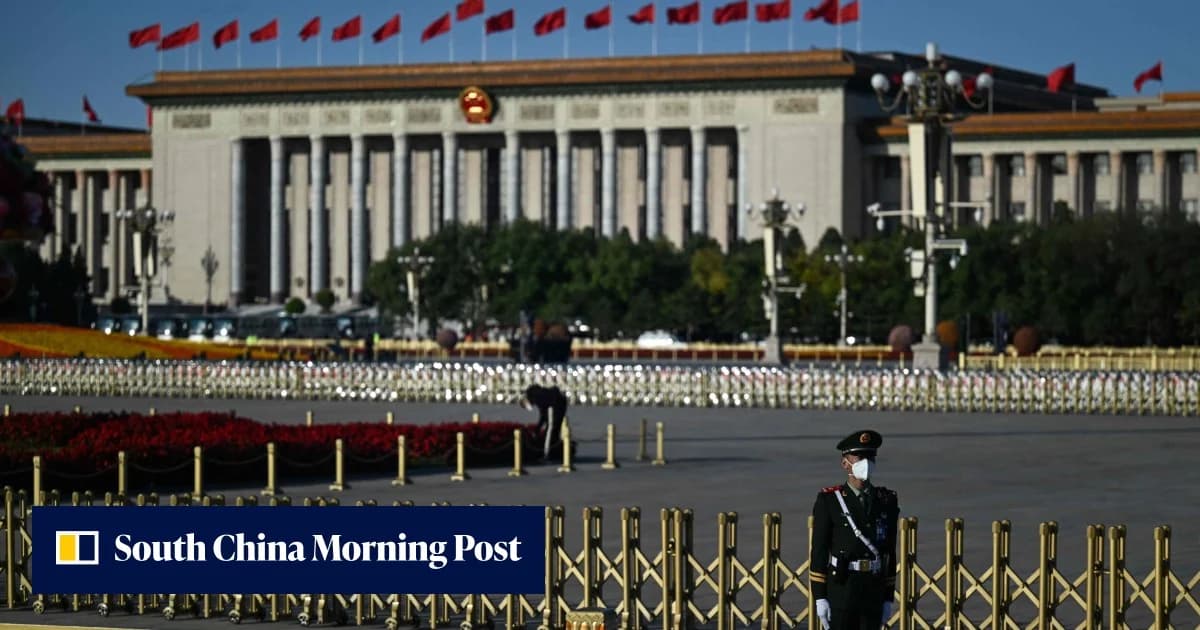
Chinese lawmakers have submitted a draft amendment to the Criminal Procedure Law to the National People’s Congress Standing Committee for initial review, state news agency Xinhua reported on Monday. The proposal seeks to restrict residential surveillance at a designated location (RSDL), a measure that has faced significant criticism for its use in state security and terrorism cases.
Originally introduced in 1996 and expanded in 2012, RSDL was intended to be a mild restriction on personal freedoms to lower arrest rates. Since its introduction and expansion, it has become the harshest form of detention used in state security cases, including terrorism. The draft amendment, which consists of 55 articles, aims to clarify that residential surveillance should be positioned "as an alternative measure to reduce pretrial detention."
Under the current law, RSDL can be applied if a suspect has no fixed residence or if a national security or terrorist offense makes surveillance at a person's own home impractical for the investigation. The new draft would prohibit police from designating a surveillance location for suspects or defendants who lack a fixed residence, requiring them to use other compulsory measures instead.
Liu Renwen, a legal scholar at the Institute of Law under the Chinese Academy of Social Sciences, told Xinhua that RSDL has been abused in practice, undermining judicial fairness. He stated that the amendment is intended to narrow the scope of the measure to fully protect the lawful rights of suspects and defendants.
The draft also includes several other changes to the 1979 law, which was last revised in 2018. These include preventing custody from being extended beyond prescribed limits and providing more relief, legal aid, or police assistance for victims who struggle to produce evidence. Notably, the draft refines basic principles by stating that "presumption of guilt is prohibited."
The move comes after repeated calls from the legal community to restrict or remove RSDL. Lawyers have previously accused authorities of using the measure to extract information through torture, noting that suspects were often kept under 24-hour watch without supervision.