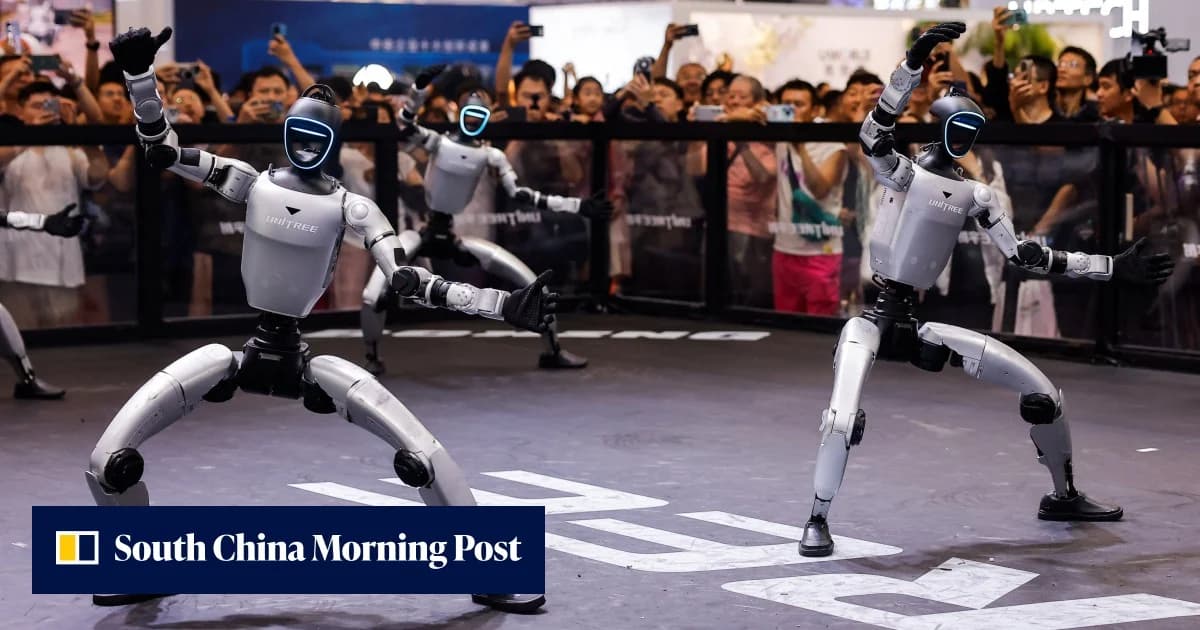
Robots developed by Chinese humanoid maker Unitree Robotics can now paint pictures and play chess without any prior training, relying on frontier AI models to navigate complex physical tasks, according to founder and CEO Wang Xingxing. During a presentation at the China International Import Expo (CIIE) in Shanghai on Thursday, Wang explained that the machines use OpenAI’s GPT-6 to navigate complex physical tasks through real-time model inference.
Wang noted that the robots are capable of executing intricate sequences, such as blending pigments and dynamically replacing brush water. He remarked, “The precision required to change pigments without error is quite high,” and added, “Seeing it perform at this level with zero training was truly stunning.” While Unitree showed video clips of the robots painting, the company did not perform a live demonstration on stage.
Wang previously stated last month that GPT-6 has moved the industry's breakthrough timeline forward to “within one or two years.” He suggested that GPT-7 could potentially solve core challenges in embodied artificial intelligence by next year. However, Wang warned that the primary hurdle for the industry is currently a “last-millimetre” mechanical gap, rather than digital reasoning. He described the fundamental problem as the alignment error between the AI model’s inputs and outputs, but projected that this physical bottleneck would be overcome within one or two years.
To accelerate this transition, Wang said Unitree is developing a “self-evolving” feedback loop. This system would allow humanoid robots to write code, run simulations, and autonomously improve their own real-world performance.
Other industry figures at the expo shared a positive outlook on the timeline for embodied AI. Wang Qian, founder of X Square Robot, pushed back against forecasts that mass adoption is five years away, stating, “We believe we are very close to a ‘GPT moment’ for embodied AI – highly likely within a year or so.” He expressed hope to see robots building robots and chips manufacturing chips to achieve true artificial intelligence in the physical world.
In contrast, Moore Threads co-founder Wang Dong offered a more cautious perspective regarding hardware and data. He warned that embodied AI development is lagging expectations because of crippling hardware costs and severe data scarcity. Wang Dong stated that because collecting real-world interaction data is difficult, developers are forced to rely heavily on synthetic training sets. He added that Moore Threads is attempting to provide its own chips and solutions to domestic developers because Nvidia chips are extremely expensive.