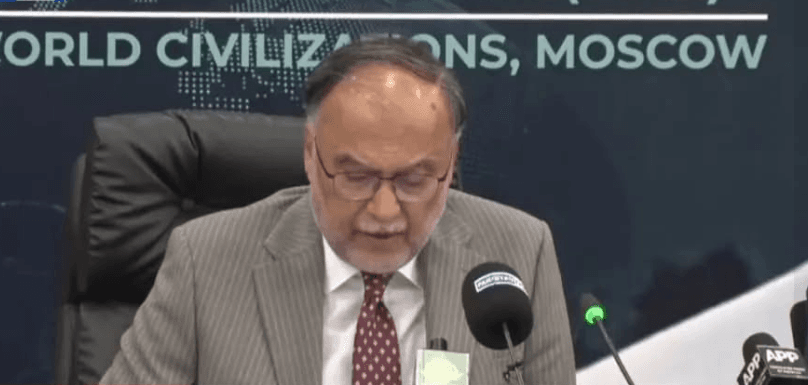
Minister for Planning, Development and Special Initiatives Ahsan Iqbal announced on Thursday that Pakistan aims to develop one million artificial intelligence (AI) professionals by 2030. This goal is part of a broader strategy to bolster the nation's digital economy and increase technological cooperation with Russia.
Speaking at the Pakistan-Russia IT Collaboration: Industry Engagement Framework, Iqbal called for enhanced bilateral cooperation in information technology. He emphasized the need for joint ventures, technology partnerships, market access, and pilot projects to turn business interactions into commercial opportunities. He noted that recent business-to-business meetings held by the Pakistan Software Export Board (PSEB) and P@SHA showed potential, with five Russian companies holding 16 meetings with 11 Pakistani firms. Iqbal stated that new initiatives should provide a clearer path from these discussions to actual commercial contracts.
Iqbal highlighted that e-Pakistan is one of five core pillars of the National Economic Transformation Plan, which seeks to turn Pakistan into a trillion-dollar economy by 2035. He suggested that cooperation with Russia could focus on areas such as automation, enterprise software for industry, digital supply chains for agriculture, secure digital systems for trade, AI, cloud computing, and cybersecurity. The minister stressed that Pakistan must move toward developing products and digital platforms for international markets rather than just exporting IT services.
Regarding human resources, Iqbal noted that Pakistan produces more than 75,000 graduates every year. He stated that the National AI Policy aims for the one million AI professional goal by 2030 and mentioned that seven new AI centers would be established to link research, skills development, startups, and industry.
Iqbal pointed to Pakistan's experience in digital governance, citing the National Database and Registration Authority (NADRA) identity system and the RAAST instant payment system, which processed 646 million transactions in one quarter. He observed that Russia's expertise in enterprise software, cloud computing, and cybersecurity complements Pakistan's engineering talent. He suggested the two countries could jointly develop and deliver technology solutions in their own markets and in third countries.
The minister emphasized that partnerships must be company-led, commercially driven, and transparent. He acknowledged that payment and settlement mechanisms are practical challenges that relevant institutions are working to solve. He stated that the success of these forums should be measured by trade, investment, and employment opportunities rather than just announcements.
Iqbal also identified the language barrier as an obstacle, noting a lack of Russian-language expertise among Pakistani academics. He recounted a previous visit to Moscow where he learned that Pakistani students were unable to benefit from certain scholarships due to a lack of Russian proficiency. To address this, the government is promoting Russian-language education through a center at Allama Iqbal Open University in collaboration with the Higher Education Commission.
Concluding the session, Iqbal expressed hope that technology would shape the future of Pakistan-Russia relations, stating, "Energy has powered our partnership for years. Now, let’s let technology power our future."