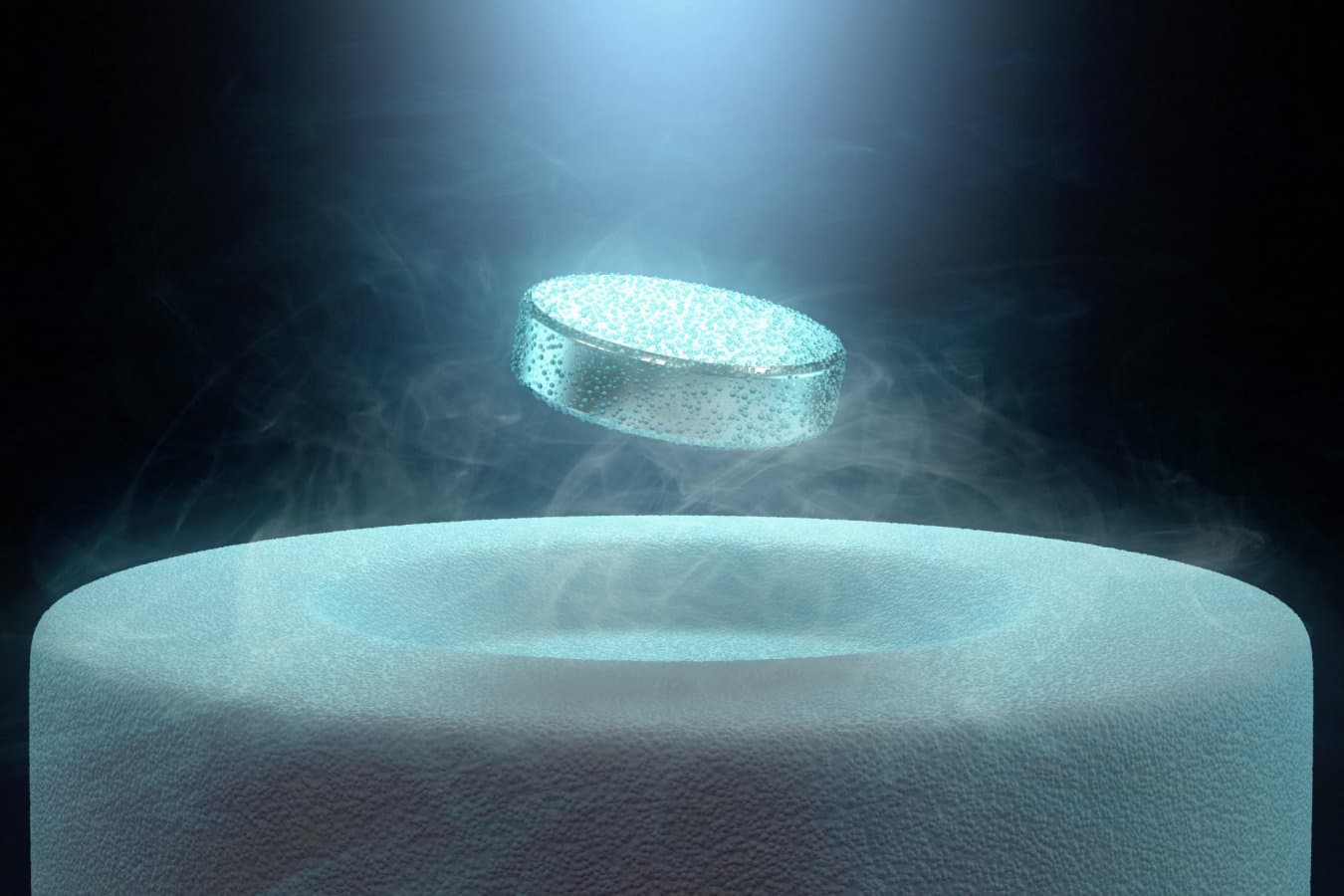
Researchers in Singapore have achieved a new record for the fastest magnetically levitated rotor. Using a tiny magnet that levitates within a superconductor trap, the team created what may be the fastest spinning object visible to the naked eye and one of the fastest spinning objects ever manufactured.
Tao Wang and his colleagues at the Agency for Science Technology and Research in Singapore used a spherical magnet made of neodymium, iron, and boron. The magnet was approximately 30 micrometres wide, which is comparable to the width of a human hair. To achieve the record, the team placed the magnet in a lead cylindrical container inside a vacuum chamber. They then used liquid helium to cool the setup to roughly -269°C (-452°F).
Because lead acts as a superconductor at these temperatures, it exhibits the Meissner effect, expelling magnetic fields and allowing the magnet to levitate. The vacuum environment ensured the magnet could spin without colliding with air particles. Using a magnetic coil, the team pushed the rotor to 138 million revolutions per minute.
Wang stated that the spinning was very stable, noting it would take 17 days for the speed to decrease by 50 per cent. He compared the magnet's endurance to the Earth's rotation, stating, “In terms of how many turns it makes before slowing down significantly, this is in the same league as the Earth’s spinning.” He further noted, “This, so far, is the fastest magnetically levitated rotor.” While a nano-sized sphere levitated by lasers holds the record for the fastest human-made object, that object is invisible to the naked eye.
The rotor's lack of friction and sensitivity to its environment make it a promising sensor. The team has already used it to test as a gauge of vacuum at very low temperatures. Wang suggested this could benefit builders of quantum computers, which require extreme cold and isolation.
Other researchers highlighted potential future applications. Benjamin Stickler at Ulm University in Germany said the magnet could precisely sense and measure magnetic fields. Andrea Vinante at the National Research Council in Italy, a member of the team, stated it could serve as a platform for testing fundamental physics, such as searching for dark matter particles or sensing gravitational waves at unexplored frequencies. Vinante also noted that because quantum effects dominate at such low temperatures, the magnet could be used to explore quantum mechanics and its interplay with gravity at micrometre scales.