Chinese engineers have developed a bubble-lubrication system that reduces net energy consumption for commercial shipping by applying principles used in high-speed torpedoes. The technology, which creates a gas-filled cavity to reduce water contact, allows projectiles to reach extreme speeds. The Shanghai Merchant Ship Design and Research Institute, a subsidiary of China State Shipbuilding Corporation, is now using a related drag-reduction method to assist large cargo vessels.
The institute announced on October 17 that the second-generation intelligent Bubble Lubrication System (BLS) was installed on a newly built 50,000-tonne product and chemical tanker. During a five-month operational trial, the vessel achieved net energy savings of about 5 per cent. The institute noted that for a 50,000-tonne tanker with a typical daily fuel consumption of about 20 tonnes, a 5 per cent reduction would save roughly one tonne of fuel a day, though this is an estimate based on typical consumption rather than a direct measurement of daily savings during the trials.
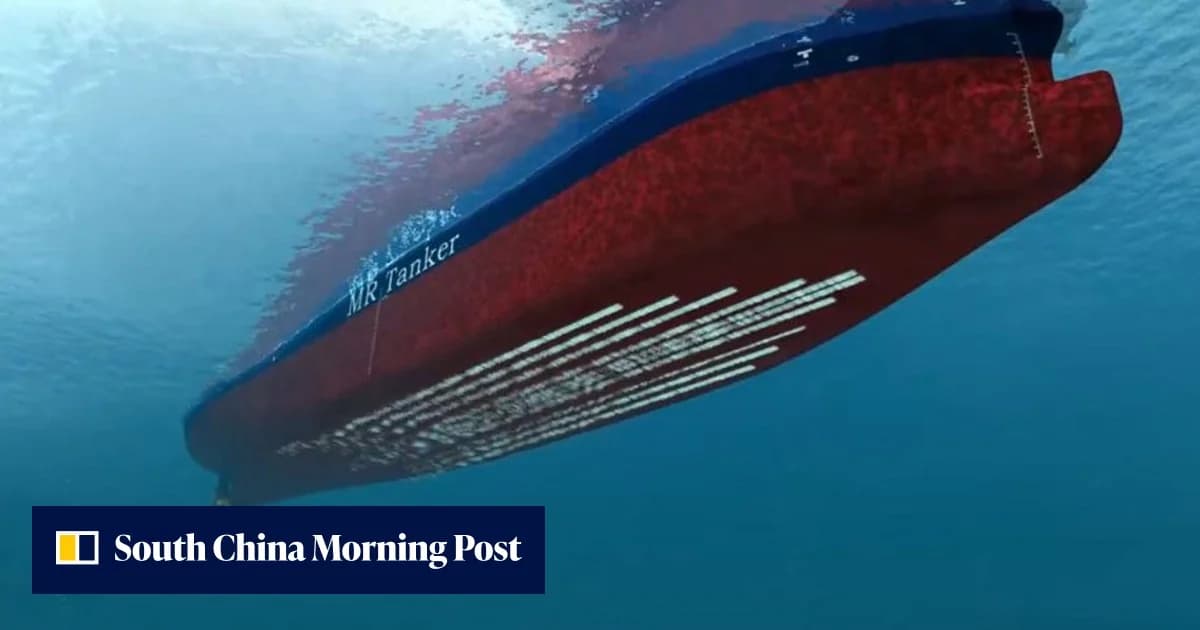
The BLS works by continuously injecting compressed air beneath the hull to form a layer of microbubbles between the ship and the seawater. According to a press release from the institute, the system "turns the boundary layer of seawater around the hull into a gas-liquid mixture," which changes the water flow to reduce frictional resistance and the energy needed for propulsion. However, the institute noted that overall savings depend on whether the reduction in propulsion power outweighs the electricity used by the compressors to generate the bubbles.
The new system is designed for various commercial vessels and can operate with liquefied natural gas, electricity, methanol, or ammonia. The institute stated, “The system is compatible with vessels powered by liquefied natural gas, electricity, methanol or ammonia.” A 3,300 TEU feeder container ship equipped with the second-generation system is expected to be completed and delivered soon.
The technology has been inspected and recognized by the China Classification Society and Italy’s classification society Rina. This upgraded version builds on a first-generation system tested in April 2022 on an 1,800-TEU feeder container ship. Development of the second generation began in May 2022 to move away from manual operation. The new version includes an improved air-supply structure to lower compressor power consumption, along with automated controls. The press release stated, “An intelligent control system adjusts the air supply according to the vessel’s speed and draught,” and “A digital operational support system monitors and analyses the ship’s energy efficiency in real time.”