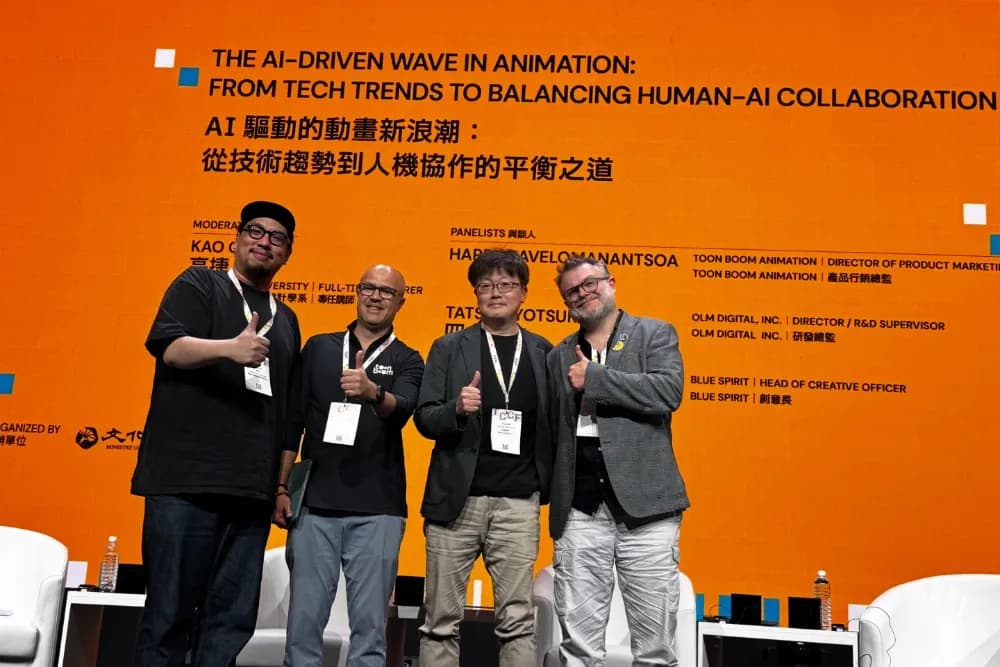
OLM, the Japanese animation studio responsible for the “Pokemon” anime and film series, has developed an AI coloring tool capable of capturing a show’s specific aesthetic from only three hand-painted frames. Yotsukura Tatsuo, OLM Digital board director, announced the development at the Taiwan Creative Content Fest (TCCF) in Taipei.
The tool was created during ANIMINS, a 15-month research project led by Yotsukura under the GENIAC program, which is overseen by Japan’s Ministry of Economy, Trade and Industry. The project, which explored how anime creators can utilize AI, concluded in February.
Because AI models typically require massive amounts of training data that studios often cannot provide, OLM utilized a different method. An artist hand-paints three frames, and the system learns the line shapes and color palette of that specific show in approximately 90 seconds. The tool then colors the remaining frames in about 15 seconds each. Yotsukura stated that the more frames an artist paints by hand, the more accurate the results become.
Yotsukura clarified that the tool is not strictly generative AI. He explained that because the system only trains on a production’s own frames, no other works are harmed. He noted the tool can adapt immediately to new characters or creatures, such as dragons. OLM’s primary goal is for the tool to fit into existing anime workflows without disrupting them. During the proof-of-concept stage, Yotsukura estimated the tool cut painting workloads by around 30%, though he noted that checkers who review every colored frame have somewhat more to do.
Other companies are pursuing similar goals. Toon Boom Animation, the Canadian maker of Harmony and Storyboard Pro, is finishing a beta for a coloring tool in its Ember AI suite, with in-betweening expected to enter beta within a couple of weeks. One Manila studio that tested Toon Boom's coloring tool reported cutting the painting time on a 90-second scene from 15 hours down to two or three.
Yotsukura, who also serves as CTO for OLM’s Malaysian and Thai arms, mentioned that OLM is also experimenting with AI for in-betweening. He suggested that larger gains may come from indirect uses, such as AI agents that could help new directors or production managers recall a director's intentions for specific cuts on long-running series. These agents could also speed up approvals and license management for secondary uses of titles, which Yotsukura called the most revenue-critical part of the business.
Yotsukura compared the gap between AI demos and production reality to gacha, the Japanese capsule-toy machines, where a turn may or may not yield the desired prize. He stated that while AI can get close enough to 80% to raise expectations, raising that quality to 90% or 100% is work so hard it can make you heartsick. He emphasized that professional animators require tools that return their direction 100% of the time.
He compared the arrival of AI to 3DCG, which took about 20 years to be accepted in anime. He admitted to rejecting 3DCG 20 years ago, but noted it is now unthinkable for anime not to have it. He predicted AI will move faster because its quality is already high from the start.
In contrast, Charles Beirnaert, chief creative officer of the French studio Blue Spirit, stated the studio uses no AI on the Netflix series “Blue Eye Samurai,” noting they are not allowed to use it for Netflix projects. Beirnaert noted that while they ask at what stage AI might be permitted, the answer is always no. On an Amazon series, the studio may use AI only to pre-visualize characters and robots, with none of it reaching the final image.
Beirnaert’s team did test AI on a conventional CG show they are greenlighting. One person used AI to recreate a traditional pilot in days, covering modeling, layout, and animation. While the animation fell short of the original, the backgrounds were better. Beirnaert stated, “For me, AI is not meant to replace animators. The day every animator is replaced, I will change job and do something else.”
Regarding costs, Beirnaert offered a random estimate of €1 million in savings on an €8 million budget, suggesting AI could help projects that stall at 80%–90% financing. Yotsukura countered that OLM operates with fixed budgets and views AI as a way to gain more creative freedom within those budgets rather than to shrink them.
Yotsukura noted that while the question a year or two ago was how many staff AI could replace, the question is now shifting toward new shots that AI tools make possible. He concluded by stating that “not using AI” is probably no longer an option from here on.