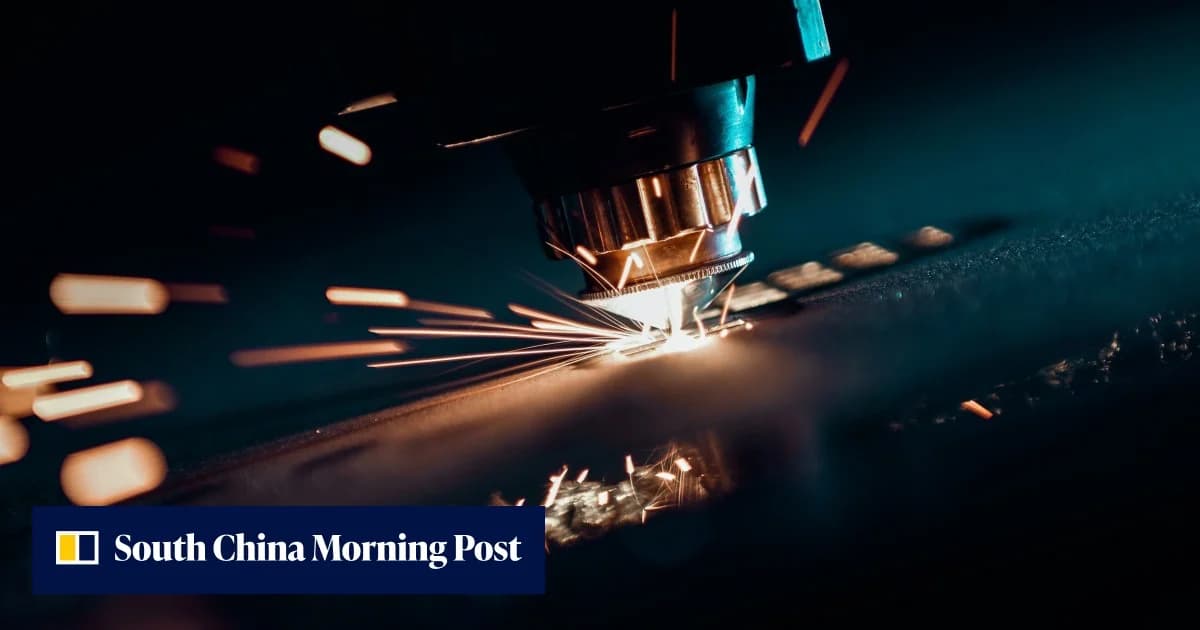
Chinese scientists have successfully performed the world's first precision laser cutting in orbit. Using a robotic arm attached to the exterior of the Tiangong space station, the team sliced a piece of "large-scale equipment." According to the official Science and Technology Daily, the laser maintenance device was operated remotely from "hundreds of kilometres away" to produce millimetre-scale cuts.
The Tiangong device was a joint development between the Shanghai Institute of Space Power-Sources and Huazhong University of Science and Technology (HUST). Researchers reported that the project moved from initial design to a flight-ready model in just one year. Professor Huang Yu, who led the HUST research team, told Science and Technology Daily that high-precision repair and regular maintenance are essential for the long-term operation of space stations.
To adapt ground-based laser processing for space, the team had to address challenges such as extreme space environments, achieving millimetre-level positioning, and executing micrometre-level precision cutting, Huang said. The device utilizes multi-axis positioning mechanisms and an advanced vision system. In a September social media post, HUST’s mechanical science and engineering school stated that "A multilevel vision system guides, identifies and positions the device, automatically completing high-precision laser cutting and waste material recovery." The school added that automated repairs on the Tiangong could extend its lifespan and establish a foundation for an in-orbit maintenance system.
The development of space-based laser technology has drawn scrutiny due to dual-use concerns, specifically the potential to damage, disable, or destroy other spacecraft. Both Beijing and Washington have pursued research into laser-weapons and directed-energy, leading to fears of an orbital arms race.
Other space agencies are also exploring laser applications for manufacturing and repair. In July, an abstract from the Marshall Space Flight Centre posted on Nasa’s STI research repository stated that laser systems can perform joining, cleaning, cutting, and repair activities. These capabilities could allow for the construction of large in-space structures that are too big for a single launch vehicle. The abstract noted that Nasa is working on projects including a compact vacuum welding chamber planned for the International Space Station and an autonomous robotic arm for simulated lunar welding. A 2020 Nasa report on space welding suggested that welding and additive manufacturing in space could make spacecraft repairs more economical by removing the need to ship new parts from Earth.
Regarding potential military applications, a report from last month by the US Defence Intelligence Agency alleged that China could deploy space-based directed-energy weapons by the late 2020s. The agency did not provide evidence for this forecast, nor did it specify if the devices would be laser-based or high-power microwave-based.