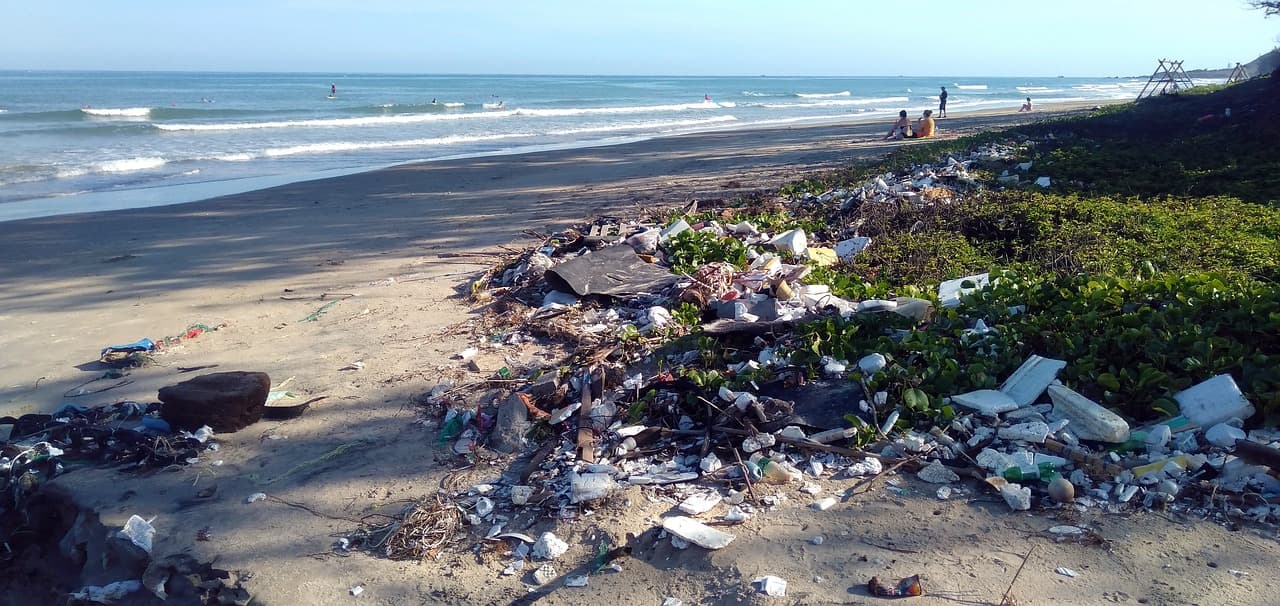
The ocean surrounding the Great Pacific Garbage Patch may be changing color due to the accumulation of microplastics. The patch, situated roughly midway between Hawaii and California, spans about 1.6 million square kilometres and is estimated to hold nearly 80,000 tonnes of plastic waste transported by currents. In certain areas near the surface, microplastic densities may reach up to 17 milligrams per cubic litre.
While the environmental impact on marine life is a primary concern, three separate datasets have revealed distinct changes in the water's color. Researchers noted that while global oceans are generally darkening due to factors like phytoplankton growth and agricultural runoff, the Great Pacific Garbage Patch is experiencing a different trend. Shea Cheatham of the University of Bergen, Norway, explains that ocean color is an indicator of its contents because it is formed by sunlight interacting with seawater and its contents. She notes that the specific circulation patterns of the garbage patch make it a likely site for microplastic accumulation dense enough to be detected from space.
Cheatham and her team analyzed three satellite datasets collected between 2002 and 2022. The findings showed that parts of the Great Pacific Garbage Patch experienced an approximate 10 per cent increase in blue light and a 2 to 4 per cent increase in green light over those 20 years. While the satellites did not all agree on the exact extent of the brightening in these colors—which combine to create cyan—all datasets confirmed that some brightening occurred.
To identify the cause, researchers used computer simulations to model how the water's color would change if microscopic plastic pieces were added versus natural elements like different types of micro-algae. Cheatham stated that brightening in both blue and green light is rarely produced by natural changes. Her simulations showed that including microplastic particles made the observed brightening pattern near the garbage patch more than four times as likely.
According to Cheatham, microplastic particles do not absorb much light but instead scatter it strongly. This scattering causes the ocean to brighten as plastic quantities increase, with the effect being most prominent at blue-green wavelengths.
Tim Smyth of the Plymouth Marine Laboratory in the UK clarified that while the team has shown the color change might be caused by microplastics, they have not actually proven it. Smyth described the findings as compelling evidence for a potential satellite signature of microplastic accumulation, rather than evidence that satellites have actually detected the microplastics themselves.