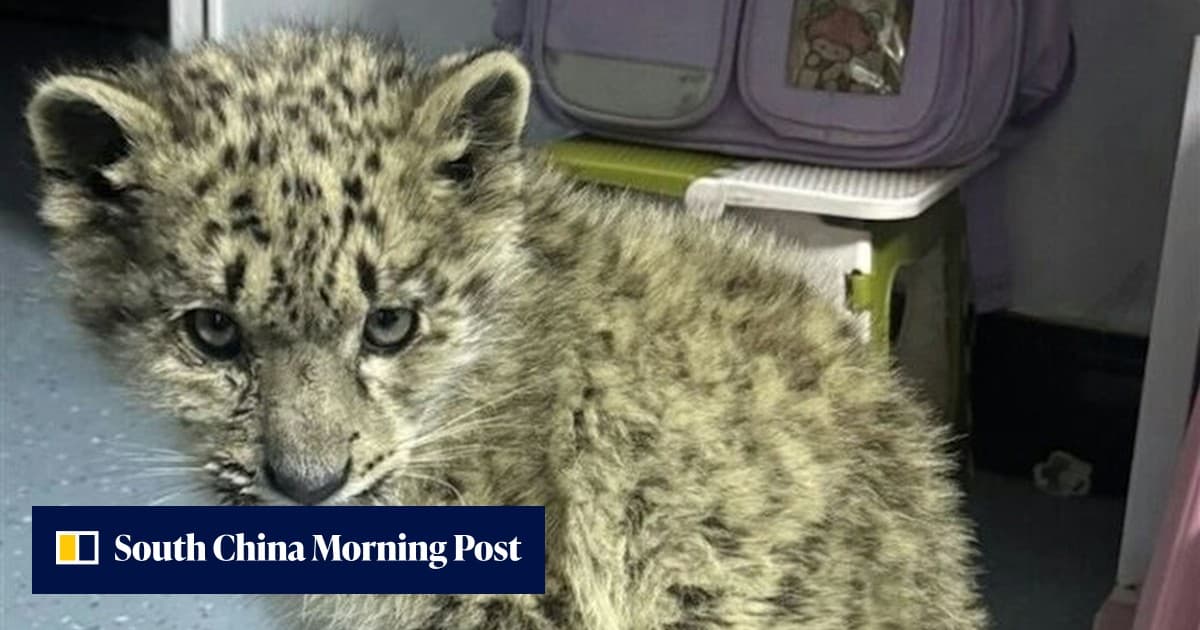
A beloved snow leopard cub named Ling Xiaohan died last Sunday after a 26-day fight for his life. The five-month-old cub was found weak, injured, and unable to move in the Qinghai Lake reserve on the Qinghai-Tibet Plateau.
The Qinghai Wildlife Rescue and Breeding Centre stated that the cub died from complications arising from a severe brain injury, though the cause of the injury remains unknown. On Monday, the centre expressed deep regret on the official social media account of its subordinate unit, Xining Wildlife Park, stating it was unable to save the cub and will conduct a comprehensive review of the rescue efforts.
The cub was first rescued by patrolling reserve rangers on October 6. Since then, the story has sparked a massive outpouring of mourning online, receiving more than 23 million views on social media in the days following his death.
Snow leopards hold first-class national protected status in China, the highest level of protection. The International Union for Conservation of Nature (IUCN) lists the species as vulnerable, meaning it is “considered to be facing a high risk of extinction in the wild”.
According to China Green Times, the affiliated newspaper of the National Forestry and Grassland Administration (NFGA), the Qinghai wildlife centre has rescued 15 snow leopards in 10 years, with three of those animals released back into the wild.
The cub's name followed a convention established in 2017. The centre gives rescued snow leopards the surname Ling to symbolize ice and snow and hopes for recovery. The second character is typically drawn from one of China’s 24 traditional solar terms based on the rescue date, while cubs receive the additional character Xiao, meaning “little”. Ling Xiaohan was named after the han lu or “cold dew” solar term, which occurred on October 8 this year, around the time he was rescued.
The centre uses social media to share stories of endangered animals to raise awareness. In early 2025, another rescued cub named Ling Xiaozhe went viral, garnering more than 10 billion views. Qi Xinzhang, head of the centre’s science education and external communications department, told Xinhua in May last year that this success was due to “Xining’s years of work in snow leopard rescue and breeding”.
Xining, the capital of Qinghai province, serves as a major conservation hub. The province is home to Sanjiangyuan, a region that serves as a source for the Yangtze, Yellow, and Lancang rivers. President Xi Jinping has emphasized the importance of ecological conservation in Qinghai, describing the province as shouldering “the important mission of safeguarding the country’s ecological security” during a June 2024 visit.
Since 2005, the principle that “lucid waters and lush mountains are invaluable assets” has guided China's balance of economic development and environmental protection. Qinghai Daily reported in 2025 that the province is home to an estimated 1,200 snow leopards, with wildlife populations showing signs of recovery.
In October, the NFGA stated that China’s snow leopard population doubled to around 5,000 animals from about 2,500 in 2013. China accounts for more than 60 per cent of the species’ global habitat. However, snow leopards face threats from climate change and human activities at elevations of up to 5,800 metres (19,000 feet). A 2016 IUCN assessment predicted that overall numbers could decline by 10 per cent over three generations despite growth in some countries. The United Nations’ Vanishing Treasures programme estimates fewer than 7,500 snow leopards remain in the wild across 12 countries in Central and South Asia.