LIVE Watch Now
Breaking
CPO Inspects Taxila and Wah Saddar Police StationsChinese firms raise funds for advanced display technologiesPunjab Increases Card Payment Tax, Claims 50% ReliefAustralian Labor Party Divided on AI Copyright LawsPakistan Secures Three Bronze Medals at International Physics OlympiadFinance Ministry Warns Against Misleading Reports on Sovereign BondsLe Pen Cleared to Run, Khamenei’s Funeral, Mbappé Scores WondergoalCDA Relocates Graves for Islamabad Road ProjectEngland to face Argentina in World Cup Semi-FinalKarachi Launches Safety Nets Under ManholesAtlanta officials face backlash for clearing unhoused people’s belongings near World Cup siteEx-Ethiopian Airlines CEO Tewolde Gebremariam Appointed as New PIA ChiefSouth Africa’s Jayden Adams Dies After Playing in World CupLinkedIn Dominates in AI-Generated ContentPunjab police arrest over 26,000 drug peddlersUkraine’s Zelensky proposes new PM in government reshuffleFamily bonding through gaming: A father’s perspectiveCritics slam bill allowing ex-legislators’ children blue passportsMcGregor’s UFC Return Ends in 69 Seconds Due to Knee InjuryUS Senator Lindsey Graham Dies After Sudden IllnessCPO Inspects Taxila and Wah Saddar Police StationsChinese firms raise funds for advanced display technologiesPunjab Increases Card Payment Tax, Claims 50% ReliefAustralian Labor Party Divided on AI Copyright LawsPakistan Secures Three Bronze Medals at International Physics OlympiadFinance Ministry Warns Against Misleading Reports on Sovereign BondsLe Pen Cleared to Run, Khamenei’s Funeral, Mbappé Scores WondergoalCDA Relocates Graves for Islamabad Road ProjectEngland to face Argentina in World Cup Semi-FinalKarachi Launches Safety Nets Under ManholesAtlanta officials face backlash for clearing unhoused people’s belongings near World Cup siteEx-Ethiopian Airlines CEO Tewolde Gebremariam Appointed as New PIA ChiefSouth Africa’s Jayden Adams Dies After Playing in World CupLinkedIn Dominates in AI-Generated ContentPunjab police arrest over 26,000 drug peddlersUkraine’s Zelensky proposes new PM in government reshuffleFamily bonding through gaming: A father’s perspectiveCritics slam bill allowing ex-legislators’ children blue passportsMcGregor’s UFC Return Ends in 69 Seconds Due to Knee InjuryUS Senator Lindsey Graham Dies After Sudden Illness
◕ SundialUpdated recently
Trending
Technology

Astronomers Discover Jupiter-Sized Planet Orbiting White Dwarf

Astronomers Discover Jupiter-Sized Planet Orbiting White Dwarf

Key Takeaways

  • WD 1856 b is the only known planet to have survived its star's death.
  • The James Webb Space Telescope provided new insights into this unique planetary system.
  • This discovery challenges our understanding of how planets interact with their stars.

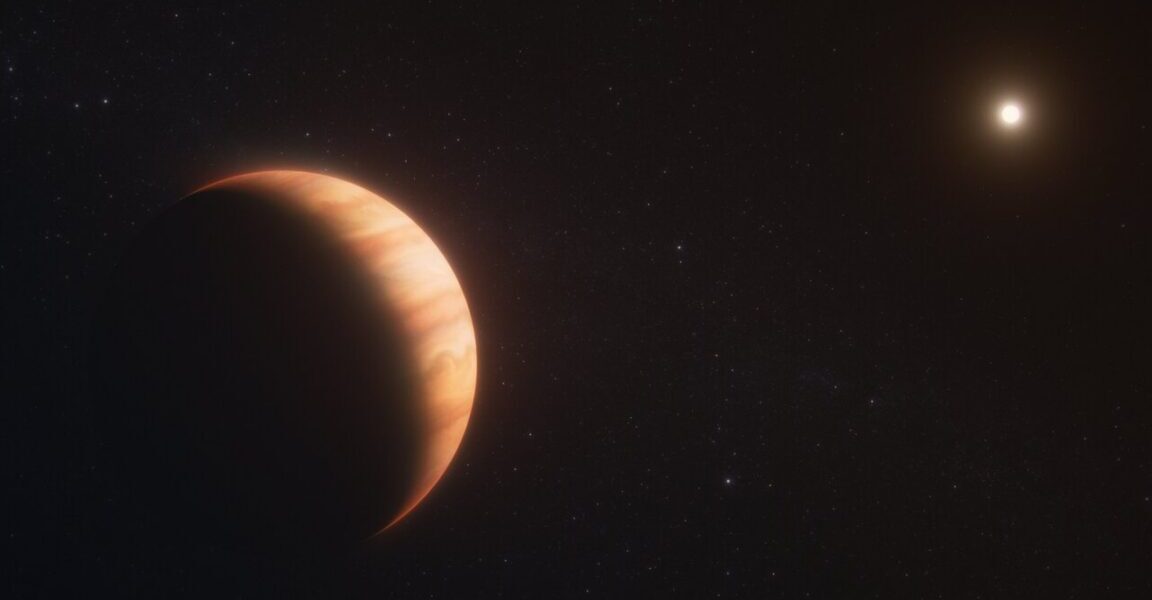
Astronomers using the James Webb Space Telescope (JWST) have made a groundbreaking discovery, confirming that WD 1856 b is not only the sole known planet to have survived its star's death but also the first Jupiter-sized world orbiting a white dwarf. This finding challenges existing theories about planetary survival in such extreme environments.

The initial detection of WD 1856 b was an accidental discovery made by the Transiting Exoplanet Survey Satellite (TESS) in 2020. TESS astronomers were surveying approximately 2,000 white dwarfs for signs of transiting objects like comets or asteroids. However, what they found in the WD 1856 system was a gas giant planet, which O’Connor described as “weird” upon first observation.

Christopher O’Connor, a theoretical astrophysicist at Cornell University and co-author of the recent Nature study on WD 1856 b, explained that this discovery is particularly intriguing because white dwarfs are remnants of Sun-like stars that have exhausted their nuclear fuel. These stars typically leave behind an Earth-sized core composed mainly of carbon and oxygen. The presence of a Jupiter-sized planet orbiting such a star suggests a complex interaction between the two.

The James Webb Space Telescope’s observations provided new data on WD 1856 b, revealing that it orbits extremely close to its white dwarf host, at just one-tenth the distance from Earth to the Sun. This proximity raises questions about how the planet managed to avoid being consumed by the star during its red-giant phase.

The discovery of WD 1856 b challenges our understanding of planetary systems and their evolution. It suggests that planets can survive in environments previously thought inhospitable, potentially offering new insights into the long-term stability of exoplanets.

Further research is needed to understand the mechanisms by which such a planet could have survived its star's death. O’Connor noted that this discovery opens up new avenues for studying planetary systems and their interactions with stellar remnants.

As soon as they looked at it, they said, okay, that’s weird.

Christopher O'Connor, Theoretical astrophysicist at Cornell University