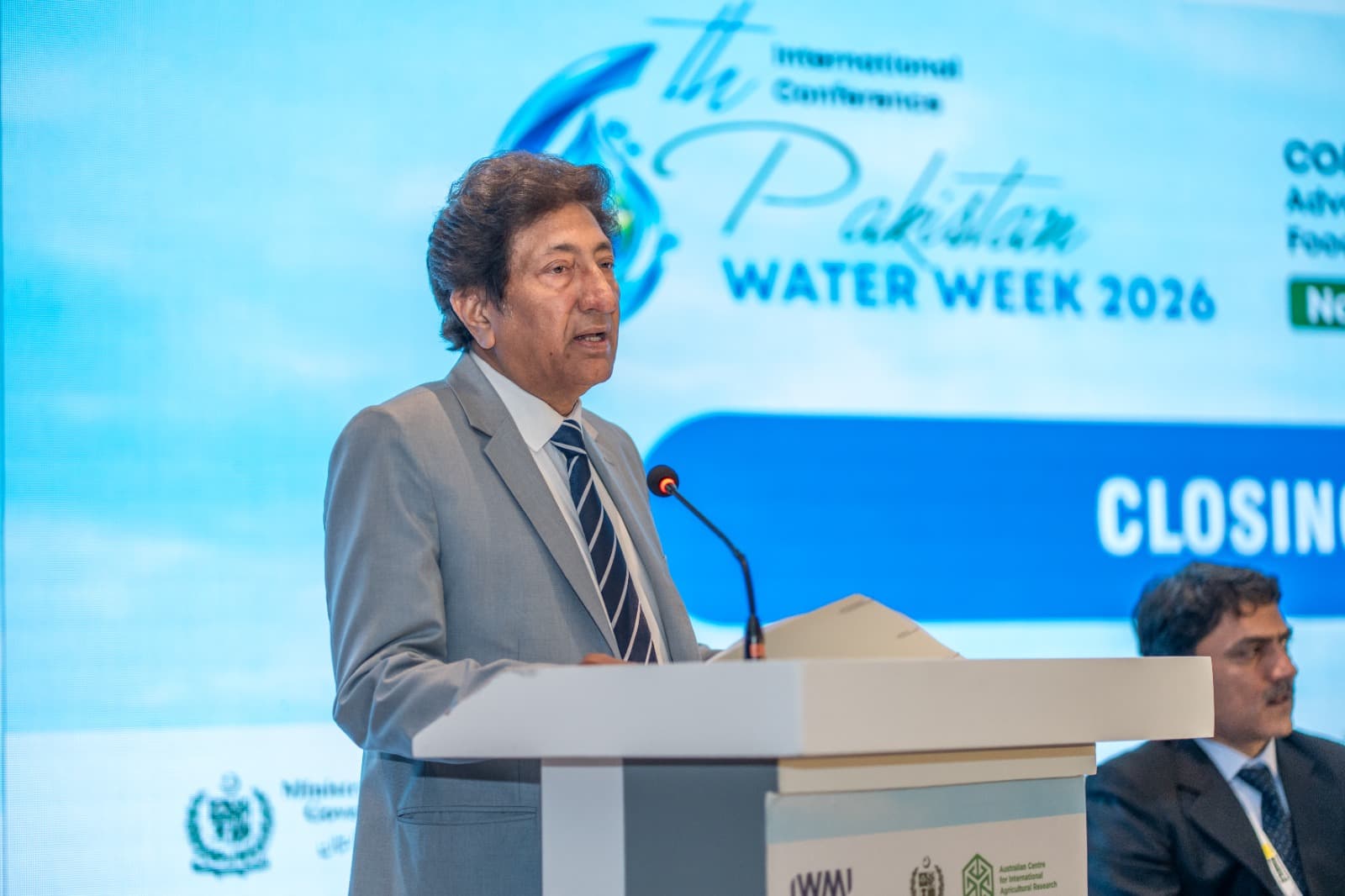
The sixth Pakistan Water Week (PWW 2026) concluded in Islamabad with a message to stakeholders and the international community that the period of generating knowledge about Pakistan’s water challenges must transition into measurable, accountable, and coordinated action. The conference, held under the theme “Commitments to Action: Advancing Water Security and Climate-Resilient Food Systems in Pakistan,” featured 26 sessions with approximately 350 in-person and over 800 online participants.
The event was organized by the International Water Management Institute (IWMI) and the CGIAR Policy Innovations Science Program, in collaboration with Pakistani government institutions and development partners including UNICEF, ACIAR, ICIMOD, EU, and FAO, according to a press release issued on Friday.
At the closing ceremony, Federal Minister for Water Resources Mian Muhammad Mueen Wattoo stated that the Government of Pakistan is committed to pursuing water security through lawful, peaceful, and evidence-based means. Wattoo praised the IWMI and its partners for creating a platform that moves beyond diagnosis and urged the organizers to convert conference recommendations into practical programs with clear indicators. He identified four implementation priorities: assigning explicit responsibility for putting water policy into practice, judging water infrastructure by its performance, linking water investment to agricultural productivity, and protecting water quality while managing surface water and groundwater together. He also committed to measuring progress over the next year regarding water service reliability, farmer benefits, and community protection.
Johan Gély of IWMI, presenting the synthesis of Thematic Area 1, “Policy to Practice,” stated that Pakistan possesses the necessary policy architecture but lacks the institutional mechanisms, accountability structures, and evidence-integration systems to deliver on it. Gély called for a shift from fragmented initiatives to coordinated governance, from evidence generation to evidence-informed decisions, and from reactive spending to preventive investment. His priorities included a legal framework for groundwater governance, updated hydrological assessments and design standards, increased use of nature-based solutions, and structured roles for young people in water governance, including a proposed youth innovator prize.
Dr. Claudia Ringler of the International Food Policy Research Institute (IFPRI) presented the synthesis for Thematic Area 2, “Innovation to Impact.” She stressed that innovation without inclusion falls short of true impact, emphasizing that solutions must be designed with and for women, smallholder farmers, and marginalized communities. She called for national data governance frameworks to enable cross-agency data sharing, investment in capacity and data infrastructure for artificial intelligence and digital tools, and reform of subsidy, credit, and extension systems to help climate-smart irrigation reach scale.
Mohsin Hafeez, Strategic Programme Director, Water, Food and Ecosystems, IWMI, delivered the vote of thanks and described Pakistan Water Week as a commitment to action rather than an end in itself. He highlighted the necessity of government leadership in translating policies into measurable results and reaffirmed the long-term partnership between IWMI and CGIAR in Pakistan’s water security journey. IWMI plans to document progress against the conference recommendations over the coming year and report it at Pakistan Water Week 2027.
Participants agreed on follow-up priorities including stronger coordination across federal and provincial water, agriculture, energy, and disaster management institutions, measurable indicators for water service reliability, agricultural productivity, groundwater levels, and community resilience, and regional cooperation on cryosphere risk in the upper Indus Basin.