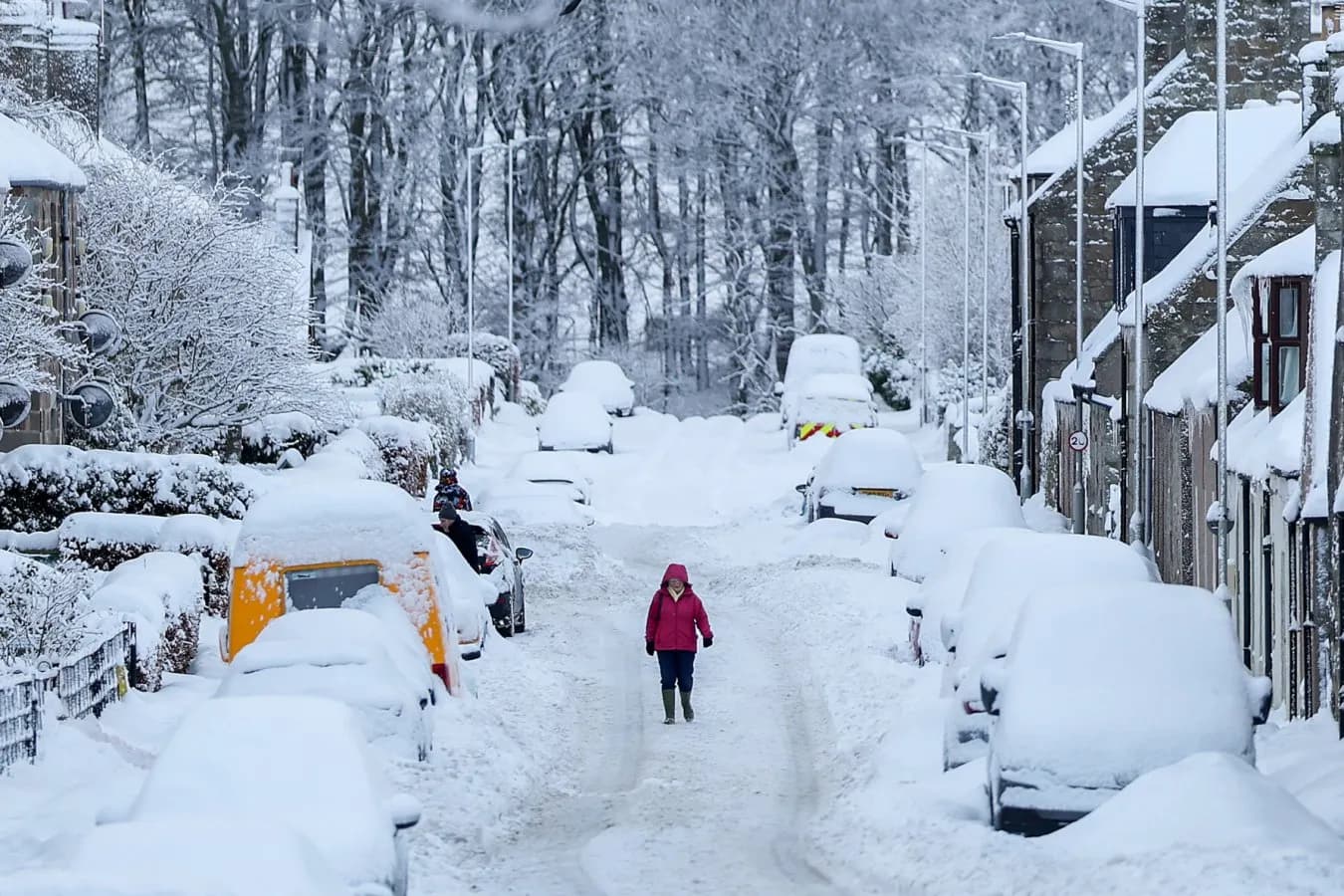
The polar vortex has experienced an unprecedented early breakdown, a phenomenon that threatens Europe with snow and cold weather. While the vortex typically strengthens in winter and weakens in spring, it collapsed on 10 November, with winds reversing to blow weakly from the east. This marks the earliest such collapse since weather balloon records began in the 1950s, breaking the previous record by 18 days.
Adam Scaife at the Met Office, the UK’s weather service, suggests that the record super El Niño may be responsible for accelerating the vortex's weakening. He explains that as trade winds weaken during El Niño, a low-pressure center of warm rising air moves eastward, creating extra waviness in the jet stream. These waves can move upward into the stratosphere. Scaife describes how these waves carry easterly momentum and crash into the polar vortex. “When they dump that momentum, they push the polar vortex against its flow, and they weaken it,” Scaife said.
However, Scaife noted that while he suspects an El Niño influence, it is not proven. “There probably is some kind of El Niño influence on it,” he said. “That would be my suspicion, but we don’t know that for sure.”
Other experts offer a different perspective on the cause. Andrew Charlton-Perez at the University of Reading, UK, suggests a high-pressure “blocking” system over Scandinavia in recent weeks may be the primary driver. This system blocked the jet stream and caused large meanders, which could have weakened the vortex through the same wave-breaking process regardless of El Niño. “I would be wary of saying it was caused by El Niño,” Charlton-Perez said. “I would say the blocking high is probably more important.”
While the current reversal of the polar vortex is not linked to the present cold weather in the UK, it could lead to more severe conditions in the coming weeks. A breakdown, also known as a sudden stratospheric warming event, occurs when high-level air rushes over the north pole, increasing pressure and temperature. This can cause cold surface-level air to descend into northern Europe. Such an event preceded the 2018 “Beast from the East” cold snap, which killed 10 people.
Scaife warns that while the vortex is expected to strengthen toward the end of November, it could break down again. “The risk of cold easterlies this winter is increasing,” he said.