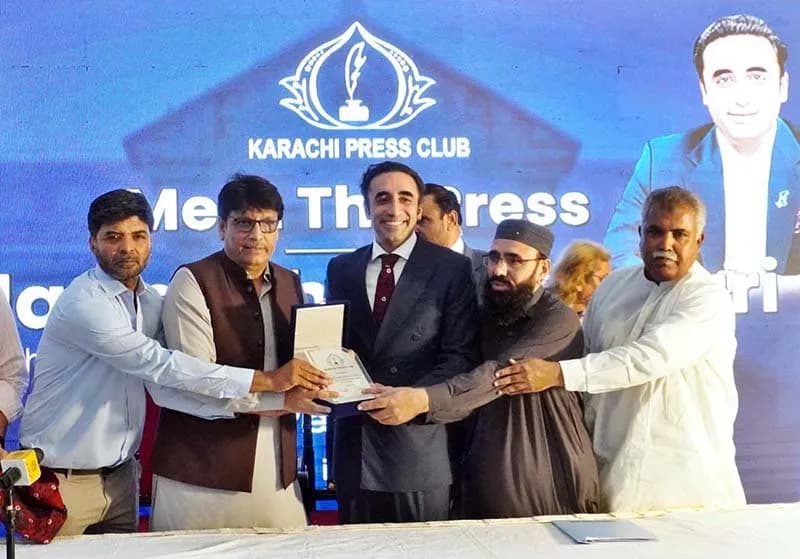
Pakistan Peoples Party (PPP) Chairman Bilawal Bhutto-Zardari accused federal ministers of being unwilling to tolerate criticism and lacking the courage to hear the truth regarding the proposed division of Sindh. Speaking on Wednesday night, November 18, 2026, Bhutto-Zardari responded to a series of statements made by federal ministers earlier that day.
"It appears they [federal ministers] have decided to pick a fight with me for speaking the truth. The reaction [to his remarks] shows they are unwilling to tolerate criticism," Bhutto-Zardari said. He questioned how ordinary citizens could expect their voices to reach the government if politicians were unwilling to listen to him.
Earlier that day, federal ministers strongly criticized Bhutto-Zardari's opposition to the proposed division of Sindh. They argued that creating smaller provinces was necessary for better governance and that public opinion should prevail. Defence Minister Khawaja Asif stated that no political system could be changed without public support, while Federal Minister for Health Mustafa Kamal described smaller provinces as inevitable, claiming the country could not function effectively without them. Other ministers, including Talal Chaudhry, also questioned Bhutto-Zardari's stance, pointing to the PPP's position on the division of Punjab and arguing that democracy required effective governance, not merely political speeches and constitutional arguments.
Bhutto-Zardari stated he was offering suggestions as a major stakeholder to improve the situation and urged political leaders to exercise caution. He claimed the discussion on new provinces began without consulting the prime minister, any minister, or other political stakeholders. “If you have initiated this debate, have the courage to hold it openly. It cannot be conducted through your own selected people, with everyone else expected to agree or remain silent,” he said.
The PPP chairman argued the discussion should focus on fundamental problems rather than just new provinces. He questioned who had the authority to declare the system had collapsed and needed a reset, asking, “Does the PCB chairman have the authority to say that the system has collapsed? Has the responsibility for deciding on a reset been handed to the PCB?”
Referring to the 1980s and 1990s, Bhutto-Zardari noted that attempts were made to create divisions in Sindh at that time. He warned that the risk remained and stated his earlier remarks were a warning, not a threat. “I was sounding the alarm, not issuing a threat. I was warning about the consequences if such a move was forced through,” he said, adding that coercion could trigger unrest.
Regarding constitutional reforms, Bhutto-Zardari described the establishment of a constitutional court under the 27th Amendment as a historic achievement and said he would not backtrack on it. He clarified he was not calling for the amendment or constitutional courts to be abolished. He proposed returning reserved seats to the opposition as a way to restore trust in a democratic reset, noting it was a suggestion and not a red line. “If we want to make a start, this is where we can begin,” he said, adding that the PPP had supported the government even when those seats were not held by the party.
Bhutto-Zardari questioned why his proposals were drawing criticism if a decision on creating new provinces had already been made. “I would remind the government that the power to say 'Be, and it is' belongs only to Allah,” he said.
Despite reservations about the government's treatment of coalition partners, Bhutto-Zardari said he continued to support the government and wanted Prime Minister Shehbaz Sharif to succeed. He noted the public's main expectation is a solution to economic problems. He also questioned if the PPP's future depended on holding the offices of governor or Senate chairman. Referring to PTI founder Imran Khan, Bhutto-Zardari asked if Khan could not be considered a political prisoner while being both a politician and an inmate. “I find it difficult to accept that every prime minister of this country is a thief. I want to see a day when someone becomes prime minister of Pakistan and does not end up in jail,” he added.