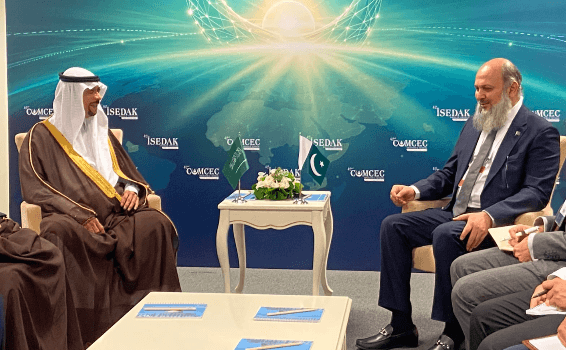
Federal Minister for Commerce Jam Kamal Khan held a series of bilateral meetings in Istanbul, Türkiye, on the sidelines of the 42nd Session of the Standing Committee for Economic and Commercial Cooperation (COMCEC). The meetings were held with representatives from Saudi Arabia, Egypt, and Tunisia to focus on strengthening economic relations, expanding trade and investment, and promoting joint ventures and industrial cooperation.
During a meeting with Mr. Fareed S. Alasaly, Deputy Governor for International Organizations and Agreements of Saudi Arabia, both sides agreed to further strengthen cooperation in agriculture and industrial development. Specific areas of focus included human resource development, livestock, and food security. Jam Kamal Khan emphasized the importance of finding new avenues for mutually beneficial joint ventures between Pakistani and Saudi companies. He proposed partnerships between leading businesses of the two countries to explore emerging trade opportunities in African markets. The Commerce Minister also stressed the need for greater institutional and private-sector engagement to translate economic potential into practical business partnerships. He invited the Saudi representative to visit Pakistan during the upcoming FoodAg exhibition to explore opportunities in agriculture, livestock, and food-related industries.
In a separate meeting with Egypt’s Minister of Investment and Foreign Trade, Mr. Mohamed Farid Saleh, Jam Kamal Khan discussed opportunities to enhance bilateral trade, investment, and industrial cooperation, particularly in the cotton and textile sectors. Mr. Mohamed Farid Saleh highlighted investment opportunities in Egypt and encouraged Pakistani companies to explore manufacturing and industrial partnerships. The Egyptian Minister drew attention to Egypt’s preferential trade arrangements with the United States, which offer opportunities for Pakistani investors to establish manufacturing operations in Egypt and access the American market, subject to applicable trade requirements. Mohamed Farid Saleh also requested details of Pakistani companies expected to participate in the upcoming business forum to facilitate direct engagement between the business communities and identify potential investment partnerships. Furthermore, the Egyptian Minister highlighted educational opportunities for Pakistani students in Egypt, particularly in science, technology, medicine, healthcare, and engineering, noting the availability of educational facilities at competitive costs. Jam Kamal Khan emphasized the need to develop joint ventures between Pakistani and Egyptian private-sector companies and explore opportunities in textiles, manufacturing, and other mutually beneficial sectors. He stressed that closer business-to-business engagement and stronger institutional linkages could help both countries expand their commercial partnerships and explore new international markets.
Meanwhile, during a bilateral meeting with Tunisia’s Minister of Trade and Export Development, H.E. Samir Abid, Jam Kamal Khan discussed possibilities for enhancing bilateral trade and exploring new avenues of economic and industrial cooperation between Pakistan and Tunisia. Both ministers acknowledged that the existing volume of bilateral trade remains significantly below its true potential and emphasized the need for coordinated efforts to identify new opportunities and strengthen commercial linkages between the two countries. The discussions focused on expanding cooperation in agriculture, minerals, textiles, auto parts, and manufacturing, with both sides recognizing considerable opportunities for mutually beneficial partnerships in these sectors. Jam Kamal Khan emphasized that Pakistan and Tunisia could benefit from each other’s experience, technical expertise, and industrial capabilities in specialized sectors. He highlighted the importance of sharing knowledge, adopting improved production practices, and encouraging joint ventures to enhance productivity and competitiveness. Both ministers agreed on the importance of closer institutional coordination and greater private-sector engagement to unlock untapped trade potential and translate identified opportunities into practical economic partnerships.
The Commerce Minister reiterated Pakistan’s commitment to strengthening economic relations with brotherly and friendly countries through enhanced trade, investment, industrial cooperation, knowledge sharing, and greater private-sector participation. The bilateral engagements on the sidelines of COMCEC reflected Pakistan’s continued efforts to strengthen economic diplomacy, diversify export markets, attract investment, and promote mutually beneficial economic partnerships with countries across the Middle East, North Africa, and beyond.