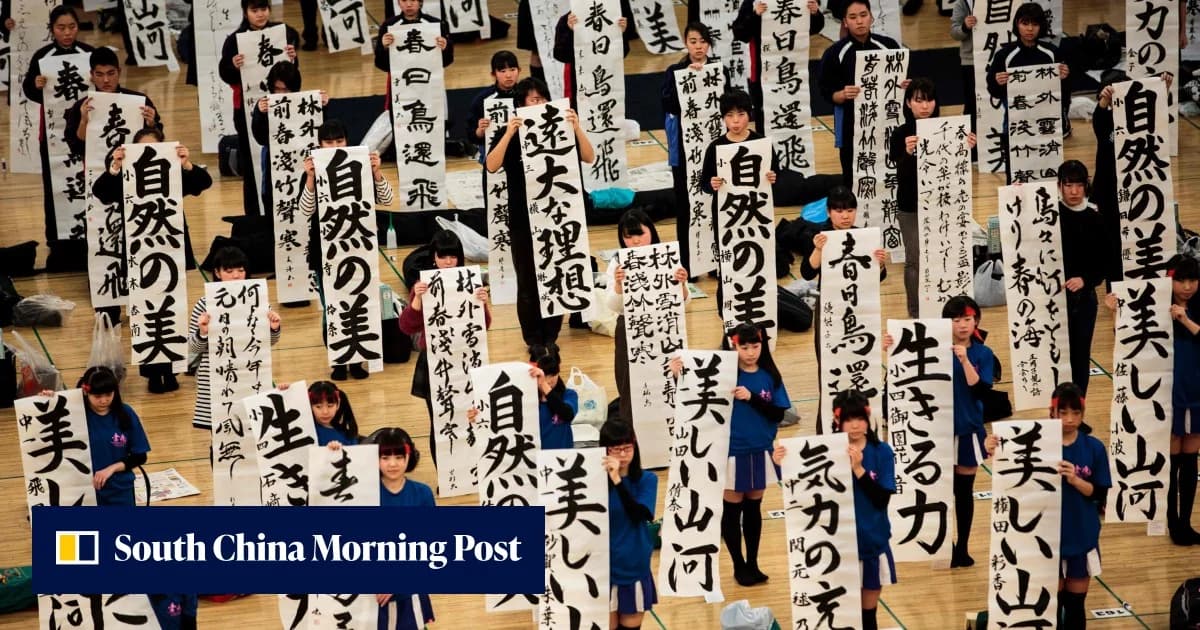
Japanese Prime Minister Sanae Takaichi has been criticized on social media for celebrating Japan’s shodo calligraphy while failing to acknowledge its origins in China.
The backlash followed a post by Takaichi on Thursday, where she expressed her delight that shodo was nominated for inclusion on Unesco’s Representative List of the Intangible Cultural Heritage of Humanity. Among the 59 nominations released by Unesco that day were Chinese cuisine, Spain’s traditional jota music and dance, and shodo.
Takaichi wrote that she was pleased shodo “has been recognised as worthy of being passed down to future generations as a Unesco intangible cultural heritage.” She described the art as a “precious Japanese cultural practice” that uses traditional brush techniques and tools like inkstones and paper to express thoughts and emotions.
Social media users responded to the post by pointing out the art's history. One top reply stated, “The brush, ink, inkstone and paper all originated in China. I suggest you study history more.” Another user commented that trying to register a culture derived from China as Japanese heritage without any shame was something they were "done" with.
According to Japan’s Agency for Cultural Affairs, Japan did not have its own writing system before Chinese characters were introduced from China around the 4th and 5th centuries. While exchanges continued for centuries, the Tokyo National Museum notes that Japanese calligraphers helped establish a distinct local style by the 10th century.
Shodo was registered as an intangible cultural property in Japan in 2021, and the Agency for Cultural Affairs selected it as a candidate for Unesco nomination in 2023. At that time, the Chinese state-run newspaper Global Times reported that the move drew criticism from those questioning the necessity of the nomination since Chinese calligraphy was already inscribed on the list in 2009.
Unesco’s list currently contains 849 elements from 157 countries. The Unesco Intergovernmental Committee for the Safeguarding of the Intangible Cultural Heritage is scheduled to decide on this year’s inclusions during a session in Xiamen, China, from November 30 to December 5.