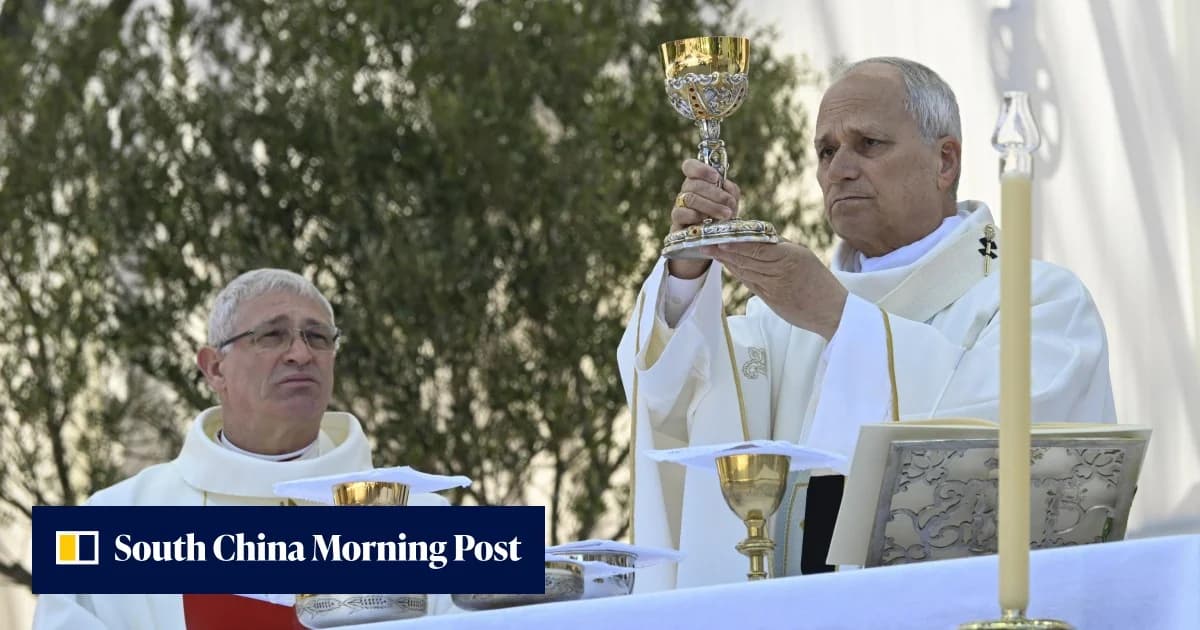
Pope Leo XIV concluded his visit to Uruguay on Sunday, traveling to the city of Florida to celebrate the feast of the Virgin of the Thirty-three. This marked the first time a pope had visited Uruguay in nearly four decades. During his homily at Florida’s cathedral, Leo emphasized the Catholic Church's role in the nation's identity, despite Uruguay's shift toward a secular and sometimes anticlerical society.
Leo praised mothers and grandmothers for passing down the faith to younger generations, acknowledging their pain when those efforts fail. He told them, “You taught your children to pray and today they no longer do so. You used to attend mass together and it has been years since they entered a church,” but urged them to continue passing on the faith.
The Vatican estimated that 50,000 people attended the mass in Florida, a city with a population of approximately 40,000. Among the crowd was Fiama Pirez, an English professor from Montevideo, who traveled to Florida so her mother could fulfill a dream of seeing a pope. Pirez stated she is "rediscovering" her faith today.
The Pope is now heading to Argentina for the second leg of his South American tour, which is expected to be the most politically delicate stop. The Catholic Church has voiced sharp criticisms of President Javier Milei’s austerity program, which has significantly reduced social spending. Milei has described social justice as “an aberration” and mocked complaints about the economic squeeze on families as “huge stupidity.”
In Argentina, Leo is expected to meet Milei at the airport for a traditional welcome ceremony and exchange of speeches. The Pope, who focuses on the poor and vulnerable, has warned that the artificial intelligence race poses threats to humanity and the environment, calling for strict international safeguards. This contrasts with Milei’s government, which has courted AI investment with promises of limited regulation.
The trip also serves to complete unfinished business left by Pope Francis, who never returned to Argentina during his 12-year pontificate. David Lantigua, a theology professor at the University of Notre Dame’s Kellogg Institute, noted that much of the tension stems from Francis's time as a slum priest advocating for the marginalized—the same group most affected by Milei’s cuts. Lantigua suggested that Leo will face similar tensions as he carries on Francis's ministry.
According to official data, poverty in Argentina reached 32.3 per cent of the population during the first half of 2026, representing about 15 million people. Milei’s government maintains that cuts are necessary to reform the economy and eliminate waste. Karina Milei, the president’s sister and secretary general of the presidency, told reporters that the papal trip is purely religious, stating, “The pope belongs to all Argentines. He doesn’t belong to a political party or a political camp.”
Security concerns have been noted, as Argentina’s state intelligence agency reported on Saturday that a person was arrested over death threats against Leo. A federal court in Campana ordered the arrest less than 24 hours after the agency was tipped off, it said, without elaborating.