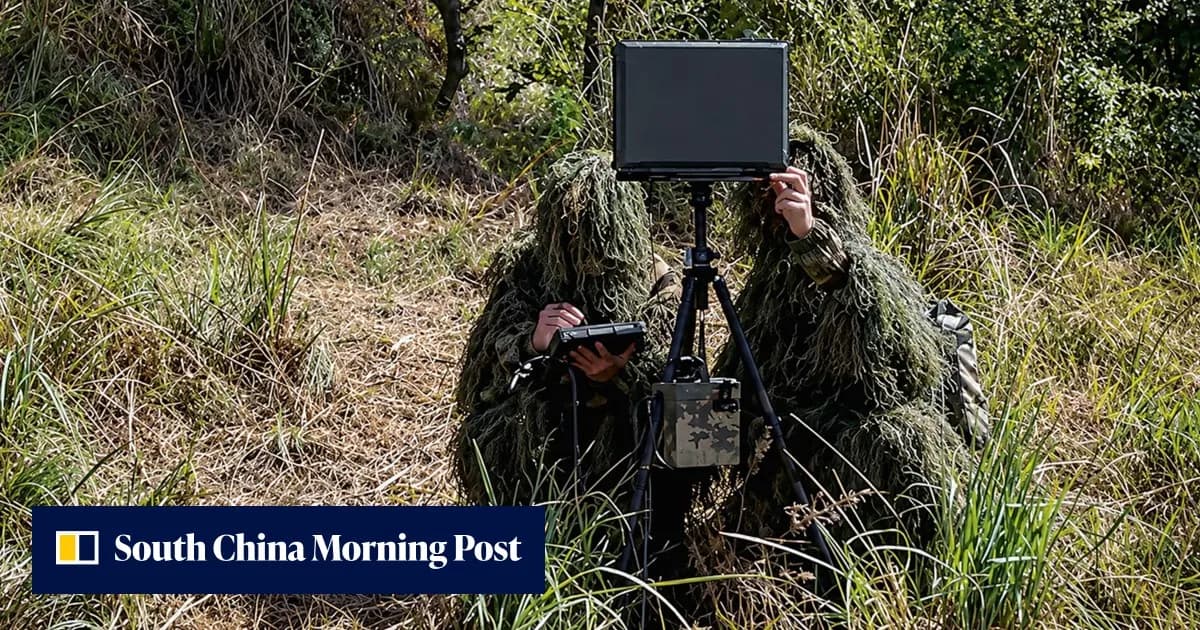
Chinese infantry units are adapting to the growing threat from drones by introducing compulsory counter-drone training, new equipment, and fresh tactics to help soldiers evade aerial surveillance and attacks. A brigade of the People’s Liberation Army’s (PLA) 75th Group Army has made such training mandatory following an exercise that exposed how troops relying on traditional camouflage were vulnerable to drone-directed artillery strikes.
According to a report published by the state-run PLA Daily on Monday, a drone equipped with thermal imaging sensors spotted infantrymen concealed beneath jungle vegetation and transmitted their positions to an opposing artillery unit, resulting in heavy simulated casualties and mission failure. This result prompted the brigade to introduce new instructional manuals and tactical exercises, as well as develop dedicated counter-drone training facilities, including simulation rooms. The report said that subsequent training focused on detecting and disrupting hostile drones, using specialised weapons and coordinating infantry responses, while requiring officers to show proficiency in counter-drone equipment and tactics.
Based in southwestern China, the 75th Group Army belongs to the Southern Theatre Command, which the Pentagon’s 2025 report on China’s military states would support the Eastern Theatre Command in a Taiwan contingency. While the PLA Daily report did not identify the specific brigade or link its training to Taiwan, official accounts describe counter-drone preparations across at least four of the PLA’s five theatre commands, including Eastern Theatre Command formations. These ground units are working to defend against drones, improve concealment against aerial surveillance, and integrate uncrewed systems and counter-drone equipment.
Other specific training measures reported by state media include:
In August, the PLA Daily reported a 71st Group Army brigade ordered compulsory training on how to conceal heat sources and lights at night, including covering the hot parts of rocket launchers.
In October, Xinhua reported a 72nd Group Army amphibious armoured company under the same command worked with multiple manufacturers to improve its use of uncrewed systems and counter-drone equipment.
CCTV and the defence ministry described 78th Group Army troops training to evade reconnaissance drones, while 81st Group Army reconnaissance troops used insulating blankets, damp soil and turf to reduce the heat signatures that could reveal their positions to drones.
Dennis Blasko, a former US Army attache in Beijing, said the PLA was developing counter-drone weapons, doctrine and training “throughout the entire force” rather than just in selected brigades. He noted that Chinese manufacturers have produced handheld and vehicle-mounted counter-drone systems and detection equipment, while individual formations are experimenting with their own solutions, including protective cages fitted to armoured vehicles. However, Blasko warned that so many units conducting their own testing could result in “a lack of standardised procedures and time lost [through duplicated efforts]”.
Colin Karotam, a senior resident fellow at the Australian Strategic Policy Institute, said counter-drone training was probably spreading beyond the units identified, although he lacked “clear evidence of this”.
The risk from drones could be particularly high in a Taiwan conflict, with PLA forces exposed to threats while assembling on the mainland, crossing the strait, and establishing positions ashore. Taipei has proposed acquiring up to 208,200 coastal-attack drones, including more than 40,000 targeted for 2027. The purchases remain subject to funding decisions, with lawmakers proposing cuts and freezes to supplementary defence spending, including drone procurement, ahead of a final vote expected later this month.
Washington is also expanding its investment in uncrewed warfare. Its “Hellscape” concept envisages using large numbers of uncrewed systems to disrupt a Chinese military operation against Taiwan, while the Pentagon’s Replicator initiative was launched to accelerate the deployment of thousands of autonomous systems. A separate US$1 billion Drone Dominance programme aims to acquire more than 200,000 small attack drones by 2027. Japan also plans to deploy relatively inexpensive attack drones and other uncrewed systems under its Shield coastal defence initiative, with further drone purchases expected as Tokyo considers a five-year defence budget of up to 80 trillion yen (US$508 billion) from April 2027.
Timothy Heath, founder of defence consultancy Perceptum, said drones would be “absolutely essential” in a Taiwan conflict. He stated, “The danger is perhaps greater for China because troops crossing an open body of water are highly vulnerable.” Heath warned that Taiwanese drone swarms – potentially reinforced by uncrewed systems operated by foreign militaries intervening in the conflict – could “overwhelm defences on board ships,” while PLA troops reaching shore could remain exposed to further strikes. He noted that Taiwanese and other troops could conceal their positions before hostilities, potentially making them harder for mainland Chinese drones to detect and target.
In a June analysis for the Modern War Institute, Joshua Arostegui, research director of the US Army War College’s China Landpower Studies Centre, argued that adding heavy armour to the PLA’s high-speed Type 05 amphibious vehicles could undermine the buoyancy and speed needed to cross contested waters. He described a broader approach involving uncrewed aircraft and vessels operating ahead of amphibious forces, electronic warfare, decoys and networked operations rather than relying on vehicle armour alone. Arostegui noted his analysis included proposed concepts and emerging systems, not evidence that the entire protective architecture had been fielded.
Blasko warned that applying lessons from individual units consistently across the force could take time as drone threats evolve, stating, “It may take a few years to standardise doctrine and allow it to be flexible enough to adapt to new technologies.”