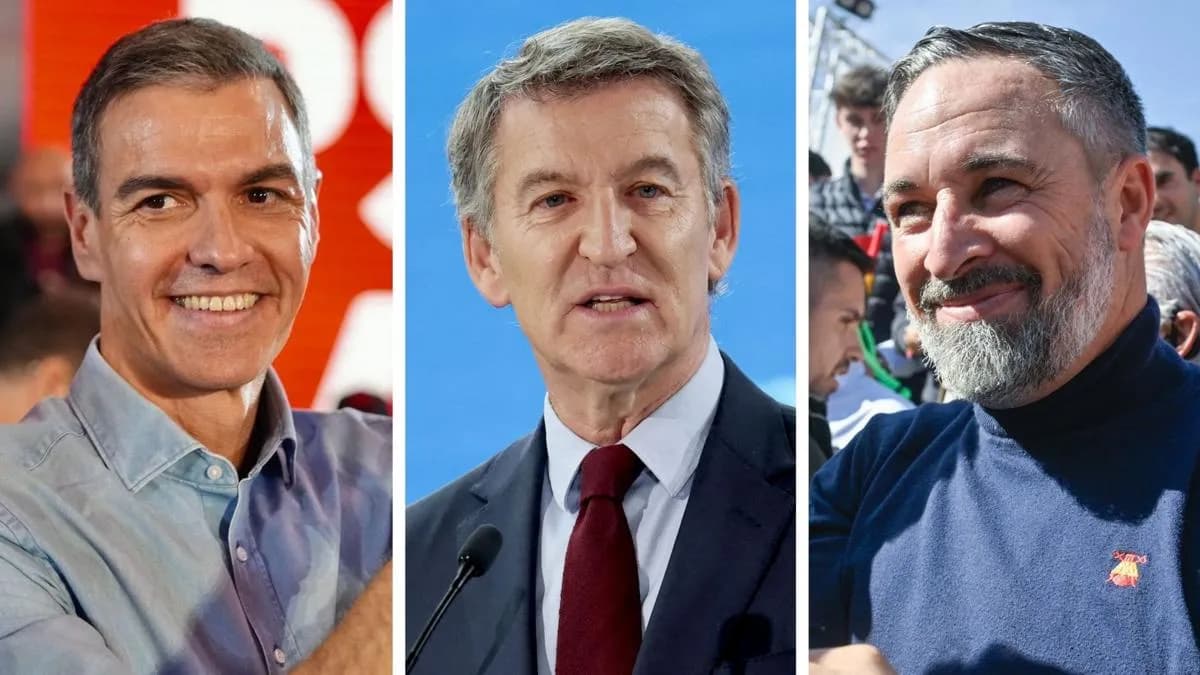
Spanish voters are set to head to the polls on 29 November for a snap election, with conservative and far-right parties positioned as the favorites to end eight years of Socialist-led rule under Pedro Sánchez. While the government intended to focus on the nation's housing crisis, it has been hampered by corruption scandals, a migrant crisis in the Ceuta exclave, and two rail disasters, the most recent of which killed 69 people at Urda on 28 October.
Alberto Núñez Feijóo, leader of the People's Party (PP), is currently the favorite to become Spain's next prime minister, topping most polls as the leader of the conservative opposition since 2022. Feijóo, who served as president of the north-west Galicia region from 2009 to 2022, is campaigning on his reputation as a capable administrator. "It's called management: and it's what I know how to do, it's what I want to do, and it's the change Spain needs," Feijóo told voters.
Feijóo has stated that the best outcome for the country would be a PP majority governing alone, potentially with support from the far-right party Vox. While his party has worked in coalition with Vox in four regions, he has not ruled out a national coalition under strict conditions and red lines. Despite his lack of international recognition and English proficiency, Feijóo maintains that the "enormous problems" faced by Spaniards are of greater importance: "I don't know English, but I know how to govern."
Pedro Sánchez, who has led the Socialists for 12 years and served as Spain's prime minister since 2018, called the snap election eight months early. He is seeking "an epic comeback of a progressive Spain" at the ballot box. However, his campaign faces significant hurdles, including graft cases against his inner circle and family. Former transport minister José Luis Ábalos is currently serving a 24-year prison sentence for accepting kickbacks, while leading party figure Santos Cerdán awaits trial for alleged bribery. Additionally, Sánchez's wife, Begoña Gómez, faces trial over allegations of influence peddling and embezzlement, and his brother, David Sánchez, is banned from public office for nine years for misconduct.
During the Socialist campaign launch, Begoña Gómez gave her first party speech, calling for the backing of Spanish women "because when women step forward, all of Spain follows".
The rise of Santiago Abascal and his populist Vox party could seal Sánchez's fate. Abascal, 50, has moved Vox into the mainstream, focusing on "remigration" of foreigners who do not contribute to Spain. He has accused Pedro Sánchez of promoting an "act of invasion" with his policies. Abascal has promised to use the Spanish navy to defend the national borders and "send a message to the world that there is no room here for all of Africa and all of the Americas".
Other significant figures include Ada Colau, who heads the left-wing Frente Amplio coalition, and Míriam Nogueras of the pro-independence Junts per Catalunya. Junts played a pivotal role in supporting Sánchez's government, and it was their decision to reject housing proposals last month that pushed the Socialist leader to call the election.
Within the People's Party, Isabel Díaz Ayuso, president of the Madrid region since 2019, remains a highly influential figure known for her direct communication style. On the Socialist side, Carlos Cuerpo, the interim transport minister, has been ranked as the best-regarded politician among the Spanish public by the Centre for Sociological Research (CIS). Sánchez described the political landscape by stating: "I believe politics is a team sport; on the opposing team we have Feijóo and Abascal, and on my team we have Carlos Cuerpo."