A key section of the 12-mile-long Crimean Bridge has collapsed into the Kerch Strait following a seven-stage operation by Ukrainian forces. The double-arched structure, which serves as a prestige project for Russia and a symbol of occupation for Ukraine, suffered a fatal blow to its main road arch, which weighed thousands of tonnes and measured about 227m in length.
President Volodymyr Zelensky confirmed on Tuesday that the attack was carried out gradually to cut across several layers of defence. For several weeks, Ukraine's Security Service and its General Staff phased out air defence systems, radars, electronic warfare assets, and other designated targets.
A significant strike was reported on 16 November, when drones hit the bridge at night. Traffic was paused briefly then reinstated, and although the arch over the road section was visibly damaged, the structure remained standing. This hit was the penultimate stage of a complex attack.
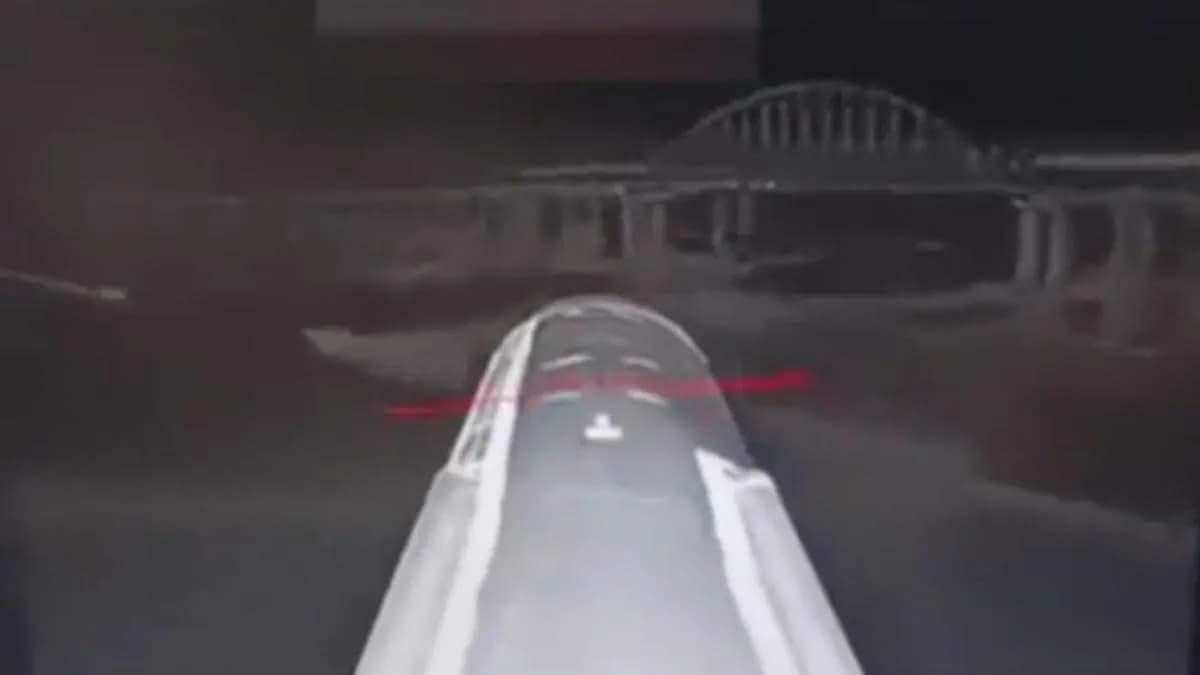
In the early hours of 17 November, the final strikes dealt a fatal blow to the weakened arch structure. One verified video, filmed from a camera on board a Ukrainian-made Flamingo missile, shows the weapon approaching the main span of the bridge and heading towards the steel arches. Munitions expert Justin Bronk from the Royal United Services Institute said the Flamingo had potentially been modified to be controlled remotely, which improved its accuracy enough to strike the bridge supports. Bronk added the missile's "very heavy warhead" made it "more suitable" for attacking the bridge's reinforced concrete spans and supports.
Zelensky later confirmed that several types of missiles and drones had been employed in the attack, which led the massive road arch to collapse into the strait. Daylight images taken from the shores of Crimea to the north show a section about 200m (660ft) long of the tarmac was too dragged below into the sea. While the parallel arch supporting the railway section has remained standing, it may also have been damaged.
Colin Capriani, a structural engineer from Monash University in Melbourne, Australia, told BBC Verify that the damage to the bridge's main span is "catastrophic". Capriani added it was "very hard to envisage" how the bridge could be rebuilt given it is clearly well within range of Ukrainian weaponry. He noted that while major attacks in 2022 and 2023 had already caused serious damage to the road spans of the bridge, the structure survived.
David MacKenzie of engineering consultancy COWI stated that "the most critical and vulnerable part of the bridge has been hit", adding that "although the wreckage of the bridge can be cleared fairly quickly, reinstating full road traffic will take over a year".
The collapse has increased the risk of a serious transport and logistics crisis for Crimea. While a land corridor remains through the occupied parts of the Zaporizhzhia and Kherson regions, Ukraine has been systematically striking transport routes across northern Crimea, as well as bridges and other crossings in the area around Chongar. This has already caused problems with the delivery of fuel and other supplies, including military cargo. Moscow can also still utilise the ferry crossing across the Kerch Strait, but its capacity is very limited and anything on the Black Sea has become vulnerable to attack. Additionally, debris from the Crimean Bridge, particularly its enormous arch, may have blocked the shipping channel, making it harder for larger vessels to pass through and creating further problems for ports in the Sea of Azov, including the occupied cities of Mariupol and Berdyansk.
Kremlin spokesman Dmitry Peskov has said that the bridge "will be rebuilt, and it will be even better than before".