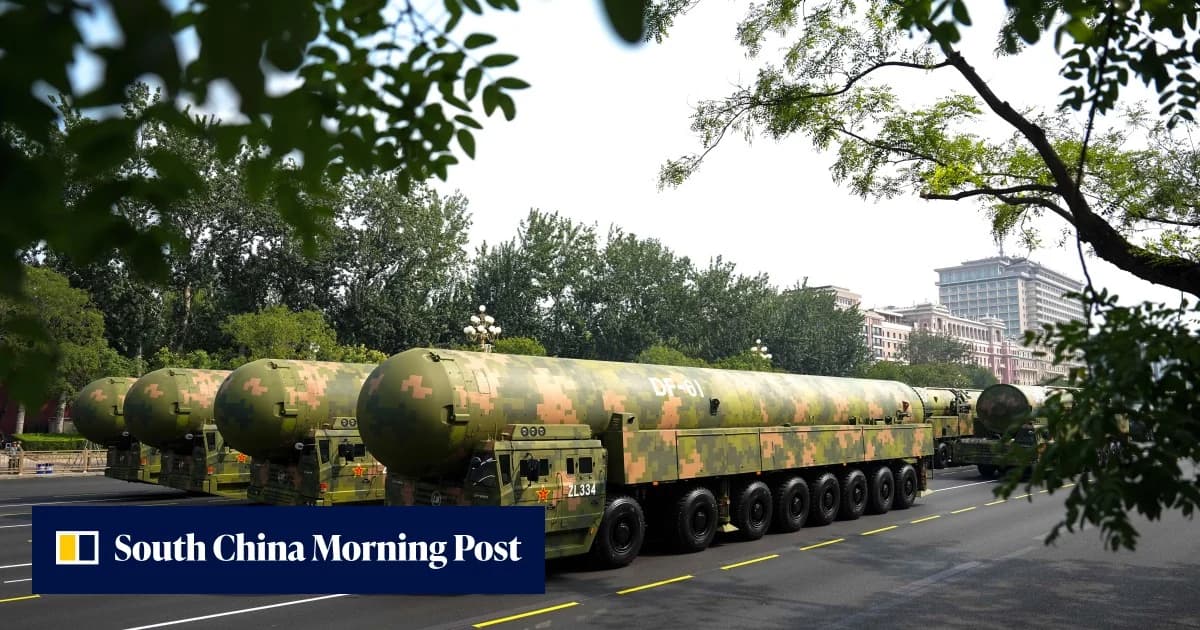
China’s newest land-based intercontinental ballistic missile, the DF-61, has entered routine military training at a pace described by a researcher as "far faster than the combat capability generation cycle of traditional intercontinental missiles." Shao Yongling, a researcher with the PLA Rocket Force, told CCTV on Thursday that the missile's progression from its public debut at a September 2025 military parade in Beijing to active training was notably rapid.
Shao stated that the DF-61 had already completed development, design finalisation, trial fielding, and reliability verification before it was unveiled, suggesting the weapon was technically mature. He attributed the quick familiarization of units to the missile's compatibility with the rocket force’s command, communications, and support networks, as well as the service's experience training ICBM crews. Routine training currently includes field manoeuvres, repositioning, and launch procedures to improve the missiles' ability to survive attacks and bypass enemy defences.
While the DF-61 is the latest addition to a fleet including the DF-5, DF-31, and DF-41, China has not disclosed technical specifications such as its range or warhead capacity. Estimates vary: the SCMP previously reported a possible range of 12,000km (7,450 miles) to 15,000km (9,320 miles), while Janes estimated a maximum range of about 18,000km (11,180 miles) and a capacity for up to 12 nuclear warheads. The Pentagon has assessed that the older DF-31A can reach most of the continental United States, while the Centre for Strategic and International Studies estimates the DF-41's range at up to 15,000km.
Experts suggest the speed of the DF-61's integration might be due to its similarity to the DF-41. Mackenzie Knight-Boyle of the Federation of American Scientists’ Nuclear Information Project noted that the DF-61 and DF-41 have nearly identical launchers and missile canisters. She stated that the speed of training and network compatibility "would make sense if it is, in fact, a modified version of the DF-41 ICBM rather than an entirely new missile," adding that one cannot assume the rocket force has become faster at developing new ICBMs based on this.