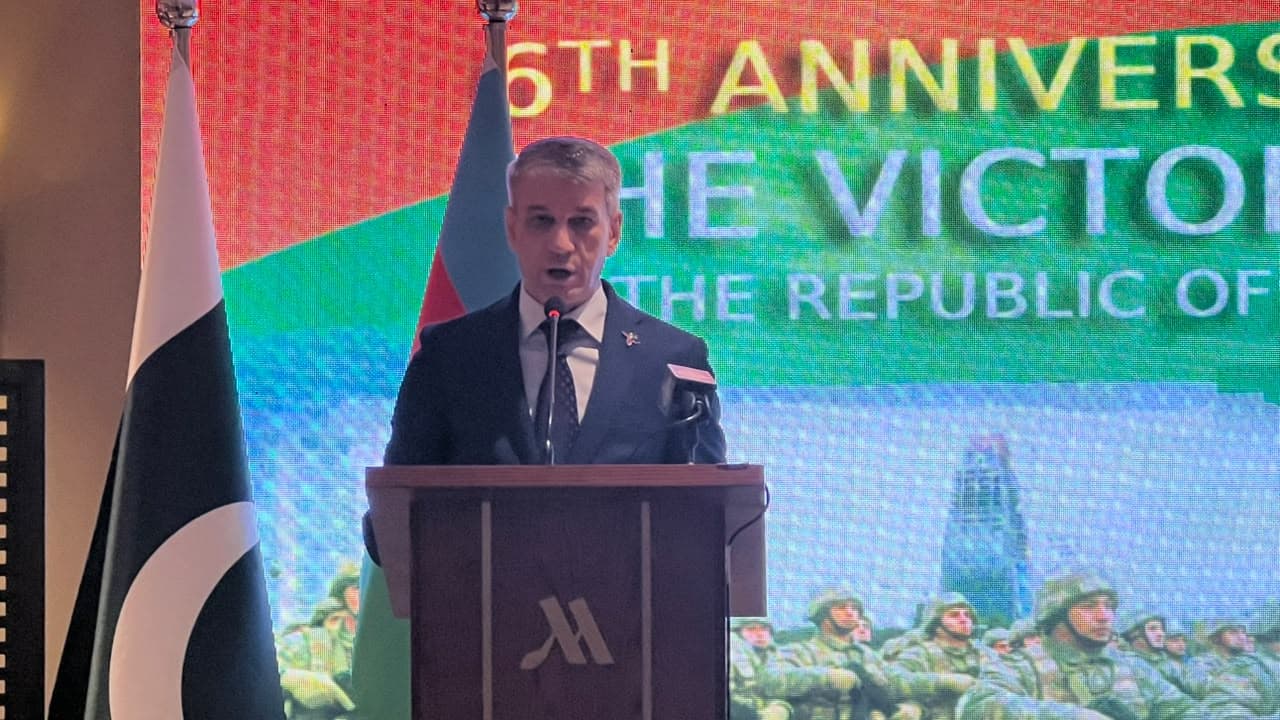
Ambassador of Azerbaijan to Pakistan, H.E. Irfan Davudov, stated that the historic victory during the 44-day Patriotic War was made possible by the courage and sacrifices of Azerbaijan’s armed forces, the political, diplomatic and military vision of President and Supreme Commander-in-Chief Ilham Aliyev, and above all, the unity of the Azerbaijani people.
Speaking at a ceremony in Islamabad on Wednesday marking the 6th Anniversary of Victory Day of the Republic of Azerbaijan, Ambassador Davudov said November 8 has become one of the most glorious and defining days in the country's history, marking the start of a new era. He noted that President Ilham Aliyev designated November 8th as Victory Day through a presidential decree to recognize the liberation of Shusha, which the ambassador described as Azerbaijan’s cultural capital and a strategically important location in the Karabakh region.
Recalling the events leading to the 44-day war, Ambassador Davudov said war was never the choice of the Azerbaijani state or its people. He stated that Azerbaijan pursued peaceful means for nearly three decades to resolve the conflict caused by Armenia’s military aggression and occupation of internationally recognized Azerbaijani territories. The envoy said Azerbaijan remained committed to negotiations and made every possible effort to avoid war, considering the moral, humanitarian, social and economic consequences for both sides.
However, the ambassador stated that Armenia’s continued refusal to withdraw from occupied territories, its non-compliance with international resolutions, and repeated provocations against Azerbaijani armed forces and civilians made military action inevitable. He said the Second Karabakh War, also known as the Patriotic War, resulted in the liberation of large parts of Azerbaijani territories that had been under occupation for almost 30 years.
Ambassador Davudov said that by liberating these territories, Azerbaijan fulfilled four United Nations Security Council resolutions adopted in 1993. These resolutions called for the immediate, unconditional and complete withdrawal of occupying forces but had remained unimplemented for nearly three decades. He observed that while international law, including the UN Charter, recognized Azerbaijan’s right to self-defence and the liberation of its occupied territories, the country had initially exhausted diplomatic avenues to achieve a peaceful settlement.
Paying tribute to those who died, the ambassador said the memory of Azerbaijani soldiers and civilians who sacrificed their lives for the country’s independence, sovereignty and territorial integrity would always remain alive. “We once again commemorate with gratitude the cherished memory of our brave martyrs who sacrificed their lives for the independence, sovereignty and territorial integrity of our country,” he said.
Emphasizing the need for lasting peace, Ambassador Davudov said that while military victory was a significant achievement, sustainable peace is essential for the region's future. He stated that Azerbaijan proposed a peace agreement with Armenia immediately after the Patriotic War and continues to support negotiations despite challenges. “We remain committed to building a future based on mutual respect, sovereignty, territorial integrity, good-neighbourly relations and regional cooperation,” he said.
Regarding post-war reconstruction, the ambassador said Azerbaijan has launched extensive restoration and development activities in the liberated territories. These include constructing residential settlements, infrastructure, roads, and bridges, as well as rehabilitating religious and cultural monuments destroyed during the occupation. According to the ambassador, more than 120,000 people, including workers and former internally displaced persons returning for permanent residence, are currently in the liberated territories. He described the restoration of security and normal life as a major achievement of policies founded by Heydar Aliyev and pursued under President Ilham Aliyev.
Finally, Ambassador Davudov expressed gratitude to the government and people of Pakistan for their consistent political, diplomatic and moral support during Azerbaijan’s difficult years. He said Pakistan’s principled position and adherence to international law were highly appreciated, particularly during times of double standards in international affairs. He noted that relations between Pakistan and Azerbaijan are experiencing their highest level of development, citing high-level exchanges, media and educational cooperation, and expanding military and technical cooperation as pillars of the strategic relationship.