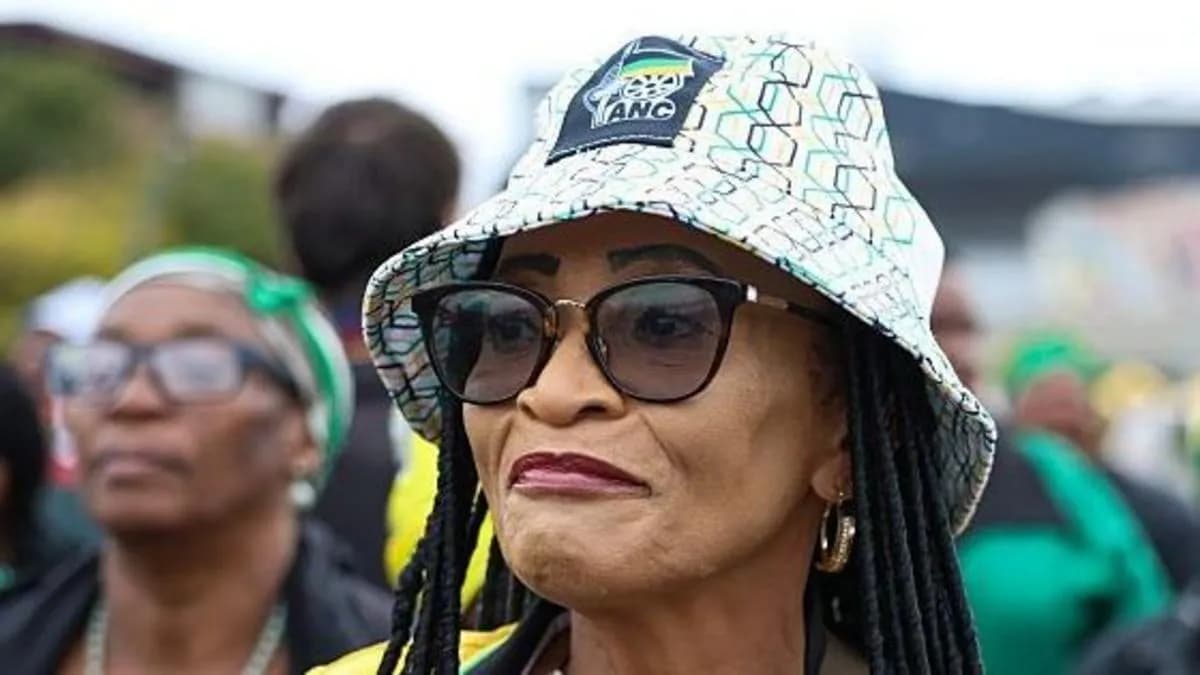
The African National Congress (ANC) is in a race against time to secure power-sharing deals in most of the country's cities after a massive drop in its support in this month's local elections. The party, which has dominated South Africa for more than 30 years, suffered its worst result since it came to power in 1994 when the country transitioned from the racist apartheid system to democracy.
The ANC won a majority in just one of the country's nine provinces, Limpopo, down from six in the last elections. Nationally, the party received 31% of the vote, down from 46% in the last local election, though it still received more votes than any other party. In the economic powerhouse of Gauteng province, which includes Johannesburg and Pretoria, the pro-business Democratic Alliance (DA) got the most votes in both cities, as well as the province's other main region, Ekurhuleni. The DA also retained its majority in its power base of Cape Town and got the most votes in Nelson Mandela Bay, where Gqeberha (Port Elizabeth) is located.
Parties have until 27 November to negotiate and form local governments. While the ANC is sharing power with its long-time rival, the DA, at the national level, it appears that ANC party officials do not want to replicate this at the local level. State broadcaster SABC reported that most of the party's top leaders see an agreement with the DA as a last resort. Instead, the party has been courting smaller parties to try and form councils. In Gauteng, numerous reports point to an arrangement between the party and the anti-immigrant ActionSA, which emerged as the third largest party in the province with 17%, leaving it as a potential kingmaker. ActionSA is unlikely to work with the DA as they cannot agree on the mayoral candidates in Johannesburg and Pretoria.
The ANC's reluctance to partner with the DA in key cities points to continued strain between the two. While the Government of National Unity (GNU) has remained intact since 2024, there have been those in the ANC who have been angered by what they view as the DA's dual role as opposition and partner in the coalition government and have pushed for the arrangement to end. A party insider told the Daily Maverick on Sunday that a nationwide agreement to work with the DA at municipal level "was overwhelmingly rejected" at a meeting held by ANC members.
Political analyst Andre Duvenhage told the BBC there was a possibility that "a lot of asymmetrical coalitions" could emerge, where parties work together in one area and be in opposition elsewhere. Another political analyst, Sandile Swana, said that any party wanting to leave the GNU over the failure to secure deals locally would be "[shooting] yourself in the foot".
The decline in ANC support was seen as being mainly due to high levels of corruption and a loss of confidence in its ability to provide basic services, such as electricity, water and rubbish collection. While some attribute the increase in backing for the DA to its record of competent management in municipalities under its control, some have accused it of neglecting poorer areas and townships.
The experience of coalition governments over the past 10 years does not inspire much confidence that things will improve. Half of the country's cities have been governed through power-sharing agreements since 2016 and these types of arrangements have often been viewed as unstable and chaotic. Experts agree that even after new arrangements take effect, it will take longer than a five-year term to resolve the issues facing many municipalities, particularly South Africa's biggest city Johannesburg. Duvenhage told the BBC, "I think if we are really turning the ship around, we are talking about a 10-year period," while Swana echoed this, saying it would take a decade to "cleanse and purify" local councils and "reinstate them as "proper municipalities".