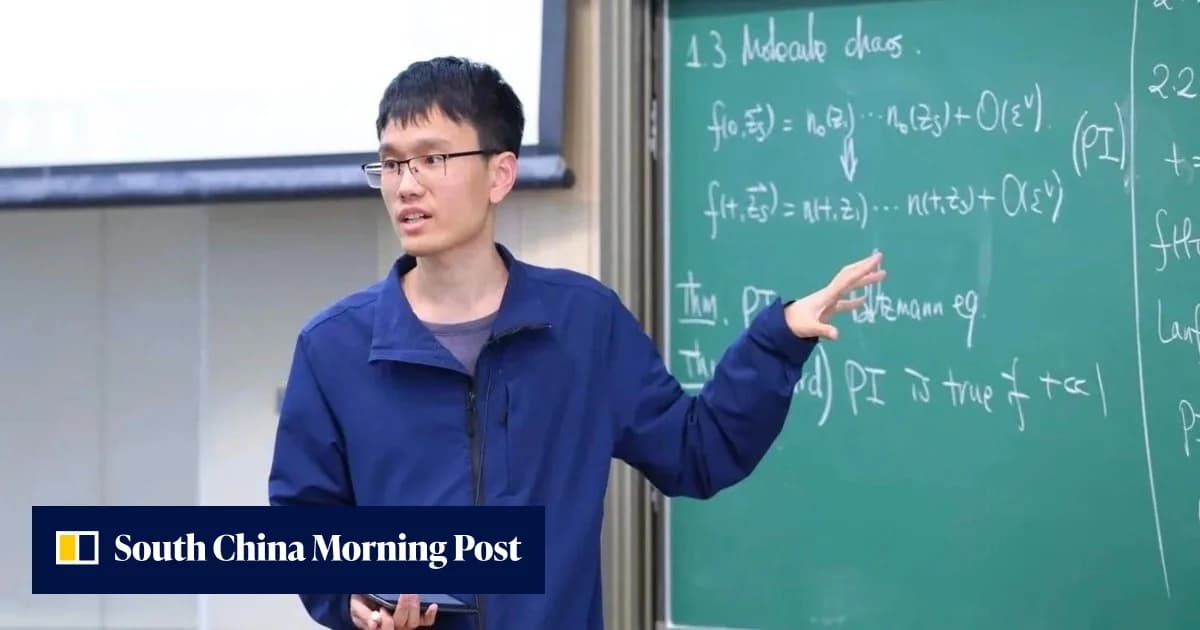
Star mathematician Ma Xiao has left his position in the United States to return to his alma mater, the University of Science and Technology of China (USTC) in Hefei. At age 28, Ma is making a "dramatic career pivot" from pure mathematics to artificial intelligence.
According to an announcement from the university on Sunday, Ma has accepted a joint professorship with USTC’s Institute of Geometry and Physics and its new Artificial General Intelligence Institute. The institute was launched in January to conduct original research and nurture talent for international impact.
Ma’s move marks a shift from pursuing elusive theorems to betting that the future of mathematical discovery will be automated. He told DeepTech, the Chinese version of MIT Technology Review, in July that he will "likely shift my main focus to agents" in the next two to three years. He has already developed an agent system for mathematical proofs called qmd-prover and is attempting to create an automated pipeline that links idea input, proof, verification, and paper generation.
Ma’s academic career reached a peak in 2024 when he and his team made a breakthrough on Hilbert’s sixth problem, a century-old puzzle regarding the connection between microscopic atoms and fluid motion. The results were published in the Annals of Mathematics. This work helped propel his collaborator, Deng Yu, to win the 2026 Fields Medal. Deng told Xinxiang Daily in July that "Without Ma’s involvement, we would have taken many detours."
Ma graduated with a PhD in Mathematics in 2023, after which he continued his postdoctoral training at the University of Michigan and was appointed to the position of Donald J. Lewis research assistant professor. However, he has now chosen to return to China.
Ma’s path to success began in the city of Xinxiang, Henan, where he was reportedly intrigued by a mathematical problem in the sixth grade and taught himself university-level calculus. In 2014, at age 16, he enrolled in USTC’s School of the Gifted Young. He graduated from USTC with a bachelor’s degree in 2018 before moving to Princeton University for a doctorate.
Ma began working on Hilbert’s sixth problem in 2022 alongside Deng Yu and his "collaborating mentor during my postdoctoral period," Zaher Hani.
Regarding his new role, Ma emphasized the importance of modern tools for students, stating, "I take on students, and Codex, Claude Code and Git are tools they must know. If you can’t use them, you are very likely an ‘illiterate’ person of the new era."