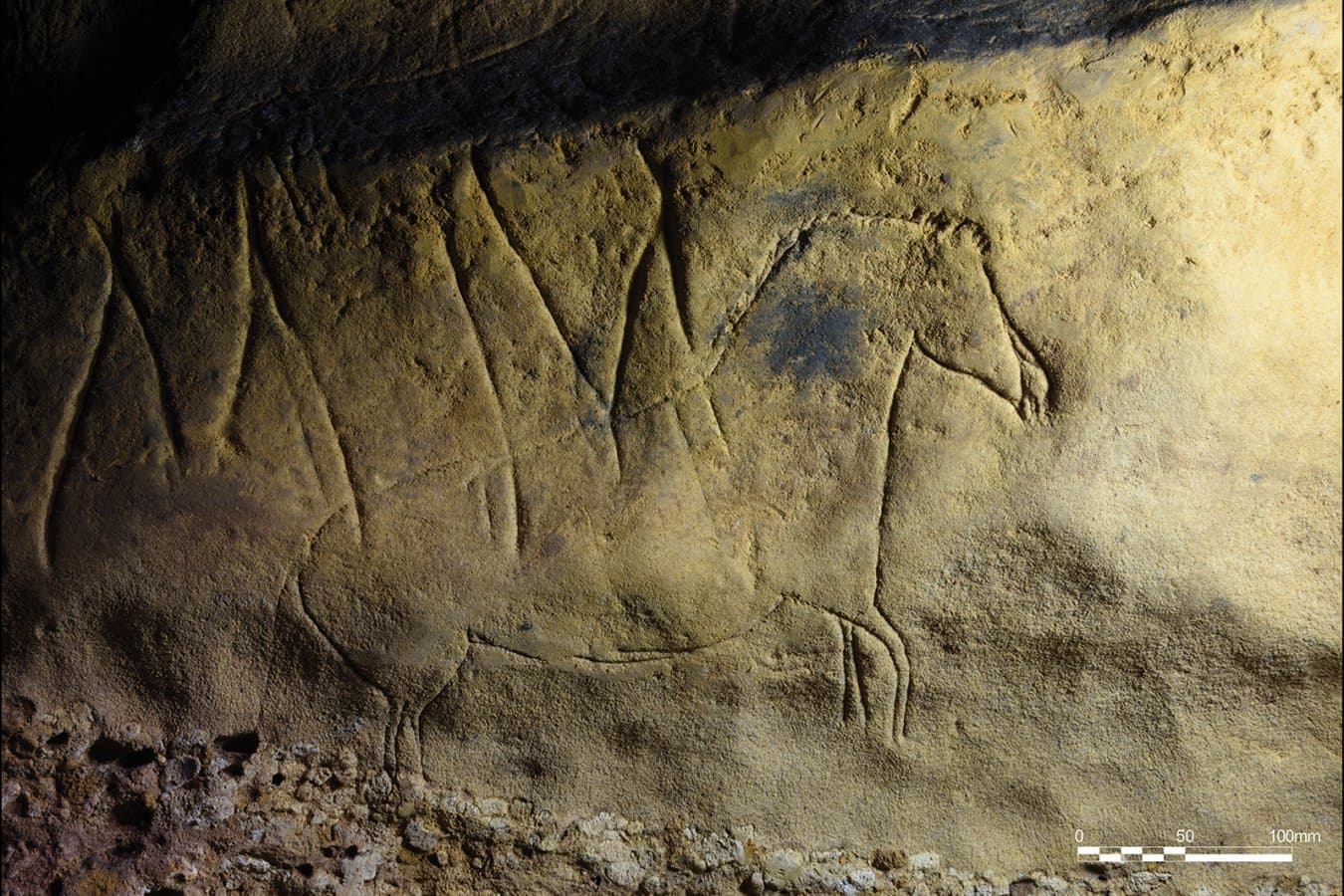
A gallery containing hundreds of engraved motifs and dozens of prehistoric animal images has been discovered in a cave in Spain. The site, Cova de la Font Major, is located west of Barcelona and had been a popular tourist attraction, yet the art had gone unnoticed until recently.
Josep Maria Vergès of the Catalan Institute of Human Paleoecology discovered the rock art after a tourist group caught his attention. The visitors, who were wearing wetsuits for an adventure activity, emerged from an opening leading into a small side gallery. Vergès stated, “Since it was my first time working at the site and I was unfamiliar with this side gallery, I went to take a look.”
Upon entering, Vergès found walls covered in modern graffiti consisting of names and dates dating back to 1957. He used a headlamp to cast a raking light across the walls to create shadows in the grooves. Vergès noted that he "almost immediately" noticed vertical lines that appeared ancient among the modern graffiti. As he turned toward the opposite wall, he saw a horse and realized it was "executed in a Palaeolithic style." He further discovered "many more engravings, many of them figurative representations of different animals."
To date, 280 motifs have been identified in the gallery, including 55 animal figures. The find is described as one of the richest and most important archaeological discoveries along the Iberian coast between the Pyrenees and Gibraltar. While dating the engravings themselves is extremely difficult, human occupation in the cave has been dated to between 26,000 and 41,000 years ago. Based on the style, the art is likely to be over 19,000 years old.
Míriam Salas-Altès, a team member at the Catalan Institute of Human Paleoecology and Social Evolution, highlighted a figure of a hind, or adult female deer. The deer is depicted with its head lowered, with its muzzle extending across a natural fissure. Salas-Altès stated that the crack appears to have been deliberately incorporated into the composition to represent a body of water. She added, “If this hypothesis is correct, the scene would constitute one of the earliest known representations of water in human artistic expression.”
The team also identified non-figurative engravings, including Y-shaped signs, circular or semicircular shapes, and groups of lines arranged in twos, threes, or fours. Some cases featured series of up to 40 straight, parallel lines. Regarding their meaning, Vergès stated that "dozens of different theories" exist, but "unfortunately, the code needed to understand its message has not fossilised."
Paul Taçon of Griffith University in Australia stated that the discovery fills a gap in knowledge regarding the distribution of Palaeolithic art in western Europe. He noted that while the exact age is undetermined, it is “obvious” the art was made by a Palaeolithic culture. Taçon called it "exciting" that new discoveries at long-visited sites are revealing evidence of a "very early painting tradition."