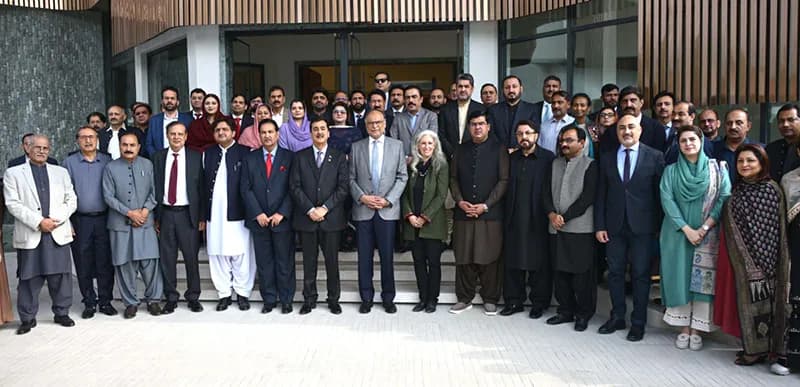
Chairman Senate Syed Yousaf Raza Gilani advocated for the revival of student unions and the creation of a robust, empowered local government system on Wednesday, November 11. Speaking at a UNICEF-organized workshop titled “Strengthening Parliamentary Oversight of Public Expenditure Management,” Gilani described these initiatives as necessary for strengthening democracy and nurturing future leaders. He observed that the nurseries of leadership at the grassroots level had become dormant and needed to be revived to address the leadership vacuum in the country.
Drawing on his own political journey, Gilani stated that he began his career at the local level before rising to become the Prime Minister of Pakistan and serving in various other constitutional roles. He argued that strong local governments at the tehsil and district levels are vital for transparency, accountability, and the effective use of public funds.
Gilani emphasized that the Parliament has a constitutional responsibility to ensure the transparent and responsible use of public resources to maintain public trust. He stated that the role of Parliament must go beyond just approving budgets to ensuring that national resources are properly utilized for the people. He warned that budget allocations do not guarantee development unless funds are released on time, institutions fulfill their duties, and spending results in tangible improvements in lives. He underscored that every rupee spent must deliver measurable results regarding economy, efficiency, and effectiveness.
Addressing Pakistan’s limited financial resources and development challenges, Gilani stressed the need for parliamentary oversight in sectors such as health, education, nutrition, sanitation, and social protection. He called on parliamentary committees to ensure resources reach deserving segments of society for their intended purposes. Referring to Sustainable Development Goal 16 (SDG 16), he noted that accountable and transparent institutions are fundamental to sustainable development.
He urged Public Accounts Committees to look past identifying financial irregularities to examine underlying causes like weak planning, procurement procedures, and project implementation, while recommending reforms. Gilani also called for prioritizing audit observations based on financial significance, recurring irregularities, and systemic weaknesses. To strengthen parliamentary committees, he highlighted the need for professional support, reliable information, coordination with the Office of the Auditor General, and capacity-building for members. He added that parliamentary accountability must remain impartial, evidence-based, and constructive.
The workshop was also attended by Speaker Provincial Assembly Punjab Malik Muhammad Ahmad Khan, Federal Minister for Planning and Development Prof. Ahsan Iqbal, Speaker Azad Jammu and Kashmir Legislative Assembly Chaudhry Tariq Farooq, Auditor General of Pakistan Maqbool Ahmad Gondal, and UNICEF Representative in Pakistan Ms. Pernille Ironside. Gilani concluded by thanking UNICEF for its efforts and expressed hope that the workshop would produce practical recommendations for the effective use of national resources.