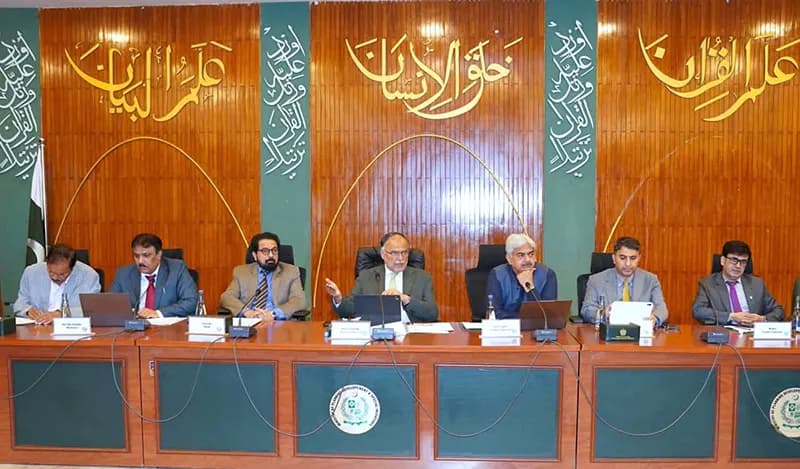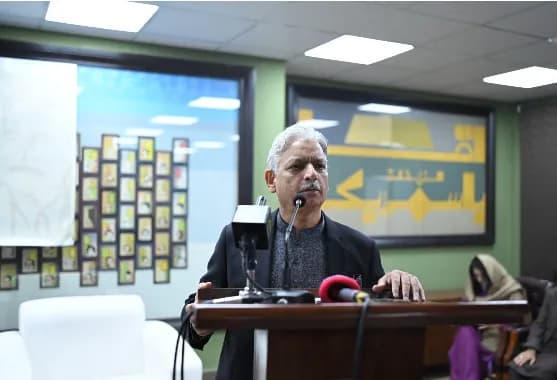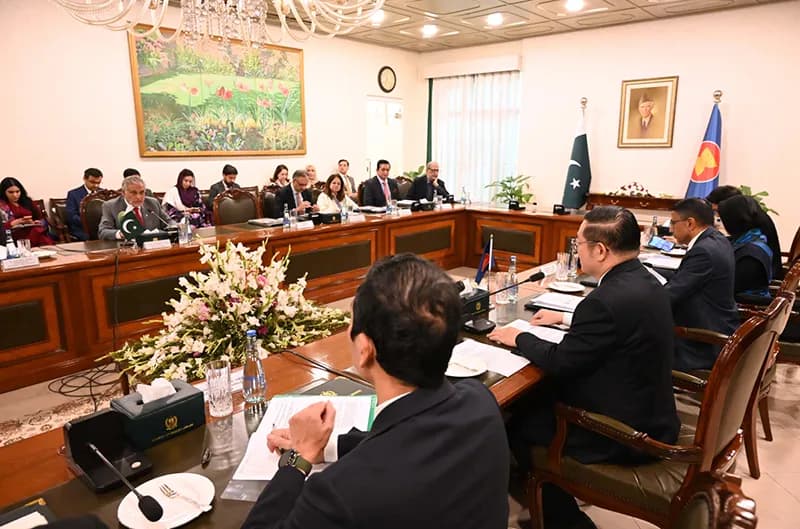
Deputy Prime Minister Ishaq Dar has expressed hope for an early agreement between the United States and Iran, warning that the world cannot afford a prolonged conflict in the Middle East. Speaking in an interview with Euronews broadcast by PTV News on Saturday, Dar stated, “I’m a born optimist. I think I would certainly expect that sooner or later, I hope it’s sooner, that we will achieve that objective. Because, you see, the world cannot afford [it]. See the energy supply chain disruptions. See the price hikes. See the people suffering. And even in our country, people are suffering.”
Dar noted that despite violations of the June 18 accord, Islamabad has not abandoned the peace process and continues to urge Washington and Tehran to honor their commitments. He described dialogue and diplomacy as the only viable means for resolving international conflicts, rejecting bloc politics and unilateralism.
According to Dar, Pakistan’s diplomatic efforts led to Islamabad hosting the first direct, face-to-face negotiations between the United States and Iran in 47 years on April 10 and 11. The 21-hour session brought the two sides close to an agreement before one delegation paused for consultations. This mediation eventually resulted in the June 18 ‘Islamabad Memorandum of Understanding’, which was signed remotely by Iranian president and US President Donald Trump while the latter was attending a G7 summit in Europe.
Dar also highlighted a five-point Middle East peace initiative he formulated during a March 31 visit to China. He called for a new regional security architecture, noting that the Regional 4 (R4)—comprising Pakistan, Saudi Arabia, Turkiye, and Egypt—has worked to promote restraint. These efforts expanded on October 23 in Istanbul through talks with the E4 (the United Kingdom, France, Germany, and Italy), with Germany inviting both groups for follow-up discussions in December. Dar stated, “This is a combined responsibility to keep both parties cool and make them understand that there is no solution through kinetic actions — it has to be through dialogue and diplomacy.”
Regarding regional security, Dar said Pakistan wants a stable neighbor in Afghanistan. He recalled three visits to Kabul in 2025 to break a four-year stalemate, noting that Islamabad acted on Afghan requests regarding trade, the economy, and refugees within eight weeks. However, he stated Pakistan’s demand that Afghan soil not be used for terrorism remains unmet. Dar cited what he described as credible evidence shared with international institutions linking October terrorist attacks to groups operating from Afghanistan, including the Tehreek-e-Taliban Pakistan (TTP), Balochistan Liberation Army (BLA), Majeed Brigade, Islamic State Khorasan Province (ISKP), and East Turkestan Islamic Movement (ETIM). He reported that Pakistan has lost 100,000 lives and suffered $150 billion in economic losses in the fight against terrorism.
On relations with India, Dar said the resumption of bilateral dialogue depends on New Delhi. He described the August 5, 2019 changes in Indian Illegally Occupied Jammu and Kashmir (IIOJK) as unconstitutional and contravening UN Security Council resolutions. He also referenced a May 2025 conflict between the two nuclear-armed neighbors following the Pahalgam incident, noting that Prime Minister Shehbaz Sharif offered an international investigation which India declined. Dar strongly objected to India’s decision to place the 1960 Indus Waters Treaty in abeyance, arguing that international agreements cannot be unilaterally suspended. He stated, “No treaty can be held in abeyance… Pakistan simply cannot afford to just accept any variation in the treaty.” He added, “weaponising water is not desirable” and said, “I think international treaties need to be respected, no matter how big or small a country. So, I think we should learn these basic principles which will bring back the international order to prove that justice is there for everybody.”
On the economy, Dar reported Pakistan’s external debt stands at $130 billion, while untapped mineral and rare-earth potential is estimated between $6 trillion and $10 trillion. He noted that Pakistan’s economy was the world’s 24th-largest between 2013 and 2017 before falling to 47th place by 2022 due to policy reversals. He proposed a ‘Charter of Economy’ to protect policies from political changes and noted that Pakistan has entered CPEC 2.0 with China.
Regarding Europe, Dar highlighted improving engagement with the European Union and the United Kingdom, with bilateral trade approaching $9 billion. He urged European institutions to extend Pakistan’s GSP+ trade status, which expires at the end of this year, noting Islamabad is prepared to meet all 32 conventions required for the new regime starting January 1, 2029. He dismissed the description of Pakistan as a “high-risk market” as a matter of perception, pointing to dedicated security forces for foreign investors and federal interventions in Khyber Pakhtunkhwa.