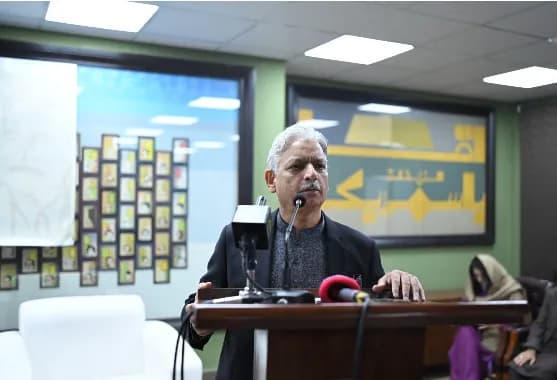
The Pakistan Academy of Letters (PAL) organized a literary seminar and a special poetry recital to honor the memory of Allama Muhammad Iqbal at the Sheikh Ayaz Conference Hall in Islamabad on November 21. The event, which sought to highlight the relevance of Iqbal’s philosophy in the contemporary era and strengthen the younger generation’s connection with his intellectual and literary legacy, featured two distinct sessions.
The first session, a seminar titled “Iqbal’s Thought in the Context of the Contemporary Era,” was presided over by Professor Dr Ehsan Akbar, a renowned poet and intellectual. During this session, Khurshid Ahmad Nadeem, a renowned writer, journalist, and Chairman of National Rahmatul-lil-Alameen Wa Khatamun Nabiyyin Authority, delivered the keynote address.
Nadeem highlighted various dimensions of Iqbal’s thought and their relevance to contemporary society, specifically focusing on his concepts of selfhood (Khudi), self-awareness, action, Ijtihad, and intellectual awakening. He stated that Iqbal’s message was not confined to poetry or philosophy but presented a comprehensive vision for the intellectual, moral and practical development of individuals and society. Nadeem added that through his poetry, Iqbal instilled in Muslims a sense of self-confidence, lofty vision, continuous struggle and awareness of their cultural and national identity. He emphasized that drawing guidance from Iqbal’s philosophy in the present era required more than merely reading and repeating his ideas; rather, his teachings should be translated into individual and collective practices.
Renowned poetess Dr Mehnaz Anjum conducted the proceedings, highlighting the significance of the seminar’s theme and Iqbal’s intellectual legacy. She also moderated the subsequent poetry session. During the event, Amina Arshad recited selected verses from Iqbal’s poetry, which received warm appreciation and applause.
The second session, the poetry recital, was chaired by noted poet Ali Akbar Abbas. The recital began with verses by Dr Mehnaz Anjum, followed by a series of poets including Ahmad Muaz, Tayyabullah Khan, Muhammad Rizwan, Farzand Ali Hashmi, Akbar Niazi, Mubashir Saleem, Shahid Iqbal, Tanveer Haider, Zakir Rehman, Nusrat Yab Khan Nusrat, Munir Fayyaz, Rashid Saleem, Iqbal Hussain Afkar, Younas Majaz, Dr F. Rafiuddin Siddiqui, Afshan Abbasi, Ayesha Masood and Dr Arshad Mahmood Nashad. These poets paid tribute to Allama Muhammad Iqbal through their verses and presented original work on various themes.
In his concluding remarks, Ali Akbar Abbas highlighted the literary, intellectual and cultural significance of Iqbal’s thought. He said Iqbal’s poetry was not merely an expression of emotions and sentiments but represented a living intellectual tradition and a message for practical life. Abbas noted that through his poetry, Iqbal taught humanity to recognise its true potential, pursue lofty objectives and remain committed to continuous struggle. Abbas also recited some of his own poetry during the session.