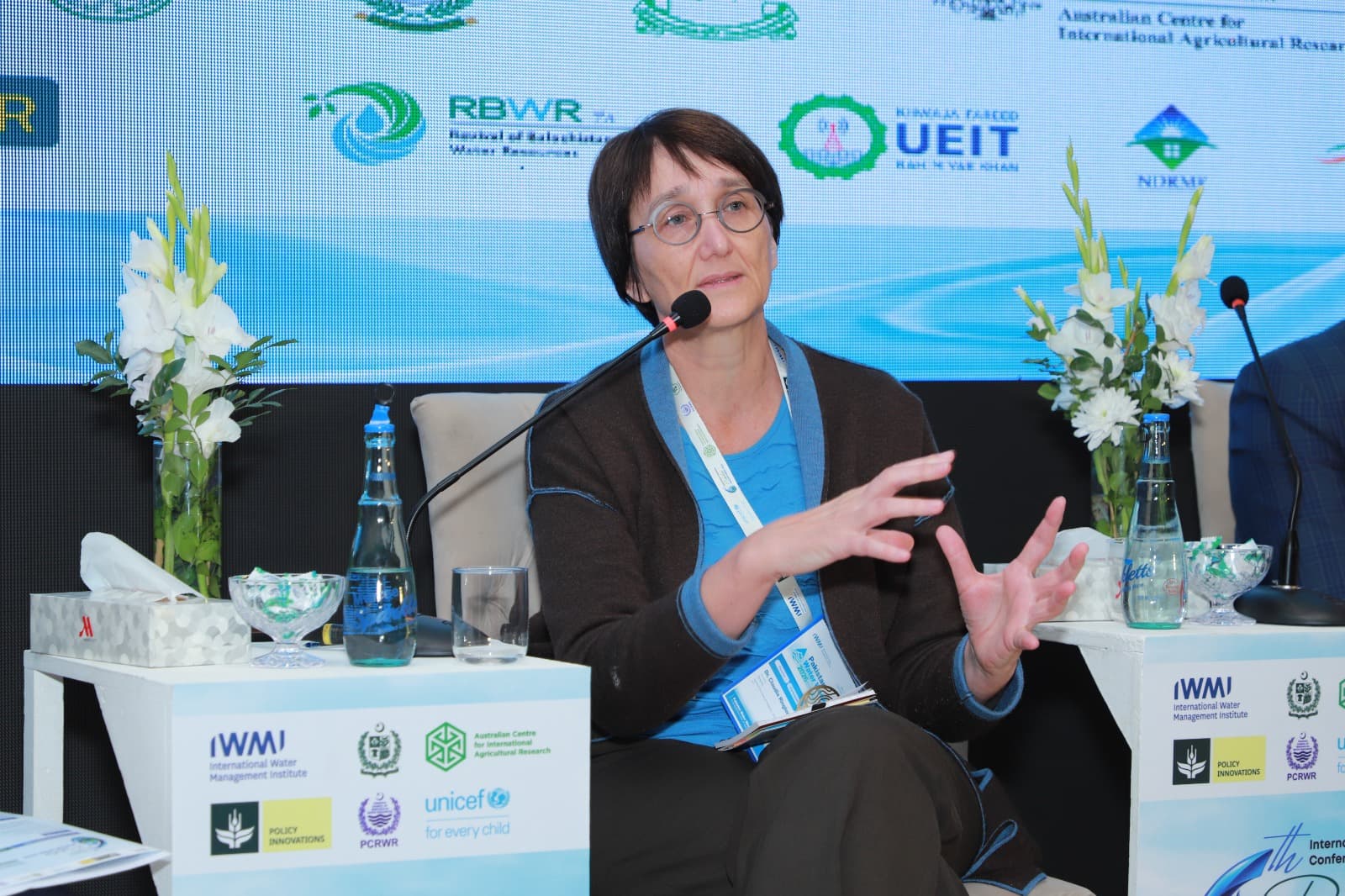
Dr. Claudia Ringler, Director of Agrifood Innovation and Resilience at the International Food Policy Research Institute (IFPRI), has called for an integrated, whole-of-government approach to tackle Pakistan’s growing water challenges. Speaking at the closing session of the five-day Sixth Pakistan Water Week 2026 international conference in Islamabad on November 5, she stressed that water challenges cannot be addressed by water management agencies alone and require collective action across various government institutions and sectors.
Ringler highlighted the necessity for stronger regional cooperation among Himalayan countries to address risks from glacial instability, rockfalls, and other climate-induced hazards. She noted that participants at the conference had proposed creating an international commission or committee involving Himalayan countries to jointly assess emerging risks, develop early detection systems, and strengthen preparedness for vulnerable populations.
Regarding water, sanitation, and hygiene (WASH), Dr. Ringler urged Pakistan to accelerate progress toward Sustainable Development Goals (SDGs) 6.1 and 6.2. She called for better alignment between federal and provincial WASH plans and improved coordination among relevant institutions to meet 2030 targets. She also suggested that integrated water modelling could help balance the competing demands of cities, agriculture, energy, and ecosystems while identifying trade-offs.
On infrastructure, she emphasized the need for evaluation frameworks that include agricultural, financial, economic, environmental, social, and governance considerations. To address groundwater challenges, specifically in Balochistan, she called for greater investment in managed aquifer recharge due to extreme water scarcity and groundwater depletion. She also suggested integrating these recharge initiatives with nature-based solutions, such as river and wetland restoration.
Ringler advocated for greater youth participation in water policy, noting that current decisions will influence the economic opportunities, food security, and nutrition of future generations. She proposed a youth innovation award to encourage technology-driven solutions, specifically through artificial intelligence. Furthermore, she called for a common national and provincial glossary for terms like water accounting, efficiency, productivity, consumption, depletion, and savings to ensure progress is assessed through measurable outcomes.
The Director also highlighted the water sector's role in climate change mitigation, suggesting a shift from diesel-powered systems to solar energy, reducing methane emissions from sewage, and improving water-use efficiency in irrigation. She stated that Pakistan must contribute to global emissions-reduction efforts rather than waiting for other countries to lead.
Ringler recommended that future conferences schedule sessions on women’s participation earlier and arrange dedicated sessions for representatives from Gilgit-Baltistan and Azad Jammu and Kashmir.
Federal Minister for Water Resources Muhammad Mueen Wattoo attended the concluding session as the chief guest. He reaffirmed Pakistan’s resolve to safeguard its rights under the Indus Waters Treaty through lawful and peaceful means and requested international support for compliance with the treaty and the binding arbitration award.
Other speakers included Dr. Neil Lazarow of the Australian Centre for International Agricultural Research (ACIAR), Johan Gely of the International Water Management Institute (IWMI), and Dr. Nadeem Javaid of the Pakistan Institute of Development Economics (PIDE). Mohsin Hafeez of IWMI delivered the closing remarks. The five-day conference focused on turning commitments into practical actions for water security and climate-resilient food systems.