LIVE Watch Now Punjabi News Channel from Pakistan
Breaking
Samsung and SK Hynix Reject KEPCO’s $19 Billion Power Prepayment ProposalPakistan Secures $3bn in International Bond IssueExperts urge businesses to invest in AI, digital skillsPower outage at Dhabeji station disrupts Karachi water supplyKarachi experiences record-breaking heat in SeptemberOil prices surge as new strikes hit Saudi Arabia and Strait of HormuzPM’s Adviser: New Provinces Debate Could Take Up to Eight MonthsGlobal oil markets face new threats as Bab al-Mandeb disruptions escalateNew auto policy shifts focus to value addition and exportsTaiwan Semiconductor Testing and Optical Supply Chains Thrive Amid AI GrowthPIBT rejects priority berthing for coal vessels, citing operational concernsKPop Demon Hunters Expands with New Phone HuggersPetroleum Division Proposes Rs75bn Fuel Relief SchemePM launches fuel relief scheme for motorcycles and small vehiclesTech Giants Gear Up for AI Infrastructure ExpansionSemicon India 2026 sees significant growth in semiconductor industryPresident upholds FTO order on FBR data confidentialityKP Government to Introduce Optional Top-Up Health Package for EmployeesSUPARCO to Celebrate World Space Week with Educational ActivitiesXi Jinping unveils ‘Greater BRICS’ initiatives to boost global economic tiesSamsung and SK Hynix Reject KEPCO’s $19 Billion Power Prepayment ProposalPakistan Secures $3bn in International Bond IssueExperts urge businesses to invest in AI, digital skillsPower outage at Dhabeji station disrupts Karachi water supplyKarachi experiences record-breaking heat in SeptemberOil prices surge as new strikes hit Saudi Arabia and Strait of HormuzPM’s Adviser: New Provinces Debate Could Take Up to Eight MonthsGlobal oil markets face new threats as Bab al-Mandeb disruptions escalateNew auto policy shifts focus to value addition and exportsTaiwan Semiconductor Testing and Optical Supply Chains Thrive Amid AI GrowthPIBT rejects priority berthing for coal vessels, citing operational concernsKPop Demon Hunters Expands with New Phone HuggersPetroleum Division Proposes Rs75bn Fuel Relief SchemePM launches fuel relief scheme for motorcycles and small vehiclesTech Giants Gear Up for AI Infrastructure ExpansionSemicon India 2026 sees significant growth in semiconductor industryPresident upholds FTO order on FBR data confidentialityKP Government to Introduce Optional Top-Up Health Package for EmployeesSUPARCO to Celebrate World Space Week with Educational ActivitiesXi Jinping unveils ‘Greater BRICS’ initiatives to boost global economic ties
◕ SundialUpdated 23 hours ago
Trending
Business

New auto policy shifts focus to value addition and exports

Pakistan’s new automotive policy aims to boost exports and domestic value addition, with targets for car manufacturers and parts producers.

Add Sun News on Google News
New auto policy shifts focus to value addition and exports
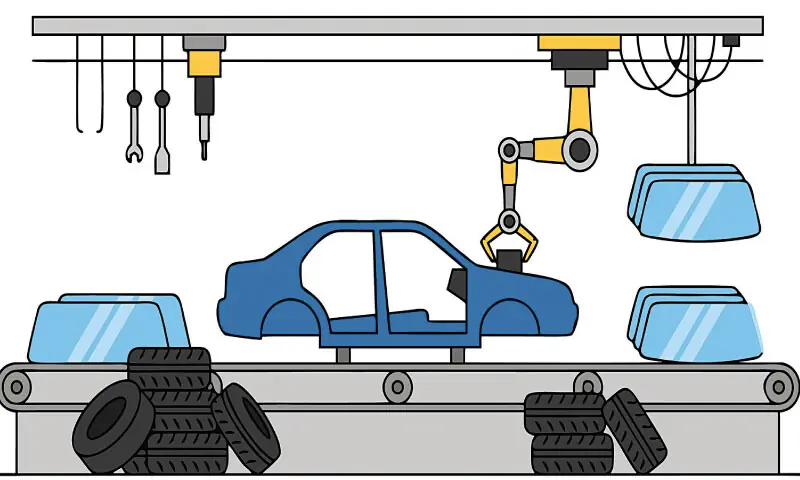
Automobile components being manufactured in Pakistan

Key Takeaways

  • Pakistan’s new automotive policy aims to boost exports and domestic value addition.
  • Manufacturers must export 12% of factory-gate production by 2029-30.
  • The policy seeks to replace conventional localisation targets with domestic value addition.

Pakistan’s proposed Automotive and Auto Parts Manufacturing Policy 2026–31 marks a significant shift in the country’s approach to the automotive industry. Rather than relying on high tariffs and localisation, the policy now focuses on domestic value addition, exports, competition, and technological upgrading.

Under the new policy, car, jeep, and SUV manufacturers are required to export 12% of their factory-gate production value by 2029-30. Parts manufacturers are expected to increase their exports to $700 million by 2030-31, with combined automobile and parts exports projected at $1.58 billion in the final year and $4.59 billion over five years.

The policy also aims to reduce protection and eliminate regulatory and additional customs duties, while providing exporters with a drawback of local taxes and levies. Conventional cars will need a minimum domestic value addition (MDVA) of 40% by 2030-31.

AdvertisementFollow Sun NewsWatch Live

However, the policy faces challenges. The proposed MDVA regime is criticized for using a weighted formula for materials, labour, and overheads, which may not accurately measure the actual value created. Critics argue that a simpler measure, such as factory-gate value minus direct and embedded imported content, would be more appropriate.

There is also a qualitative issue. A 40% MDVA from simple components, labour, utilities, and overheads is not equivalent to 40% from precision engineering, electronics, motors, and other sophisticated components. This potential contradiction highlights the need for a more nuanced approach to measuring domestic value addition.

Another challenge is the missing upstream ecosystem. While Pakistan produces some steel products used by automobile manufacturers, it lacks the breadth and scale of automotive-grade steel, petrochemical, engineering-material, and electronics supply chains found in successful automobile-producing economies. Much of this high-value content in modern vehicles will continue to be imported.

Pakistan’s domestic market remains small, with roughly 200,000 vehicles sold annually among numerous assemblers and models. This fragmented market makes it difficult to achieve deep localisation. A sophisticated supplier must recover the cost of dies, moulds, tooling, testing, and equipment over a large production run. Producing a specialised component for 3,000 or 5,000 vehicles annually is very different from producing it for 100,000 vehicles or a global platform.

The proposed policy contains a potential contradiction: it seeks deeper domestic value addition while allowing model proliferation that fragments the scale needed to achieve it economically. This scale contradiction poses a significant challenge to the policy’s success.