Key Takeaways
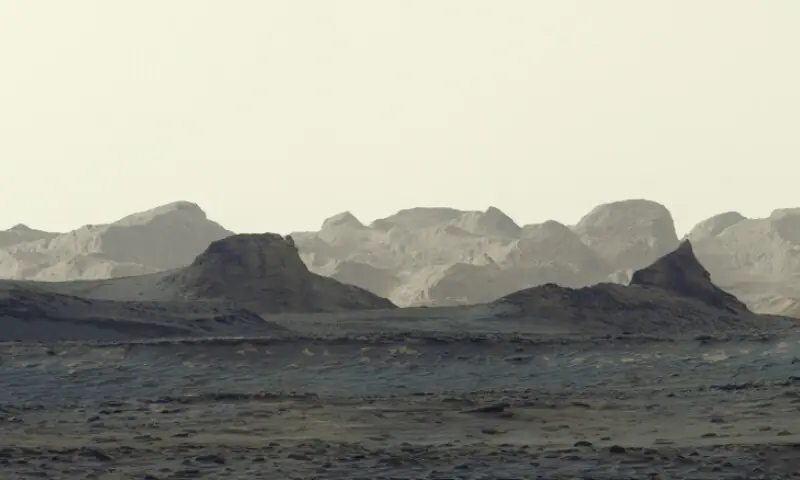
- Nasa's Curiosity rover has taken a striking image of dawn on Mars.
- The image shows sunlight bathing jagged crags formed billions of years ago.
- Curiosity has been exploring Mount Sharp since 2014 and is expected to reach a new layer in 2027 or 2028.
Nasa has released a breathtaking image of dawn on the Martian surface, captured by its Curiosity rover. The image, taken by the rover's Mastcam camera, showcases sunlight illuminating jagged crags that have been shaped over billions of years.
Curiosity, which landed in 2012 in Gale Crater, has been steadily climbing Mount Sharp, a 3-mile-tall mountain. Since 2014, the rover has ascended approximately 0.6 miles (1 km), marking the most significant elevation gain on Mars to date.
Planetary scientist Ashwin Vasavada, the Curiosity project scientist, provided insights into the image. He explained that the bright craggy peaks in the distance are part of a rock layer that likely formed around 3 billion years ago, possibly due to wind-blown sediment or volcanic ash. This layer, spanning about 10 miles, is situated in the northwestern reaches of Mount Sharp.
However, Vasavada noted that this layer is not part of the continuous stack of layers that make up Mount Sharp. It was added later, above an unconformity, which is a gap in the geological record where previous layers eroded before new ones were deposited.
The rover's journey to this new layer is expected to continue until 2027 or 2028. During this time, Curiosity will use its instruments to study the geology of this area, potentially uncovering more about the planet's past and whether it once harbored conditions suitable for microbial life.
Curiosity's mission is part of Nasa's broader exploration of Mars, which includes the Perseverance rover currently traversing the margins of Jezero Crater in the northern hemisphere. The Perseverance rover is also searching for signs of past microbial life on Mars.
Vasavada described the image as 'otherworldly,' comparing it to a road trip through Monument Valley, Arizona, but with a Martian twist. 'You can almost feel the silence and the endless open space under the sky, but as familiar as that sounds, the sky is orange and the sunrise has shades of blue. It’s like Earth, but it’s definitely Mars,' he said.
The bright craggy peaks in the distance are a rock layer that is quite different in appearance from all the layers the rover has driven through so far. We think it once was wind-blown sediment, maybe sand or maybe even ash that blew into the crater from nearby volcanic activity. After the sediment hardened into rock, eons of wind carved up the rock layer into ridges called yardangs.
Ashwin Vasavada, Nasa's Curiosity project scientist
This scene has a wildness that reminds me of a road trip through Monument Valley, Arizona. You can almost feel the silence and the endless open space under the sky. But as familiar as that sounds, the sky is orange and the sunrise has shades of blue. It’s like Earth, but it’s definitely Mars.
Ashwin Vasavada, Nasa's Curiosity project scientist