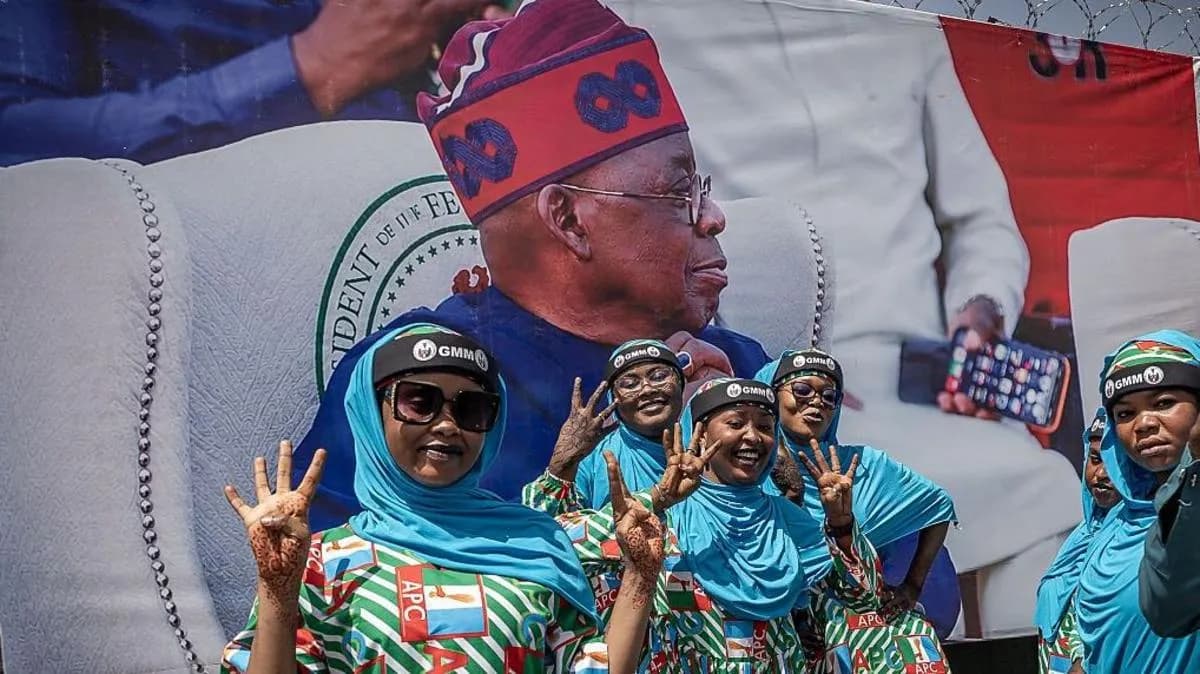
President Bola Ahmed Tinubu has launched his re-election manifesto, From Reform to Prosperity, aiming to regain the trust of Nigerians ahead of the general election in January 2027. Launched by his party, the All Progressives Congress (APC), on 10 November, the plan builds on first-term reforms such as the removal of fuel subsidies, the harmonisation of foreign exchange rates, and tax reforms.
The manifesto sets specific targets, including achieving 6% annual economic growth by 2031, constructing 200,000 affordable homes, and recruiting 78,000 additional security personnel. To address the high cost of living, Tinubu has promised to lower costs, halve youth unemployment, and increase electricity generation toward 10,000MW. His administration also announced a 125bn naira intervention package for small businesses, including loans for manufacturers and grants for smaller enterprises.
While the World Bank and the International Monetary Fund (IMF) have praised the reforms for their effectiveness, they have caused significant pain for households. Joshua Osiyemi, head of Tracka, noted that the manifesto was an attempt to get the country back on its feet by "slipping into austerity." However, Osiyemi told the BBC that fuel prices have risen and consumption costs have "skyrocketed," stating that a survey by his organisation found most families cannot survive on 10,000 naira [$7.40; £5.50] a day.
Data from Nigeria's International Centre for Investigative Reporting (ICIR) showed that imported rice prices rose by 184% between May 2023 and October 2025, with other staples like beans, garri, and bread also seeing substantial increases. Conversely, SBM Intelligence reported that the cost of preparing jollof rice fell by 11.5% between June and September 2026, the sharpest decline in 10 years for their Jollof Index. Despite this, Ikenna Okonkwo of SBM Intelligence noted that Nigerians still spend more of their income on basics and warned that these issues could be punished in the polls.
Tinubu claims the removal of fuel subsidies freed up more than one trillion naira in government resources in the first two months, though he recently stated he will work to reduce fuel costs. Opponent Atiku Abubakar has criticised this move on X, stating, "My position stands! I will restore subsidy to make life easier and affordable for Nigerians." Osiyemi countered that the 2026 budget of 68.32tn naira, with 15.8tn going to debt servicing, makes the country not fiscally strong enough to return to subsidies.
To tackle insecurity, Tinubu proposes recruiting an additional 28,000 military personnel and 50,000 police officers. Okonkwo noted that the situation in the north is complex, involving jihadists, kidnap gangs, and herder-farmer conflicts. Opponent Peter Obi also unveiled a 2027 Governance Agenda on 10 November, focusing on national unity and security, declaring, "Nobody will kidnap school children and disappear into the bush. If you kidnap children and go into the bush, you will not be alone there. We will come after you."
The manifesto's goal of 200,000 homes is a small fraction of the 14.9 million unit housing deficit identified in 2025 by a technical committee set up by the housing ministry. Furthermore, Okonkwo pointed out that the manifesto lacks details on where the investment for electricity generation will come from, noting that the power sector suffers from ageing infrastructure and low profit margins that deter investors.
Okonkwo suggested that the APC is in a stronger position as the incumbent, noting that the momentum of opposition candidates from 2023 has faded. He predicted the 2027 election will play out similarly to 2023, where the opposition was divided between two strong candidates with regional bases.