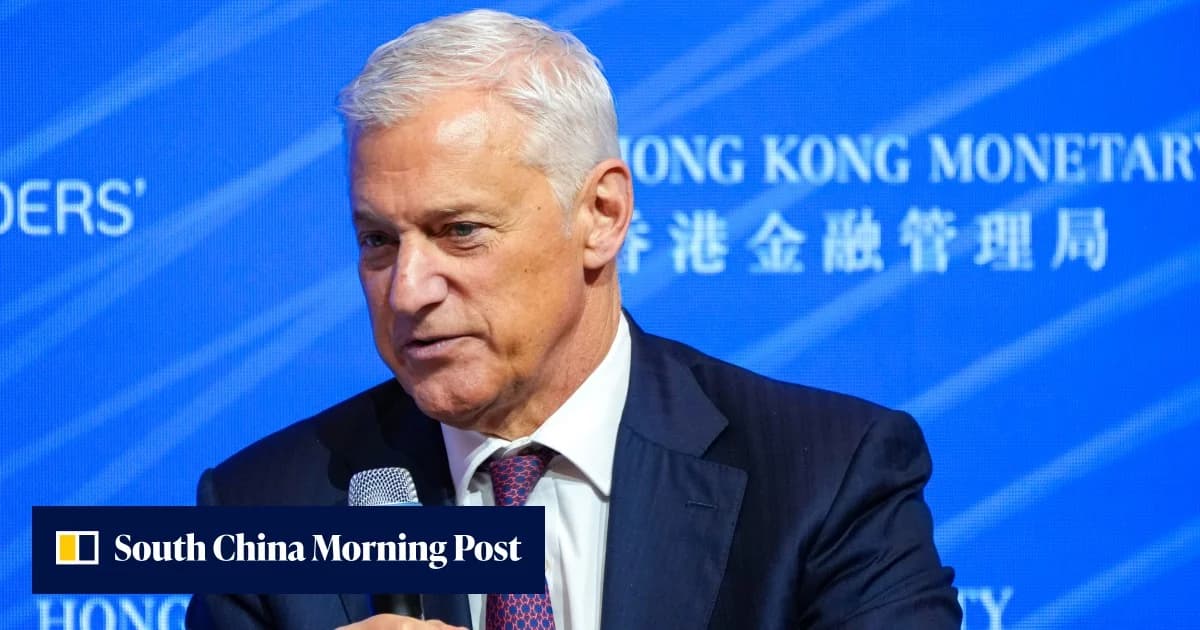
Standard Chartered group chief executive Bill Winters said on Friday that the bank expects to maintain strong earnings growth by capitalizing on rising wealth in Asia and the Middle East, the digitisation of money, and growing demand for cross-border financial services. Winters noted that rising geopolitical tensions are reshaping global finance, creating opportunities for the lender.
The London-based bank has moved its business model away from traditional lending to focus on fee-generating services, such as wealth management, capital markets advisory, and trade finance. Winters stated at a media round table in Hong Kong on Friday, “We’re not a conventional investment bank, nor are we a conventional local universal bank or a conventional commercial bank. We’ve really focused on getting a few things right and one is to serve multinational corporations and multinational individuals on their cross-border needs.”
According to the bank, this strategy resulted in a 46 per cent increase in third-quarter net profit to US$1.5 billion, while pre-tax profit rose 27 per cent to US$2.25 billion. Operating income grew 14 per cent to US$5.8 billion during the period. Fee and non-interest income rose 19 per cent to US$2.8 billion, fueled by momentum in global markets and wealth management. Specifically, wealth solutions income grew 26 per cent and global markets revenue increased 21 per cent compared to the previous year.
Following these results, the bank raised its full-year guidance. It now expects operating income growth to exceed its previous forecast of 5 to 7 per cent and anticipates a return on tangible equity of about 14 per cent in 2026.
Winters identified five structural trends shaping finance over the next decade: geopolitical fragmentation, the digitisation of money, the changing role of banks, wealth accumulation across Asia, the Middle East and Africa, and the transition to a low-carbon economy. He argued that trade fragmentation and geopolitical tensions could create opportunities by increasing demand from multinational companies needing help with cross-border operations. “The geopolitical fragmentation is an advantage for us because it allows us to solve complicated problems for multinationals,” Winters said. “We’re positioned for the themes that we think are most important for the next 10 to 20 years, and we intend to keep our focus on those things.”
The bank is also expanding its digital finance capabilities, including tokenised deposits, stablecoins, and tokenised money market funds. Winters noted that Hong Kong has been forward-looking in developing regulatory frameworks for digital assets. Regarding artificial intelligence, Winters stated that while the investment boom is supported by genuine economic value, some capital will inevitably be misallocated as companies race to build infrastructure like data centres. “Will there be some misallocated capital that will lead to some losses? Absolutely,” he said, adding that the bank's role is to identify and avoid those risks.