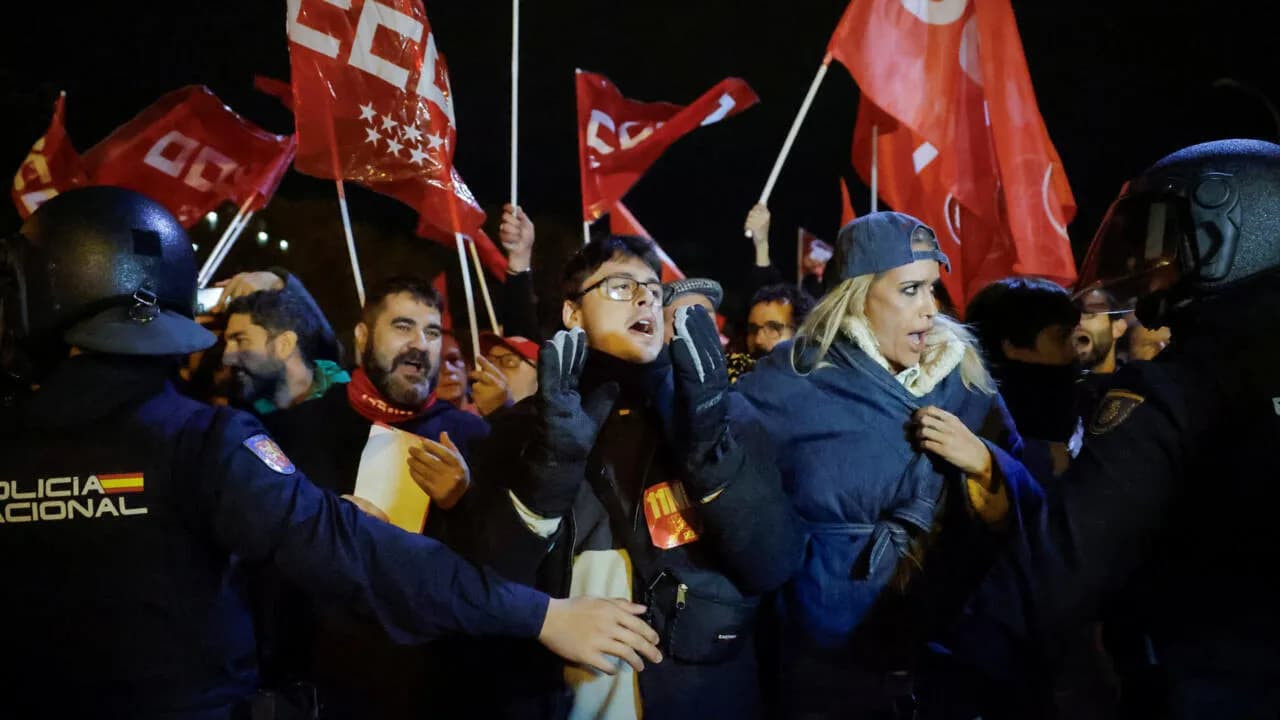
Millions of Spanish workers are participating in a general strike on Wednesday to demand government action on the nation's housing crisis and the rising cost of living. This marks the first general strike in Spain in 14 years and occurs less than three weeks before a snap election that could bring the far right to power.
The strike is expected to cause delays in the public transport system and lead to the closure or slowdown of businesses, factories, and shops across the country. In the early hours of Wednesday, minor incidents were reported, including roadblocks with burning tires in Barcelona and scuffles between police and picketers near the country’s main wholesale market on the outskirts of the capital, Madrid. At midnight, striking workers set off fireworks in public squares in Barcelona.
The two main unions, UGT and CCOO, reported widespread participation in the early hours with what they described as "significant work stoppages in strategic sectors." According to a statement posted on social media, these stoppages included 90 percent in the automotive and port sectors, 85 percent in the meat industry, 82 percent in waste collection, and 75 percent in the energy sector.
The strike follows a period of intense public anger over housing, as average rents in Spain have almost doubled in the last 10 years. Tensions reached a boiling point following the nationally televised eviction of an 87-year-old woman in Madrid last month. After her death, the woman, known as Maricarmen, became a symbol of Spaniards who feel they pay too much on rent and can’t even dream of homeownership. Housing activists used this uproar to organize the strike, gaining the backing of the UGT and CCOO unions.
The activists are seeking measures such as the elimination of tourist apartments, a crackdown on real estate speculation, and protection for renters in the form of automatic renewals of leases. Meanwhile, the UGT and CCOO unions are demanding more government intervention in the housing market and a new minimum wage agreement through talks with the business owners' association. The strike’s official slogan is "Salaries. Housing. Prices."
While the government pushed through emergency measures to limit evictions following the Maricarmen protests, right-wing parties in the Parliament refused to ratify them on the grounds they would provoke a flight of properties from the rental market. Spanish Prime Minister Pedro Sanchez called the election on October 5 to seek four more years in power for his left-wing coalition. However, his campaign has been hampered by a brutal high-speed train collision that killed 69 people, which has dominated Spanish news.
Oriol Bartomeus, a professor of political science at the Autonomous University of Barcelona, told The Associated Press that the strike is an opportunity for Sanchez's Socialists to shift the campaign focus back to housing. Bartomeus stated that the Socialists need the strike to be a success and for there not to be any violence so that the election campaign can swing back to being about housing, back in the framework of Maricarmen.
On Thursday, the government will again try to have a reduced interim Parliament ratify the two housing decrees that the full lower chamber rejected last month. Sanchez recently posted a long video on social media praising past social policies like the 40-hour work week and national health insurance, warning that right-wing parties would bring austerity. Veronica Martinez, spokesperson for Sumar, the junior member of the government, stated that "the Left needs the workers of this country to mobilise. Rights are first won on the streets and then later in the institution."
The traditional conservative Popular Party and the far-right Vox oppose government intervention in the housing market other than incentivizing construction of new homes. Both parties argue that the unions are playing politics and trying to help Sanchez stay in office. Popular Party spokesperson Miguel Tellado said on Tuesday that "This strike is not a general strike; it is an electoral strike," adding that it is "not against the government in power, but rather against the government to be."
Bartomeus noted that the right-wing parties could benefit if the strike turns violent. He stated that the Popular Party and Vox want the strike to end in "scenes of burning dumpsters and shattered shop windows" so they can claim the next morning that "This is chaos and we are coming to establish order."