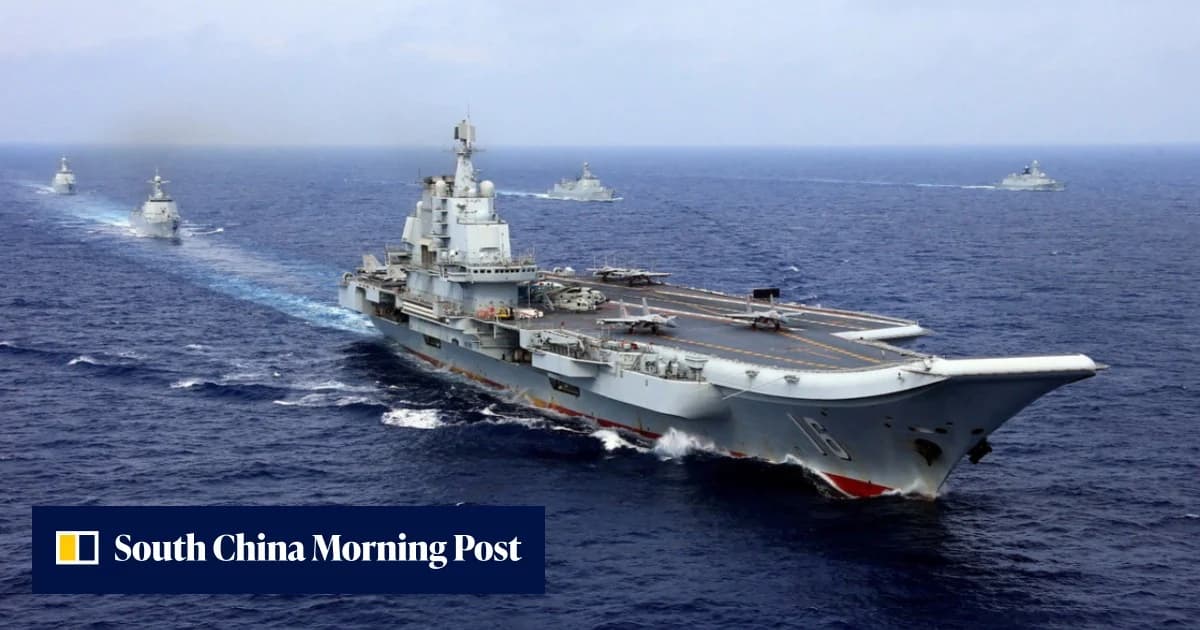
Taiwan expressed concern on Tuesday regarding a massive deployment of more than 100 People’s Liberation Army (PLA) naval vessels and mainland Chinese coastguard ships across the western Pacific. The deployment included the Liaoning strike group conducting drills in the Philippine Sea.
The maritime activity coincided with a significant increase in aerial activity. Taiwan’s defence ministry reported that 49 sorties of PLA aircraft were conducted in the 24 hours leading up to 6 a.m. on Tuesday, which marked the highest single-day total for the year. This number decreased to 22 by Wednesday morning.
Joseph Wu, head of Taiwan’s National Security Council, disclosed the widespread maritime deployment late on Tuesday via social media. Accompanying a map showing mainland Chinese vessels in the East China Sea, South China Sea, and waters surrounding the island, Wu wrote: “Taiwan is staying vigilant. We won’t provoke, but we won’t bow to any pressure.”
The map provided by Wu indicated that the Liaoning aircraft carrier strike group operated in the Philippine Sea, joined by naval assets from the PLA’s Eastern, Northern, and Southern Theatre commands in nearby waters, though specific numbers were not provided. Previous media reports noted that the Liaoning began its second round of drills in the western Pacific on October 14. It was tracked roughly 25 nautical miles (46km) east-southeast of Balut Island before sailing northeast on October 23.
These movements occurred during the biennial US-Japan Keen Sword exercise (October 19–29). According to a social media post by the US Navy’s Seventh Fleet on October 22, the Nimitz-class aircraft carrier USS Theodore Roosevelt operated in the Philippine Sea alongside warships from Japan, Australia, Canada, and France during this period. Previous reports also stated the Liaoning strike group was escorted by three major surface combatants: the Type 055 guided-missile destroyers Wuxi and Anshan, and the Type 052D guided-missile destroyer Huainan.
Additionally, satellite imagery analysis posted on social media on Monday observed China’s third and most advanced carrier, the Fujian, operating in the South China Sea.
While Wu reported theatre-wide naval activity, Taiwan’s defence ministry figures showed only about a dozen mainland vessels were operating near the island at the same time. The ministry only counts assets detected within its immediate surrounding air and sea zones. It reported six PLA Navy warships and six official ships near Taiwan in the 24 hours to 6 a.m. on Tuesday, followed by seven PLA Navy vessels and five official ships in the period leading to Wednesday morning.
Although the 49 sorties on Tuesday were a year-to-date high, they were lower than historical surges during previous major PLA exercises. According to calculations by the South China Morning Post, daily tallies reached 130 the day prior to December 31, followed by 77 sorties detected on December 31 last year. The single-day record of 153 sorties was set during the Joint Sword-2024B drills in October 2024.
Beijing maintains that Taiwan is part of China to be reunited by force if necessary. While most countries, including the United States and Japan, do not recognize Taiwan as an independent state, Washington opposes any attempt to take the self-ruled island by force and remains committed to supplying it with weapons.