The Israeli military launched a rare ground operation on Wednesday in a part of the central Gaza Strip that is not under its control. The operation took place in an area controlled by the Palestinian armed group Hamas, following evacuation orders issued for local residents.
According to the Israel Defense Forces (IDF), the "targeted" operation was launched to dismantle a "terror tunnel" west of the so-called Yellow Line. This boundary marks the more than 60% of Gaza's territory currently occupied by Israel. The IDF stated the tunnel "posed an immediate and direct threat to IDF troops."
The Israeli military body Cogat's Arabic spokesperson announced the start of the incursion on Wednesday afternoon. The spokesperson warned Palestinians living in an area north of the Nuseirat and Bureij refugee camps to stay away for their own safety and announced that a section of the north to south Salah al-Din road would be closed to traffic.
Witnesses reported that tanks advanced east of the Nuseirat refugee camp and moved onto the territory's main north to south road under the cover of artillery strikes. An AFP journalist also observed Israeli tanks positioning themselves east of the Nuseirat refugee camp.
The IDF stated that "IDF troops under the Southern Command are deployed in the area in accordance with the ceasefire agreement and will continue to operate to remove any immediate threat and thwart attempts by the Hamas terrorist organisation to harm Israeli civilians or IDF troops, or to violate the agreement."
Hamas accused Israel of a "flagrant violation" of the October 2025 ceasefire agreement, calling the advance of military vehicles and the evacuation of residents "a dangerous development and a flagrant violation of the ceasefire agreement."
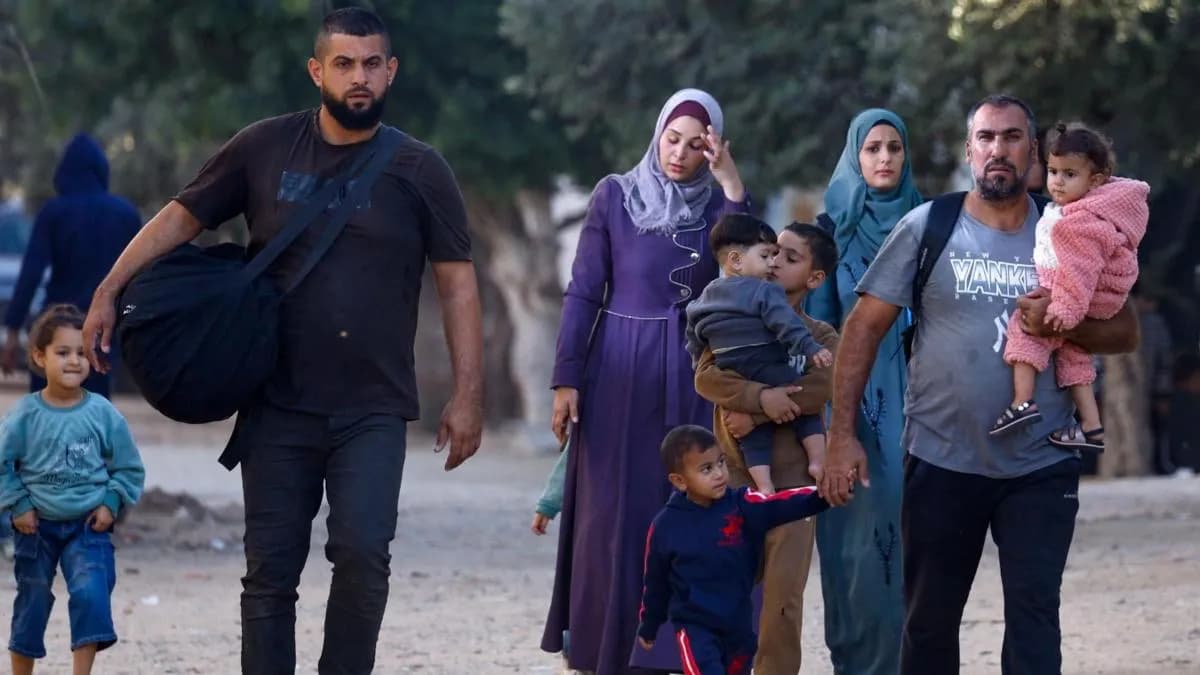
Footage from Palestinian media and social media showed families fleeing areas near the Nuseirat camp. In a video verified by BBC Verify, a man running along Salah al-Din road, approximately 1.5km (0.9 miles) west of the Yellow Line, said, "The Israeli occupation now is firing randomly near the houses and tents of people."
A resident of Nuseirat who was forced to flee told BBC Arabic's Middle East Daily programme that the situation is "extremely dire," stating, "We couldn't take any of our belongings with us - not even our blankets, pillows, or clothes. We had no choice but to leave everything behind." Another resident reported "indiscriminate gunfire and shelling" and stated there had been "numerous casualties, including fatalities."
The Hamas-run Civil Defence agency reported that three people were killed and others were wounded in three separate Israeli drone strikes on Wednesday. One man was killed in Nuseirat, a second in Gaza City, and a third in Deir al-Balah. The Israeli military stated the first two strikes targeted "terrorists" and said it was not aware of the third incident.
Since the ceasefire began last year, the Hamas-run health ministry, whose figures are considered reliable by the UN, reports at least 1,658 people have been killed in Israeli attacks. The Israeli military says six of its soldiers have been killed over the same period.
More than 1.9 million people, or about 90% of Gaza's population, remain displaced, with 1.4 million living in tents or makeshift shelters, according to the UN. Reconstruction has not yet begun, as an estimated 82% of all structures have been destroyed or damaged.
The war was triggered by the Hamas-led attack on southern Israel on 7 October 2023, which killed about 1,200 people and took 251 others hostage. Since then, more than 74,700 people have been killed in Gaza, according to the health ministry.
The disarmament of Hamas remains a sticking point in a stalled peace plan by US President Donald Trump. Hamas has agreed to give up weapons in exchange for a phased withdrawal of Israeli troops from the 60% of Gaza they currently occupy, but Israel insists Hamas must fully disarm before any pullout.