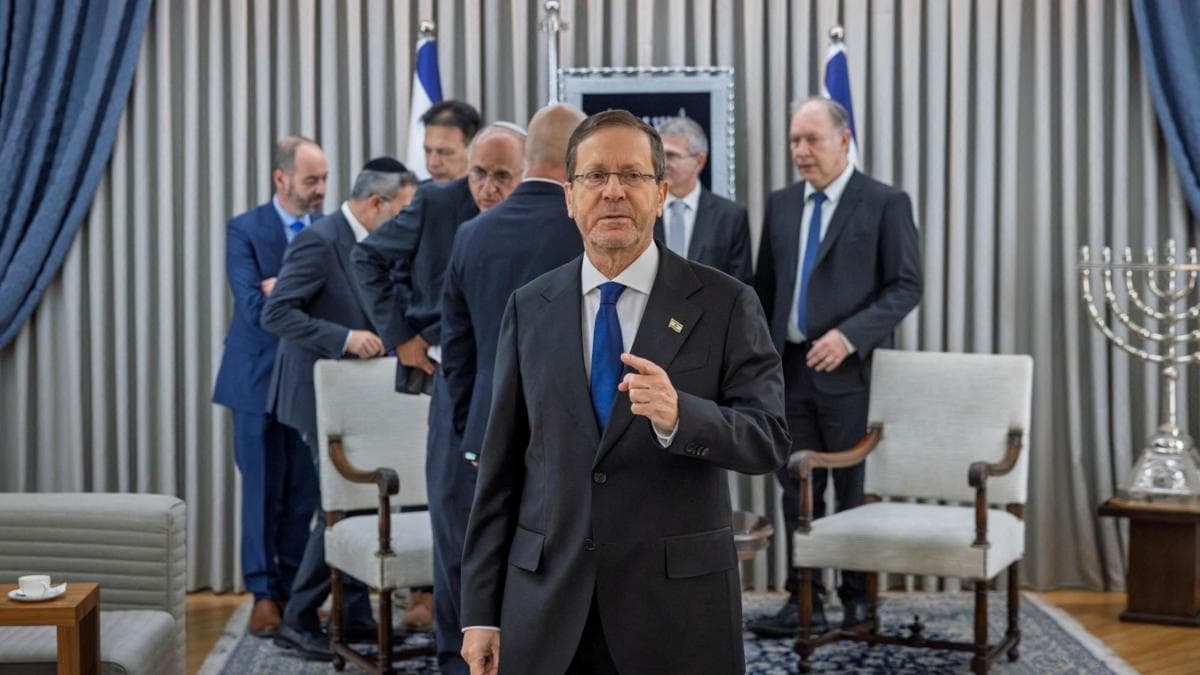
Israel's President Isaac Herzog is set to begin consultations with political parties to determine who will be tasked with forming a new coalition government. This follows the receipt of official general election results last week, which Herzog stated showed no clear winner.
During a ceremony in Jerusalem on Wednesday morning, Justice Noam Sohlberg, chairman of the Central Elections Committee, presented the official results to Herzog. Sohlberg warned that voices attempting to undermine the legitimacy of the results pose a "real danger," stating that "one of the foundations of democracy is the ability to have a peaceful transfer of power."
Herzog announced he would start the consultation process on Wednesday evening. He told party leaders that to avoid another round of elections and build a stable government, they must understand that "not every commitment and promise can be fulfilled" in the current reality.
The election held on 27 October resulted in a deadlock. Prime Minister Benjamin Netanyahu's right-wing Likud party and its far-right and ultra-Orthodox Jewish allies won 53 seats in the 120-seat Knesset. Rival Gadi Eisenkot's centrist Yashar party and three other Jewish opposition parties in his bloc won 48. Two Arab-led alliances, the United Arab List and the Joint List, won an unprecedented 19 seats due to a surge in Arab voter turnout, making them potential kingmakers. However, all but one of the Jewish parties had pledged before the polls not to work with them.
While the president's role is largely ceremonial, he has wide discretion to invite a Knesset member to form a government, who then has 28 days (with a potential 14-day extension) to do so. The president is not required to choose the leader of the party with the most seats.
The Shin Bet security service is currently investigating allegations of foreign interference in the election. Sohlberg told the Central Elections Committee that intelligence points to a "widespread phenomenon involving the influx of substantial funds into Israel from foreign states," some of which were hostile. He noted that further investigation is needed to "connect the dots and determine the scale of the phenomenon with a high degree of certainty."