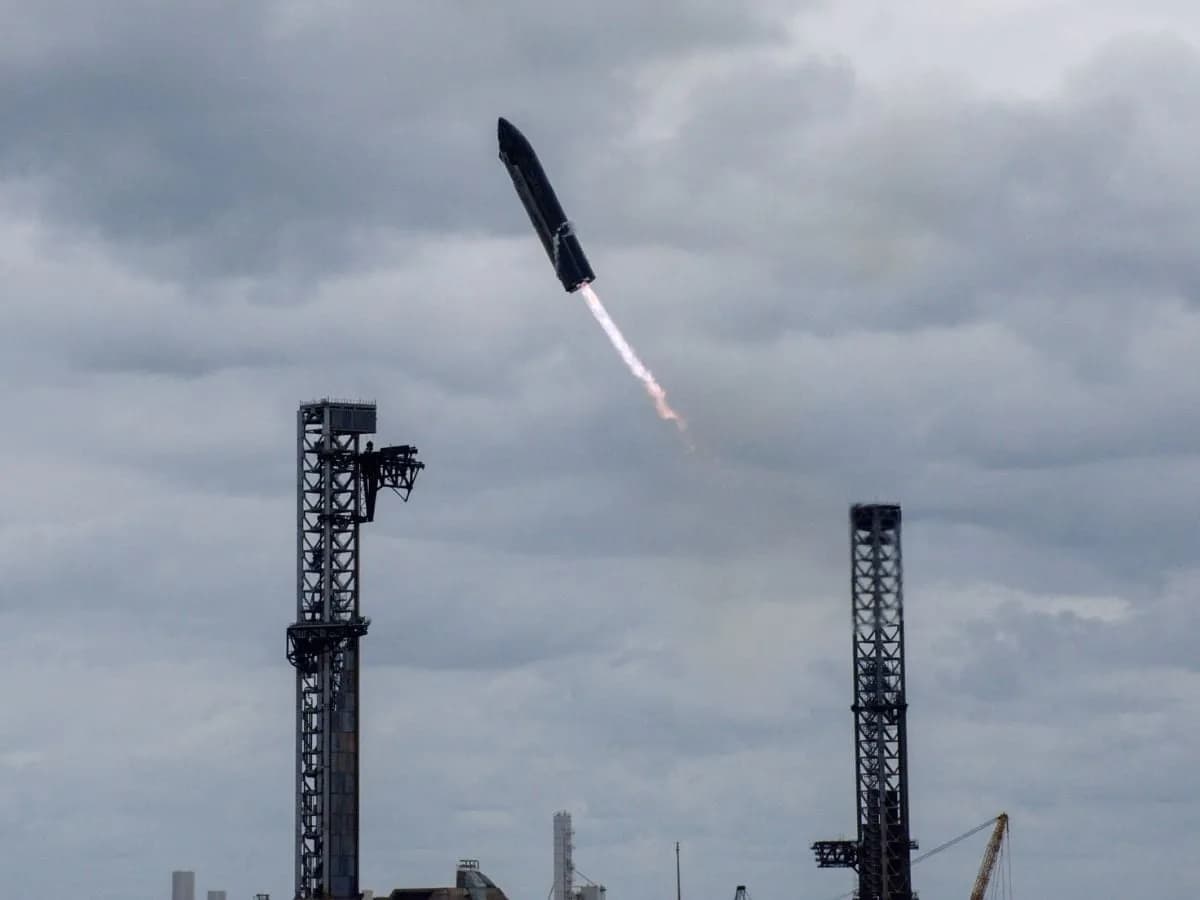
SpaceX successfully caught its Starship spacecraft in the mechanical arms of the Texas launch tower on Saturday, marking a major milestone in the company's decade-long goal to create a fully reusable rocket. The 171-foot-tall (52-meter) vessel returned from a 22-hour voyage in orbit, descending through thick clouds over the Starbase launch site.
During the descent, the ship reignited its engines to flip itself vertically. The ship descended into the tower’s “Mechazilla” arms, engines still roaring. Charred from the blazing heat of its return from space, the ship shut down its engines and hung still after the rocket system’s longest mission yet.
SpaceX mission commentator Dan Huot described the catch as "That was the missing link, the holy grail of spaceflight,"
The mission began on Friday when the Super Heavy booster, the rocket's bottom half, lifted off from the Starbase facilities in Texas to carry Starship into space. However, that booster failed to make a similar return to the launch pad approximately 10 minutes after liftoff, which prevented SpaceX from recovering both parts of the rocket for the first time.
Despite the booster's failure, the Starship upper stage completed 14 orbits of Earth over 22.5 hours. On Friday night, while cruising at an altitude of some 161 miles (260 km), the ship deployed 26 Starlink satellites. On Saturday, it fired one of its engines to begin an atmospheric plunge while flying eastward over the Pacific Ocean.
The vessel faced extreme heat as its orbital speed of some 17,000 miles per hour slowed to a supersonic free-fall. With its aerodynamic fins folded back, two small fittings near the top of the ship hooked onto the tower's mechanical arms, which closed to grasp it, leaving the vessel hanging a few hundred feet off the ground.
Elon Musk and SpaceX engineers began inspecting the ship within hours of the catch. Musk posted on X, "Ship 42 looks great!" while sharing photos and videos from the tower.
While this recovery is a significant step toward Musk's goal of a rocket system that functions like a commercial airplane with minimal refurbishment, SpaceX has not yet recovered both stages in a single mission. Additionally, the heat shield—made of hundreds of black hexagonal tiles—is not yet fully reusable, and the company is working on new designs to reduce refurbishment needs.
SpaceX has spent more than $15 billion on Starship's development. As part of a contract won in 2021 for NASA's Artemis program, the agency has provided $3.2 billion of a total contract valued at more than $4 billion to return humans to the moon. NASA expects Starship, along with a moon lander from Jeff Bezos' Blue Origin, to begin crewed flights to the moon in 2028. However, several milestones remain, including demonstrating complex fuel transfers between Starship tanker rockets in orbit to enable travel beyond Earth's orbit.