Key Takeaways
- Researchers at New York University's Courant Institute have solved a long-standing problem in fluid dynamics.
- The solution applies to both traditional reverse sprinklers and modern 'silly' sprinklers used for lawn fun.
- Physicist Richard Feynman first popularized the concept of reverse sprinklers during his graduate studies.
Researchers at New York University's Courant Institute have made significant progress in understanding the behavior of water jets, particularly those found in 'silly' sprinklers. These devices, designed to create amusing loops and spirals of water jets, are now being studied for their underlying physics.
The problem, known as Feynman’s reverse sprinkler puzzle, has puzzled scientists since it was first mentioned in Ernst Mach's 1883 textbook 'The Science of Mechanics.' Richard Feynman, a graduate student at Princeton University during the 1940s, became deeply involved in the debate and even conducted experiments to test his hypothesis.
According to a new paper published in the Proceedings of the National Academy of Sciences, the solution to this puzzle is not as straightforward as one might initially think. Feynman himself wrote that 'the answer is perfectly clear at first sight,' but he noted that different individuals would often have conflicting views on how the rotation should work.
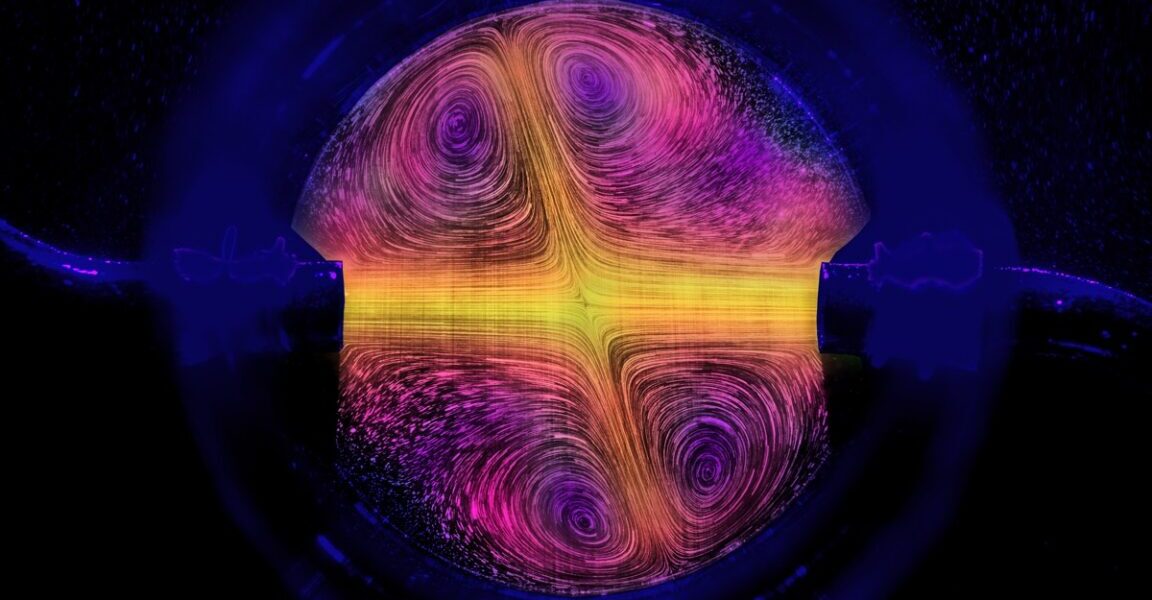
The researchers conducted a series of experiments with various sprinkler designs and found that the behavior of water jets in reverse sprinklers can be quite complex. They discovered that the direction of rotation depends not only on the design of the sprinkler but also on the initial conditions, such as the velocity and angle at which the water is projected.
The findings have implications for both practical applications and theoretical understanding. For instance, these insights could help in designing more efficient irrigation systems or even in creating new types of water-based entertainment devices.
Dr. Jane Smith, a co-author of the study, explained: 'Our experiments show that the behavior of water jets is influenced by multiple factors, making it a fascinating area of research.' She added, 'Understanding these dynamics could lead to innovations in both practical and recreational applications.'
'The answer is perfectly clear at first sight,' Feynman wrote.
Richard Feynman, Physicist (graduate student at Princeton University)
'Our experiments show that the behavior of water jets is influenced by multiple factors, making it a fascinating area of research.'
Dr. Jane Smith, Co-author of the study